



Fast Finance
Empowering frontline staff drives efficiency gains in Michigan hospital
Many hospitals are striving for increased efficiency amid looming close to $1 trillion in 10-year federal Medicaid funding cuts, which will start to bite for many in 2027 and 2028.

Published
December 2, 2025
2:22 pm
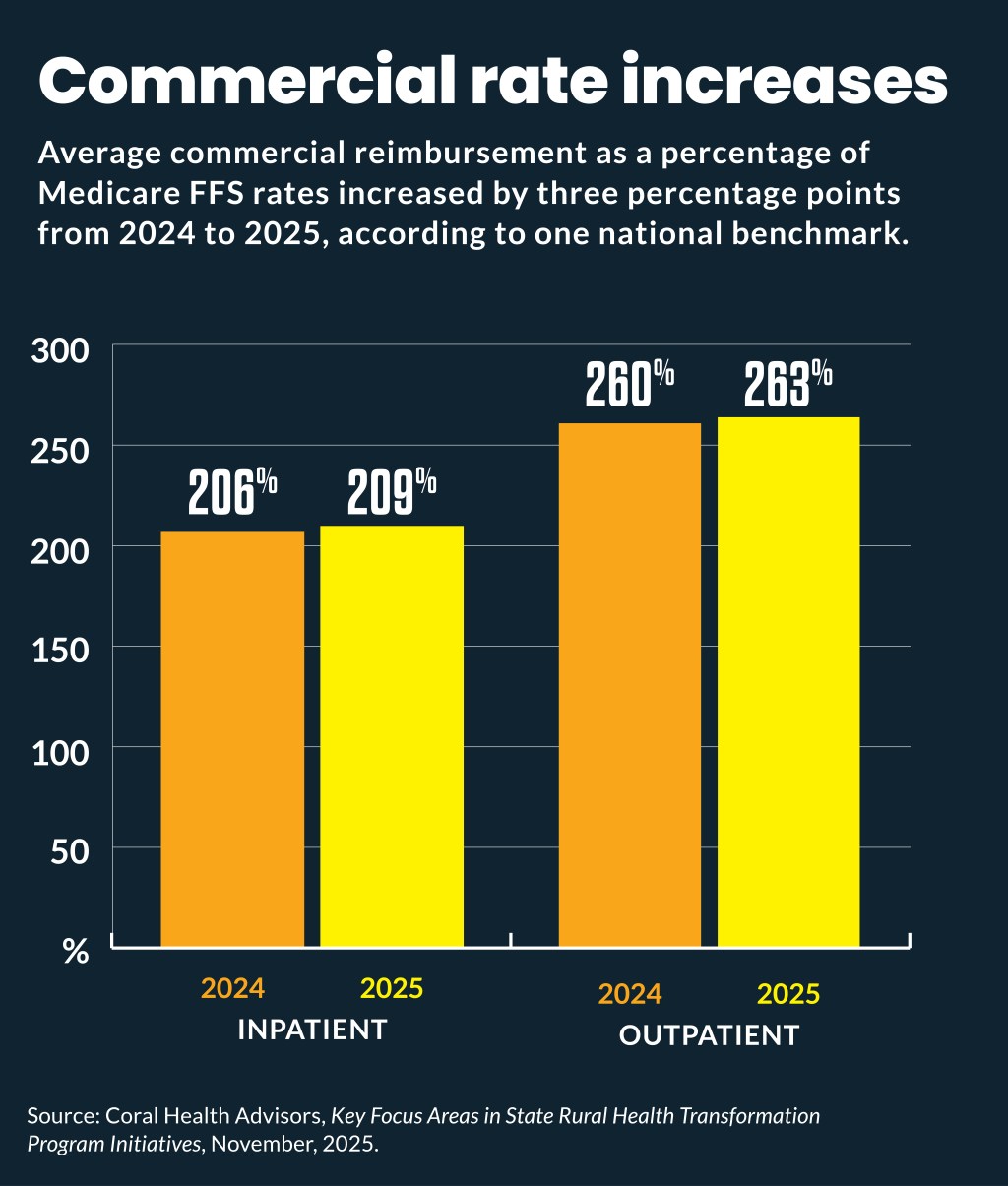
As hospitals and health systems use the next year or so to bolster their margins and cash ahead of the start of large Medicaid cuts from the One Big Beautiful Bill Act, different organizations will weigh efficiencies versus revenue enhancements.
Two former executive leaders of a hospital found the organization was able to survive and drive quality improvements while garnering commercial rates that averaged just 150% of Medicare.
“The key aspect of it was recognizing that there’s so many different problems and so many different things that get in the way of delivering great care at a reasonable cost and there’s no opportunity to improve that from a central location,” said Sam Flanders, MD, who previously served as chief quality and safety officer for Beaumont Royal Oak. “You’re never going to have a big enough team or be able to accomplish enough projects that way, which is the traditional way of doing performance improvement in health systems.”
That hospital, located in southeast Michigan, was able to perform well despite the low commercial rates it received, according to RAND data. Royal Oak hospital‘s total facility plus physician commercial prices averaged 153% of Medicare, according to 2020 to 2022 RAND data used by the Sage Transparency calculator.
Different approaches were needed because the hospital was garnering low commercial payment in an area where low commercial rates were common, the former hospital executives said.
Michigan hospitals had the lowest overall average relative prices, according to a RAND analysis of 2015 to 2017 hospital inpatient and outpatient commercial prices across 25 states found. A follow up RAND examination of 2018 commercial prices across all 50 states found Michigan hospitals had the second lowest prices across inpatient and outpatient services — after Arkansas.
A different approach
To increase efficiency amid those low commercial rates, Flanders and then-president and CEO Shane Cerone pushed an adaptation of the Toyota production system and the Kaizen process, to empower each staffer to identify and implement process improvements. That approach aims to drive small continuous efficiency improvements, as opposed to the common approach of ambitious, centrally planned efficiency projects.
Cerone, now president and CEO of Kada Health, a healthcare consulting firm, underscored that the frontline staff are the ones who best understand the millions of obstacles to clinical efficiency.
“It’s getting to the bedside and working alongside and with frontline staff to help them make improvements to make it easier to be more productive and efficient,” Cerone said. “And that’s work that’s kind of done on the shop floor, not done in the conference room or the executive suite.”
Steady efficiency improvements at the hospital were accretive to the bottom line, said Cerone.
“How do you create an organization where a great doctor can see 25 patients in a day instead of 22?” said Cerone. “And I don’t mean working more hours or working harder, but by really looking at the systems and making it easier for them to deliver care because the reality is to deliver care at the level that we saw and with our leadership team. You’ve got to be very efficient. Your systems have to be very efficient. You have to have a culture where you hate wasting people’s time, patients and providers.”
It’s the kind of increased efficiency that many hospitals are striving for amid looming close to $1 trillion in 10-year federal Medicaid funding cuts, which will start to bite for many in 2027 and 2028.
That push will need to reverse a trend of increasing inefficiency in recent years. That challenge was seen in the COVID-era surge in hospitals’ administrative costs, which increased from 186% of direct patient care costs in 2011 to 199% by 2023, according to the latest trends report by Trilliant Health, which advises health systems, payers and drug companies.
Vision vs. execution
Under their approach, Flanders said CFOs and other executives provide the “what” in terms of the organization is trying to accomplish through an organizational vision or strategic plan, while the staff are directed to find the “how.”
“What this process does is it gives a lot more control over the how to do it to the frontline staff so that they get to design the processes in order to meet the goals of management,” said Flanders, now a senior adviser at Kada Health.
Instead of looking for silver bullets, the process seeks thousands of small things that cumulatively add up to make the difference.
Staff-led changes included allowing each unit complete control over the selection and quantity of what was stocked in their location.
“And we moved and relocated some of the most commonly used things closer to where the patient rooms were to decrease steps so that they could get what they needed quicker,” said Flanders. “And that produced not only a lot of staff satisfaction and improved time with patients, but also it reduced the cost because the quantities were controlled by the floors.”
Those are the kinds of efficiencies, when done at scale, that could add up to the desperately needed savings hospitals are seeking amid the coming revenue cuts.
