


Fast Finance
Q&A: Financial lessons from Northwell’s ACO
A Northwell Health executive described how care coordination, ambulatory strategy and patient access investments strengthened Medicare Shared Savings Program ACO financial performance ahead of downside risk.

Published
February 24, 2026
12:12 pm
|
Updated
February 25, 2026
9:45 am
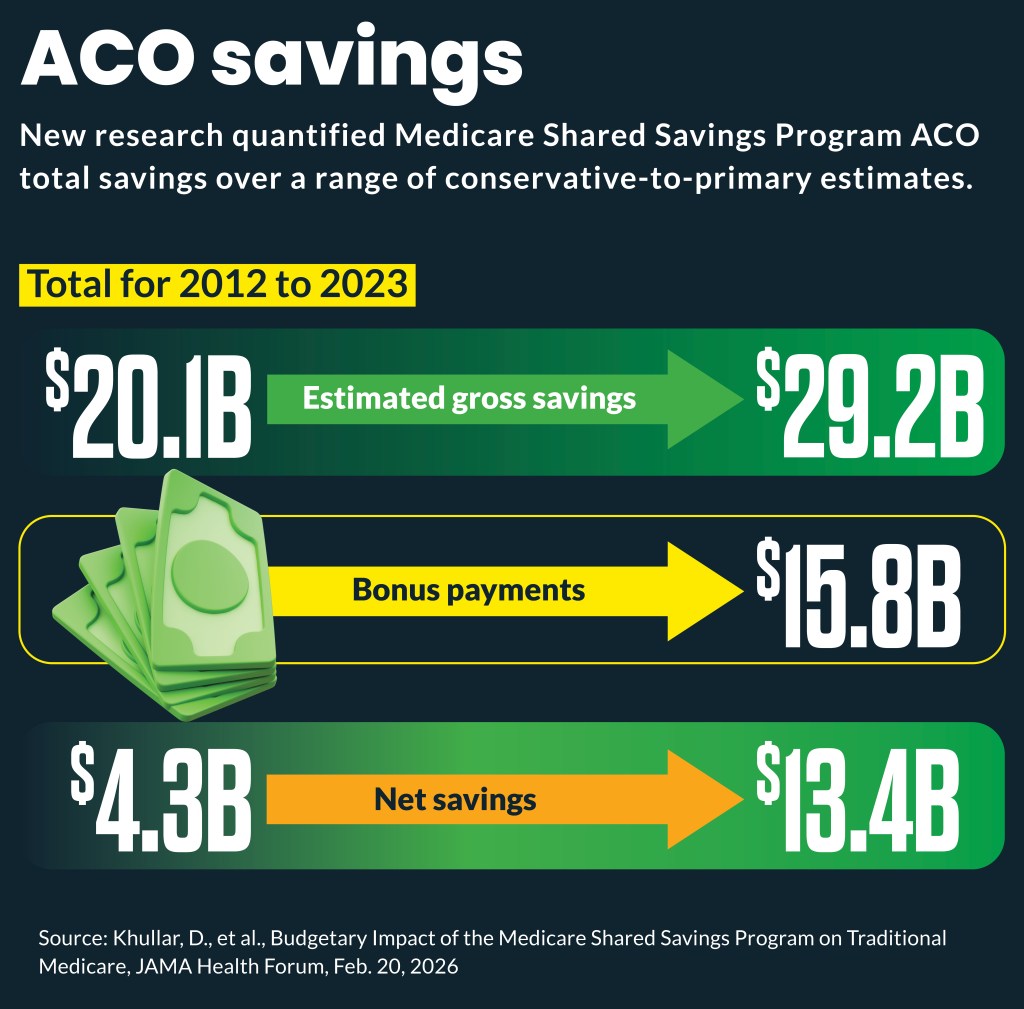
As the federal government gears up for another expansion of accountable care organizations (ACOs) and other types of value-based payment, one health system reflected on ways it improved its financial performance.
Northwell Health has been part of the Medicare Shared Savings Program (MSSP) ACO for several years, treated nearly 90,000 attributed beneficiaries, earned shared savings in the last two years, and it’s gearing up to take on downside risk in 2027.
Ramsey Abdallah, assistant vice president for operations at Northwell Health Physician Partners, recently discussed with FastFinance financial lessons learned from the organization’s ACO experience.
FastFinance: How has the ACO generated savings for Northwell?
Abdallah: As we learned where our cost drivers are, we were able to make some adaptations. The biggest area we need improvements on is just our care coordination program around reducing hospitalizations and readmissions. And there’s a direct correlation between our metrics and our quality scores in those areas and the cost that we see for those patient populations.
FF: Were there any elements within the ACO that provided the biggest ROI?
Abdallah: If we’re going to measure it in terms of benefits to the community, [it’s] because we tackle some work understanding that potentially the ROI has a negative number attached to it. But as a health system, as an ACO, as an organization, we find value in it.
One thing that we took on that the ACO MSSP model introduced was, how do you look at population health through a lens agnostic of payer? When we were analyzing our data, and I think everyone in the country can see this as well, is that we had bad access for mental health across Northwell. And we recognized that it was a massive problem here in Northwell and we wanted to do something about it.
Through the MSSP, one of the requirements that we had was to screen patients for depression. And if they were suspected to have depression, we would have to send them to some follow-up care.
It was obviously a concern to us because we already had access issues, right? How do we now catch through screening even more patients and now we have more patients sitting around who need access? There are also liability concerns, operational concerns, etc.
We decided to tackle that head on. Our behavioral service line launched an access center where we’re able to connect patients who screen positive; they don’t necessarily have depression, but they were suspected to have it. And we connected them to services within three business days.
We applied this across the board at Northwell. So, if you go see an orthopedist, if you go see a dermatologist, if you go see a urologist, if you go see your primary care [physician], we were going to do this work.
And from a strictly financial perspective, it wasn’t necessarily a favorable thing to do because there was no RVU [relative value unit]-generation capability for some of our specialists in adding time to the appointments. But we made that decision as an ROI net benefit to the community. And we found that a lot of patients actually appreciate that.
In terms of just strict ROI, what we found really helpful is a lot of the claims data that we get when we analyze it, we found that the patients who live closer to our hospitals are more likely to contact us, come back to us for services versus the patients who don’t and go somewhere else. And it’s a little bit more difficult to take action on some of those patients.
Anecdotally, those patients, if they don’t feel like they can get to us, get a walk-in appointment, or next-day or day-after type of appointment — they’re just going to the ED or they’re going to urgent care.
We’re trying to build on our telehealth capabilities so we can triage patients, touch base with them after certain types of cases — the big ones like heart failure, COPD, etc. [We] make sure they have a touchpoint with us post-discharge. And if they need to come back in, we can squeeze them into our schedule, so they can see the provider, because there’s [often] a high correlation with readmissions related to just medication management. Medication reconciliation, and just a general understanding of medication, has been probably the greatest enabler of [our] lowering readmissions and avoidable hospitalizations. That, in turn, helped us ensure shared savings over the last couple of years.
FF: What kind of questions do you most commonly get from your CFO or other finance leaders about the ACO?
Abdallah: We get asked ‘Are we ready for risk? What does that look like? Do we have the right models in place? Do we have the right operating models? Are we staffed accordingly? Are we structured to be successful?’
And the answer to the question of whether we are structured correctly is, ‘Yes, we are.’ We had a couple years to prepare for that work.
Another question we get is, ‘How sustainable are some of these programs?’ There’s always the concern from our CFO and finance people more around building care models, around regulatory programs. Because sometimes those programs lack stability. They are based on [presidential] administrations or based on policies that could go away.
Imagine building up an entire infrastructure for a program that might take three to five years before you see an ROI. And the organization and the CFO are willing to accept that because they know long term it’s beneficial to our patients and they’re able to afford the up-front capital. But they don’t want to do it if they don’t think the program is going to be around for five years. If it’s just going to be something that exists for a couple years, it’d be helpful to the patients but then it ultimately becomes detrimental because a community comes to rely on it and then we have to pull the program because the funding dries up, a policy changed, a new administration comes into the White House and things evolve or just completely go away.
There’s always that balancing act between what can we do short term and how do we prepare long term to take on risk and move us to value-based care (VBC).
FF: Are there any financial lessons learned on your ACO financial performance, something you might have done differently if you could start over from the beginning?
Abdallah: In the early stages of our journey, there was a lot of investment. It almost felt like we were always a cost center — just trying to figure out how to staff up, build up, get the right people, etc. The lesson learned is that that stuff takes time and you’re not going to recoup your money. It’s an investment for long-term success. You have to be patient and trust your process.
The other one is there’s a lot of opportunity in the ambulatory space around the finances. The hospital reimbursement side is very fixed, but there’s a lot of untapped potential in ambulatory.
Gap closure is an area that still is an issue across the board and there are a lot of opportunities to improve those, become more efficient. And that has a positive financial effect.
There’s also a lot of benefit from doing these screening programs. Very low-cost items can have high yield. If I learn who my hypertensive patients are, I learn who my diabetics are, all these chronic diseases, I can put these patients into models and really understand how to better care for them.
Variability is another thing that we learned about. It’s challenging because we expect variability. How patients are managed on Staten Island is not going to be the same as patients who are managed in one of the most diverse communities, for example, Queens. There are just different expectations. But where do we allow for the flexibility of variation versus standardization? That’s really, really important.
The last thing is that there’s almost this lag or delayed gratification with VBC. It takes time to put together all these pieces. And then the ROI can come for a while. It’s not going to be something that comes quickly for most people.
You have to build patience into the model, set the expectations and let certain things mature.
Editors’ note: This Q&A has been edited for length and clarity.
