



Healthcare Finance and Business Strategy
How principles of 4DX helped a health system transform its revenue cycle
On observing successful applications of the 4 Disciplines of Execution (4DX) across multiple industries, Emory Healthcare undertook an innovative approach in strategically using the performance management tool to solve revenue cycle challenges.

Published
November 20, 2025
4:13 pm
|
Updated
September 29, 2026
5:03 pm
On observing successful applications of the 4 Disciplines of Execution (4DX) across multiple industries, Emory Healthcare undertook an innovative approach in strategically using the performance management tool to solve revenue cycle challenges.
Health systems nationwide face profound challenges in the revenue cycle, including those posed by preauthorizations, coding intricacies and payer denials, where solutions often seem elusive. To address these challenges, leaders at Emory Healthcare in Atlanta adopted the creative approach of training professional billing staff on 4DX principles to enable them to develop effective solutions.
As a performance management method developed by Chris McChesney, Sean Covey and Jim Huling, 4DX is used across industries as an approach for effectively addressing complex and demanding challenges. It is intended to provide a framework for bridging the gap between strategy and execution.a
With the leaders’ support, Emory Healthcare’s professional billing team applied the 4DX framework in a multifaceted initiative encompassing 4DX’s four key disciplines:
- Focus on the wildly important goals
- Act on the lead measures
- Keep a compelling scoreboard
- Create a cadence of accountability
Laying the Foundation for 4DX
Implementation of 4DX began with a focus on team education and alignment. Emory Healthcare’s leaders recognized that success would depend on the professional billing team’s comprehension and engagement. So, to ensure the team thoroughly understood and knew how to effectively apply the 4DX method, each team member was given a personal copy of the book, The 4 Disciplines of Execution: Achieving Your Wildly Important Goals.
Far from being a purely symbolic gesture, this step was a necessary investment for building a shared language and foundation across the leadership group. Team members were given ample dedicated time to read and reflect on the material. And they were asked to focus on understanding not only the mechanics of each discipline, but also 4DX’s underlying principle: Execution, not strategy, is the key challenge for most organizations.
To reinforce the book’s messages and make the material more engaging, brief educational videos sourced from the authors were integrated into early planning sessions. Team members then discussed what had been shared and were given opportunities to raise questions or concerns.
From these discussions, it became clear that some members would be early adopters, immediately recognizing the framework’s relevance and power, and some would be skeptics. This result was expected because the book predicts that responses will be mixed. The leaders shared this idea openly with the team to set a tone that would encourage early adopters and skeptics to freely engage in an honest and open dialogue.
To build confidence in the process, the initiative’s leaders shared broader success stories, illustrating how 4DX had been implemented effectively in government agencies, Fortune 500 companies and across multiple industries worldwide. Highlighting its use in high-performance environments helped to frame the model as both credible and scalable, and it helped the professional billing team see beyond their own roles and perceive the larger possibilities of transformation and operational excellence.
These foundational steps helped create a unified direction and a growing sense of ownership, enabling the team to move from conceptual understanding to practical application of the framework’s four disciplines.
Discipline 1: Focus on wildly important goals (WIGs)
Prioritizing WIGs is a fundamental element of 4DX, because these goals represent the few essential objectives that must be achieved above all others. Emory’s professional billing revenue cycle team needed to consider how their work connected to enterprisewide efforts so they could apply strategic thinking in identifying these goals. Leadership emphasized that every WIG should be a meaningful contributor to the health system’s broader objectives — not just aspirational goals, but actionable and measurable outcomes that supported the entire health system’s revenue integrity and sustainability.
The team eventually committed to three WIGs to be achieved by the fiscal year end and to serve as the initiative’s North Star:
- Increase from 6 to 10 the number of metrics where the health system would seek to achieve Top 25% status in Epic’s Financial Pulse program while also achieving Emory’s FY25 cash target for the program
- Increase Emory Healthcare’s overall clinical stakeholder satisfaction survey score from 5.68 to 8 or higher (on a scale of 1 to 10)
- Increase Emory’s “sense of belonging score” on the Press Ganey People Survey from 81% to 83%b
Once the three primary WIGs were finalized, each operational department within professional billing was tasked with creating department-specific WIGs that rolled up into the overarching WIGs. This approach empowered departments to design goals they felt were relevant to their day-to-day work while still contributing to the collective effort.
Department WIGs include, for example:
- Decrease pre-accounts-receivable days from 1.4 days to 1.2 days.
- Increase the Press Ganey leader index score for department leaders from 4.05 to 4.25.
- Decrease coding denials from 1.7% to 1.5%.
The “from-X-to Y-by-date” format shown in these examples is important in 4DX because it clearly defines the starting point, target outcome and deadline — making the goals measurable and time-bound.
Discipline 2: Act on the lead measures
One of the most powerful, yet challenging, components of 4DX is the shift from focusing on lagging indicators — outcomes that reflect past performance — to identifying and acting on lead measures, which are the proactive, controllable behaviors that drive those outcomes. In the context of revenue cycle management, lagging indicators such as cash collections, denial rates and days in A/R are critically important — but they are reactive. By the time these metrics are reported, there’s little or no opportunity to influence them. To make real change, the team must focus on today’s actions that could move tomorrow’s metrics.
This shift in mindset proved to be most difficult for the professional billing team to grasp and apply. Initially, department teams would simply restate lagging measures as lead measures — such as “increase collections” or “reduce write-offs.” However, such targets don’t clarify how to get there. The real challenge lies in identifying lead measures that are trackable and tied to individual or team accountability.
For example, instead of setting a goal based on a lag measure such as “decrease avoidable coding denials,” a team might track as lead measures the number of coding audits completed and educational sessions held with providers and coders each week. These are specific, proactive actions that are within the team’s control and directly influence coding accuracy, thereby helping to decrease coding denials.
To promote this new mindset, team members were educated about difference between lag and lead measures via educational sessions and workshops, which emphasized two criteria of a good lead measure:
- Predictive of success
- Influenceable by the team
Here are examples of lead measures that the team identified through this process:
- Number of revenue cycle meetings with division stakeholders each month
- Percentage of department lead measure tasks completed on schedule
- Percentage of department lead measure tasks completed each month
- Hours set aside weekly to analyze denials
- Hours spent on charge correction analysis and prevention each month
Developing effective lead measures required deep thinking and, often, multiple iterations, making it the most time-consuming and complex part of the 4DX rollout. It required conceptual understanding and practical creativity, and the process had to be revisited at the mid-year checkpoint.
At that time, data revealed strong progress on two WIGs: Financial performance and stakeholder perception showed measurable improvements. But the third WIG regarding the “sense of belonging” had fallen noticeably behind, and the team determined this result was due to an absence of predictive, actionable measures for the goal of “promoting belonging.”
Discipline 3: Keep a compelling scoreboard
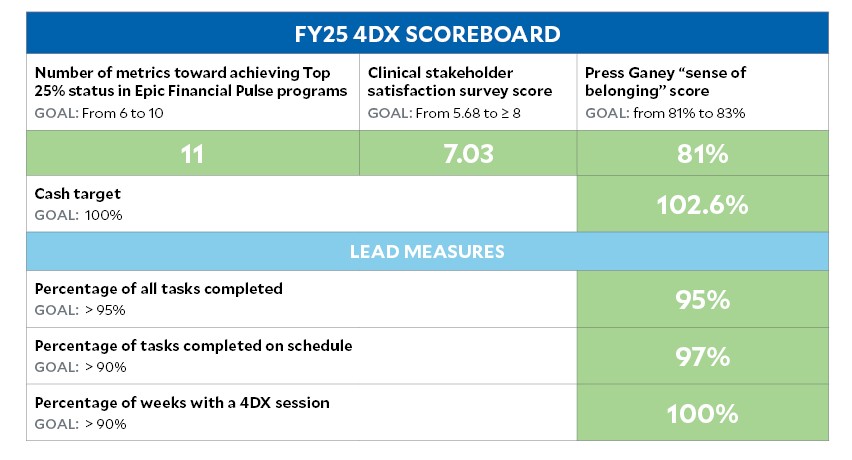
This discipline reflects the key principle of 4DX that people are more likely to stay focused, engaged and motivated when they have a clear, visual understanding of whether and how their efforts are making a difference. Emory Healthcare’s professional billing team embraced this discipline by creating a scoreboard to track progress on the WIGs and their associated lead measures that would address the core question “Are we winning this week?”
The scoreboard can be compelling without including every goal or lead measure. When developing an initial draft, the team found that including too much information made it hard to quickly understand what mattered most. They asked the leadership team for review and feedback, and through an open discussion, the group was able to narrow the focus to the three core team WIGs and just three key lead measures (i.e., the first three in the previous list of examples).
A more effective format — including color-coded indicators and straightforward language — made the data accessible, providing a level of transparency and accessibility in which people could see their impact, further fueling motivation and engagement.
Sample 4 Disciplines of Execution (4DX) scorecard based on Emory Healthcare’s revenue cycle initiative
Discipline 4: Create a cadence of accountability
Execution happens not in planning meetings but in day-to-day work, which is where 4DX’s fourth discipline comes into play: creating accountability. The professional billing team maintained this cadence of accountability through weekly 30-minute huddles, designed to drive ongoing focus, connection and shared responsibility.
Each huddle followed a structured format. The first half was dedicated to a quick, focused review of the team scoreboard, with updates on the WIGs and supporting lead measures supporting them, which helped keep everyone anchored to the bigger picture.
The second half of the huddle was where the real magic happened: Team members made individual commitments for the upcoming week to complete specific lead measures or tasks that directly contributed to the WIGs.
When reporting on the previous week’s commitment, individuals not only said whether they completed it, but also shared insights, challenges and learnings from their efforts that could benefit the group. Having team members explain the barriers they faced, for example — whether from time constraints, process issues or unexpected priorities — led to problem-solving moments and support from peers, reinforcing the idea that the huddle was a safe space for both accountability and collaboration.
As a result, this structure prioritized awareness over performance, fostering a focus on continuous learning, adaptation and transparency. The following points should be stressed:
- Lessons were not about micromanagement; they served as facilitators, not enforcers.
- Commitment scores in the dashboards, which visually tracked the completion rate of each team’s weekly promises, were not designed to shame or penalize but were tools for providing accountability and insight and for building momentum.
- Visibility into how often team members met their commitments on time helped promote a culture of integrity and follow-through.
- Ensuring that the tone was one of support, curiosity and progress — not pressure — enabled teams to take ownership of their work and feel empowered rather than policed.
Over time, the cadence of accountability became a core part of the team’s fostering a rhythm that kept goals top of mind and ensured that execution didn’t drift amid the daily whirlwind of revenue cycle operations.
Outcomes and an ongoing journey
The application of 4DX yielded significant improvements within the first year:
- Eleven financial pulse categories reached the top 25% nationally, including four in the top 5th percentile.
- Cash received was 102% of the YTD cash target by Q3.
- Stakeholder perception improved by approximately 25%, with some groups reporting up to a 60% increase in satisfaction within six months of launching the model.
Backed by an exceptional leadership team, Emory Healthcare’s professional billing team experienced meaningful progress using 4DX, such that the team now has ample momentum for continuing this work into the future.
Footnotes
a. For a video overview of 4 Disciplines of Execution, see “The 4 Disciplines of Execution in a nutshell,” FranklinCovey, franklincovey.com/courses/the-4-disciplines.
b. This score is a measure of the extent to which employees feel, valued and accepted with their organization.
