



Fast Finance
Capital expenditures surge amid aging facilities
Hospitals and health systems are increasing capital expenditures to address aging facilities, expand ambulatory networks, and invest in technology, according to recent rating and survey data.

Published
February 10, 2026
12:54 pm
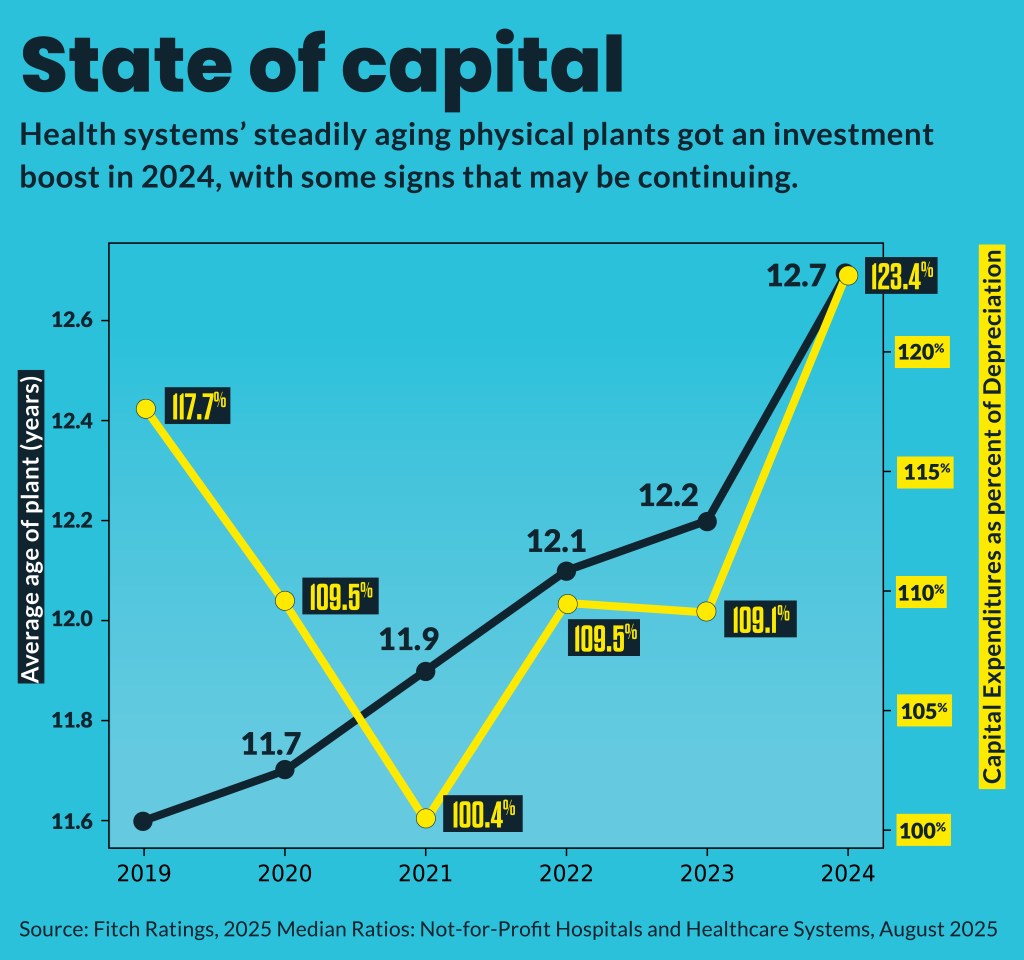
Several health systems and hospitals are boosting capital expenditures amid a long-term aging trend in the physical plant of those organizations.
The average age of plant for not-for-profit hospitals and health systems reached 12.7 years in FY24, among organizations rated by Fitch Ratings. That was the oldest average in at least 13 years. The age of plant has increased steadily from 10.6 years in 2013.
Signs of a surge in capital spending also emerged in FY24: Fitch reported capital expenditures as a percentage of depreciation expense increased to a median of 123.4%. That was an increase from a median of 109.1% the previous year and the highest since 2013.
Fitch stated that the growth in capex was enabled by improved operating performance and strong investment returns. Hospitals and health systems were using the funds to develop ambulatory networks and strengthen information technology.
Surging organizations
That capital spending surge appears to be ongoing among some organizations, according to rating reports in recent months.
- Tampa General Hospital in Florida averaged capital spending of about 140% of depreciation expense over the past five years but was expected to accelerate to 160% over the next few years, according to Fitch. Much of that will go toward completion of a 144-bed tower by the end of FY27.
- Northwell Health, a 28-hospital health system in New York, similarly expects to increase capital expenditures’ share of depreciation from a 175% average over the past five years to an average of 185% over the next several years, according to Fitch. The planned $1.5 billion in annual capital spending includes ambulatory expansion, inpatient capacity, renovations and upgrades of existing facilities, as well as information technology enhancements and joint ventures.
- Inspira Health Network, a three-hospital health system in New Jersey, plans to surge its capex from an average of about 100% of depreciation expense over the past five years to around 215% of depreciation over the next three years, according to Fitch.
“The capital plan includes the Mullica Hill patient tower, significant investment in technology including the development of a centralized command center, ambulatory growth and the expansion of core service lines including behavioral health,” said a Fitch Ratings report.
Capital challenge
Industry advisors say that it’s critical to target age of plant reductions to avoid outmoded equipment, outdated utilities and an inefficient workflow that hampers production. Despite the plans of well-financed organizations to fund reductions in their age of plant, many smaller and less well-financed organizations have struggled to do so.
“Hospitals that may be in most need of infrastructure upgrades also may have the greatest challenges accessing capital,” the American Hospital Association noted as part of its 2021 plea to the Biden administration for capital funding.
One hopeful sign for some was that healthcare municipal bond issuances in 2025 reached their highest levels since 2016, according to RSM US. Government-owned hospitals frequently have the most challenging finances.
Another challenge to upgrading physical plants through hospital capital expenditures is that the Biden-era inflation surge greatly increased the costs of any modernization or new construction.
That inflation was seen in a 35% surge in total healthcare construction spending from $48.4 billion in February 2021 to $65.3 billion in February 2023, according to the Federal Reserve Bank of St. Louis.
“Increased building costs have been a big part of the reason for the increase in overall spending,” stated a Definitive Healthcare analysis. “Many factors are at play here, including increased costs for labor and raw materials like lumber and cement.”
Although construction cost increases have slowed to 2% over the last two years, they also remained far elevated above 2021 levels.
Capex targets
Another complication of hospital capital expenditures is the growing number of areas it needs to fund, such as the emergence of costly AI initiatives in recent years.
A 2024 survey of 102 health system finance leaders found that facility spending was the last among four leading capital spending priorities for their organizations. The top three capital spending priorities were:
- Service lines
- Technology investment
- Market developments
However, 73% reported that their organizations had increased their facility budgets that year.
The top new construction and renovation targets of those organizations were:
- 58% multispecialty centers
- 55% inpatient acute care facilities
- 55% medical office buildings
- 39% single specialty centers
- 32% ambulatory surgical centers
