


HFMA CEO Jordan, healthcare leaders point to urgency of affordability challenges during ViVE conference
At a time when cost tops consumer healthcare concerns, system improvement requires bold new thinking and collaboration, according to panelists in the session 'Vitalic Health: Where Tech Meets Financial Reality.'

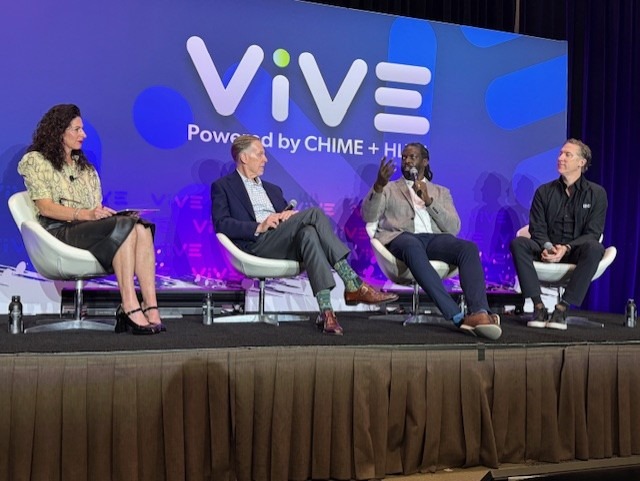
There’s an urgency to address healthcare affordability, panelists at a ViVE conference presentation Tuesday, Feb. 24, agreed — and the need for action is driving bold, collaborative ventures among leaders in healthcare, health tech and private equity.
“I think the clock’s really ticking for real now,” said Marcus Whitney, founding partner of Jumpstart Health Investors. “I don’t think anyone cares to protect incumbents anymore, so this, to me, feels like the chance to maintain the position of leadership in healthcare.”
Whitney was among three panelists who spoke as part of the session “Vitalic Health: Where Tech Meets Financial Reality” during ViVE, the annual health tech conference sponsored by CHIME, in Los Angeles. The session was moderated by Ann Jordan, JD, president and CEO of HFMA, and highlighted the need for a program such as Vitalic Health, an HFMA strategic initiative that strives to advance financial sustainability and better health outcomes in U.S. healthcare.
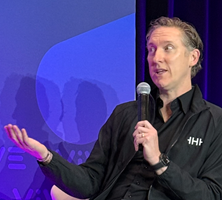
In the past five years, the industry has seen an acceleration of technological innovation that has strengthened operational efficiency and led to improvements in quality of care, access to care and health outcomes, said Jeremy Friese, MD, founder and CEO of Humata Health.
Yet technology hasn’t made significant strides in moving the needle on healthcare affordability at scale, he said. Today, 29% of American consumers believe affordability is the most urgent healthcare problem the nation faces, according to a recent Gallup poll. That’s up from 23% a year ago.
It’s a challenge the industry must solve — together — or risk losing control of how the future of care delivery takes shape, he said.
“I actually think the affordability paradox is the driver of courage in healthcare,” Friese said.
A system at an inflection point
During the ViVE panel discussion, leaders explored what it takes to build ecosystems that are financially strong and capable of delivering better health and affordability over the long haul. They also explored where technology is moving the needle for healthcare affordability, how private equity investment could support the move toward a more sustainable healthcare delivery system, and what it will take to create resilient organizations and systems, smarter investment and measurable impact at scale.
“It’s not a conversation about what’s broken, but about what we can build,” Jordan said in introducing the panelists.
“There is a massive amount to be done in perfecting the healthcare operating model,” she said. “When looking at sustainability in healthcare, there’s a big, loud voice out there saying that tech is going to be the answer. And it’s projected that U.S. healthcare providers are going to increase their technology budgets to approximately $70 billion in 2026.”
Given that a Vitalic Health survey found 94% of industry thought leaders don’t believe policymakers and healthcare stakeholders are leading the way to healthcare sustainability at a macro level, leaders must ask harder questions about how and where technology is deployed and whether it’s moving the needle on outcomes that truly matter, she said.
Much of the challenge in transforming the U.S. healthcare system to be more affordable and sustainable lies in its design, said Dennis Dahlen, CFO, Mayo Clinic.
“We’re organized around fixing things instead of preventing things,” he said. “If you were whiteboarding this, I think you’d design it differently.”
Acceleration toward collaboration
If the affordability paradox is viewed as a systems failure, rather than the failure of a single stakeholder, “It’s on everybody’s watch,” Jordan said. She asked panelists: Where do bright spots in collaboration exist?
Friese, who has worked as a practicing radiologist as well as a software developer for healthcare providers, said the degradation of healthcare affordability, as well as higher proportions of financial distress among hospitals and health systems, has resulted in a “dramatic increase in the willingness to partner across the aisle — [specifically] providers and payers — to start to solve problems.”
“Because people are struggling, there’s actually an appetite now for collaboration, and that’s exciting,” he said.
In this environment, Jordan asked panelists, “What would real courage and accountability toward sustainability look like from the leaders in this room? Are there legacy stakeholders that are actually incentivized to reverse the affordability paradox and redesign and move their own cheese?”
“That’s a really provocative question, because the use of the word courage implies we’re going to be taking risk, right?” Dahlen said. “Risk is corrosive to an incumbent marketplace, particularly those of us that have been in the marketplace forever and [created] a successful niche for ourselves.”
He described courage as the willingness to tear down existing constructs in healthcare, from fee-for-service to compensation models to the ways in which the industry uses human effort in care delivery and operations or provides access to care.
“I think that the true measure of courage, though, is the willingness to not just start something, but finish it,” Dahlen said.
It’s his hope that the creation of Vitalic Health “will be enough of a catalyst to catalyze collaboration and forward movement of us as an industry.”
For too long, transformation in healthcare has been held back by the desire to protect the incumbent entities, Whitney said.
“I’m an outsider who came [into healthcare] through the venture technology lane,” he said. “My whole job is to try to see around the corner, and I have, for the longest time, just basically felt like you had to pander to the incumbents.”
He views Vitalic Health as an opportunity for providers to intentionally lead change rather than having transformation happen to them.
“This is actually the last chance,” he said. “This is the shot on goal.”
For more information about HFMA’s Vitalic Health, please visit www.hfma.org/vitalichealth.
