


Fast Finance
Physicians increasingly targeted for unionization
Union organizing among physicians is accelerating, with resident and fellow unions expanding membership and targeting attending physicians amid reimbursement pressure and workforce engagement concerns.

Published
March 3, 2026
3:47 pm
The ongoing unionization push in healthcare increasingly is targeting physicians.
A leading healthcare union for interns, residents and fellows increased its membership from 17,000 in 2021 to more than 40,000 in 2025, according to an annual union activity report from the American Society for Health Care Human Resources Administration (ASHHRA).
And unions are gearing up for a bigger push on physician unionizing, said Chris Cimino, a consultant and author of the ASHHRA report. That push includes the May 2025 launch of a new Service Employees International Union organization called Doctors United and a national strategy to leverage resident and fellow union members to promote post-residency/attending physician organizing.
“They appear to be lining themselves up to really focus on physician organizing, pre-organizing these folks when they’re even in medical school, through residency,” Cimino said.
According to National Institutes of Health data from 2022 to 2024, only about 8% of attending physicians are unionized. But Cimino worried that increasingly burned out, overworked and angry clinicians could listen to union pitches.
“That’s why I think there’s such an urgency here to boost engagement and try to prevent large numbers of our physicians from getting swept up into this notion that the only way to get what you want is through conflict,” Cimino said.
Physicians were among the 600 unionized clinicians who conducted a one-day strike on Nov. 5, 2025, at Allina Health in Minnesota. It was the first strike in the state that included physicians, according to local media reports.
The physician unionization trend was seen in December 2024 research in JAMA. It found that 77 union petitions were filed with physician members between 2000 and 2024: 44 from 2000 to 2022 and 33 from 2023 to 2024.
Unions have increased their appeal to physicians because those representing interns, residents and fellows have succeeded in negotiated contracts providing new members with higher pay and improved working conditions, he said.
“Success at the bargaining table tends to facilitate further organizing, as nonunion workers seek similar wage and benefit gains through unionization,” noted the report.
Physician unionization drivers, according to the JAMA study, included:
- Working conditions (85%)
- Lack of voice in management (81%)
- Patient care concerns (54%)
- Financial compensation (4%)
Getting in front of the threat
Like other types of clinicians, physician unionization and strikes primarily are fueled by their perception that they have no voice in their organization, Cimino said.
“We should have a full-court press and we should be fully engaged around this whole idea of ‘How do we increase employee engagement, nurse engagement, physician engagement and so on?’” he said.
An example of effective approaches is organizations that obtain a Magnet designation from the American Nurses Credentialing Center, said Cimino. The certification program includes requirements that organizations embed nurses in decision-making roles, such as on unit-based committees that determine how care is delivered.
2025 trends
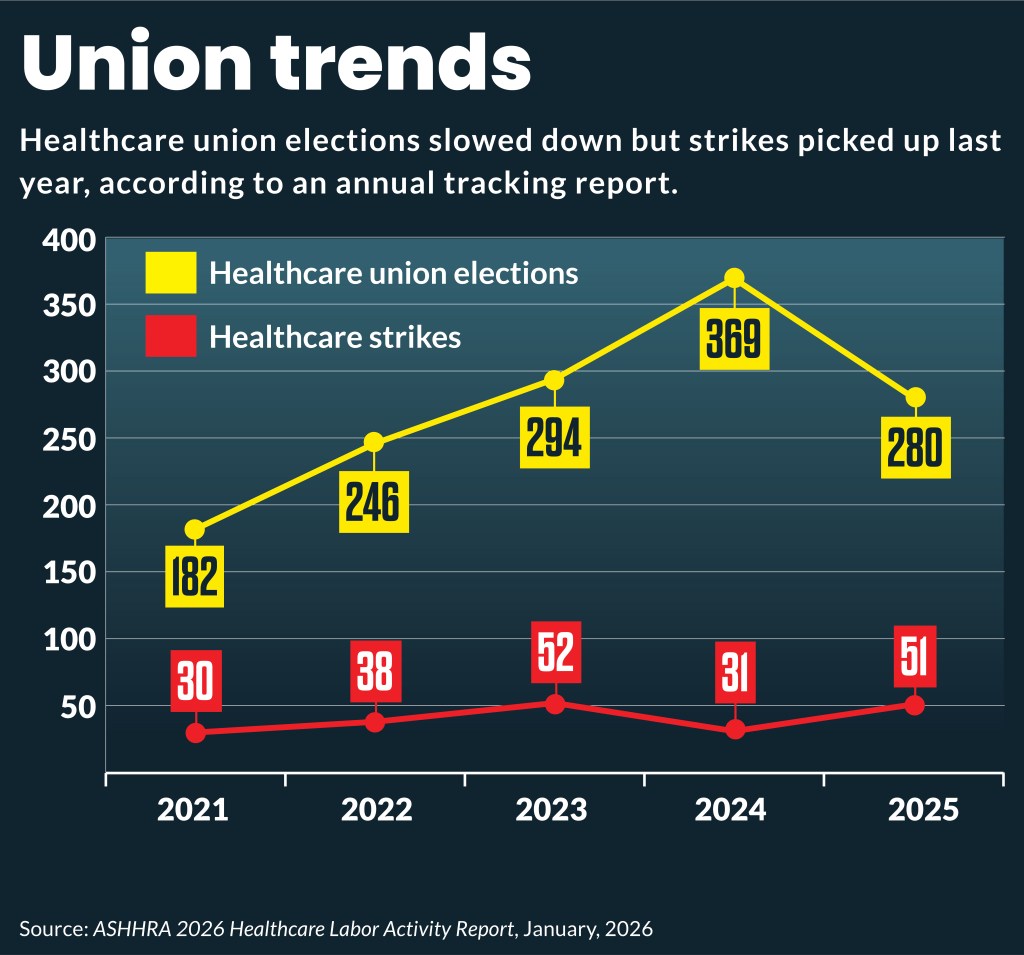
Healthcare union elections decreased 24% to 280 in 2025, down from 369 in 2024, according to the ASHHRA report. However, labor’s win rate in healthcare elections increased from 77% to 89%.
“There are fewer elections but they’re focusing more on the elections that they know they can win,” Cimino said about union leaders.
Meanwhile, the increased union focus on healthcare was seen in strike activity last year. Specifically, there were 51 healthcare strikes called by unions in 2025, up from 31 in 2024. But that increase came amid a decrease in overall labor strikes across all industries in 2025.
Leading issues raised in those strikes included:
- Improved staffing/reducing workloads
- Increased wages
- Improved workplace safety
- Emphasis on executive compensation
Similar themes were raised in nurse strikes in early 2026, Cimino said. Strikes involving three hospitals in New York City and 31,000 nurses and other employees at Kaiser Permanente emphasized wage and benefit increases. Those included union demands to increase the average nurse base salary from $165,000 to $220,000 at one New York hospital.
“When I started doing this 35 years ago, we used to say, ‘People don’t organize around money; that’s not a primary driver.’ That’s changed,” said Cimino.
2026 outlook
Going forward, Trump administration appointments to the National Labor Relations Board (NLRB) were expected to dampen the union push. During the Biden administration, NLRB policies were seen as pushing unionization.
Overall, healthcare union activity was expected to remain steady at 2025 levels or possibly even higher, Cimino said.
Potentially fueling union activity this year was the start of some payment reductions from the One Big Beautiful Bill Act, which will cut $1 trillion in Medicaid spending over the next 10 years.
“When healthcare funding declines, hospitals and health systems have fewer resources to provide regular wage increases and sustain existing employee health and welfare benefits,” stated the ASHHRA report. “As 2026 unfolds, healthcare leaders may find themselves caught between rising employee expectations for higher pay and improved benefits and the reality of declining reimbursement and high levels of uncompensated care.”
