



Fast Finance
Despite pressures, healthcare construction spending to increase
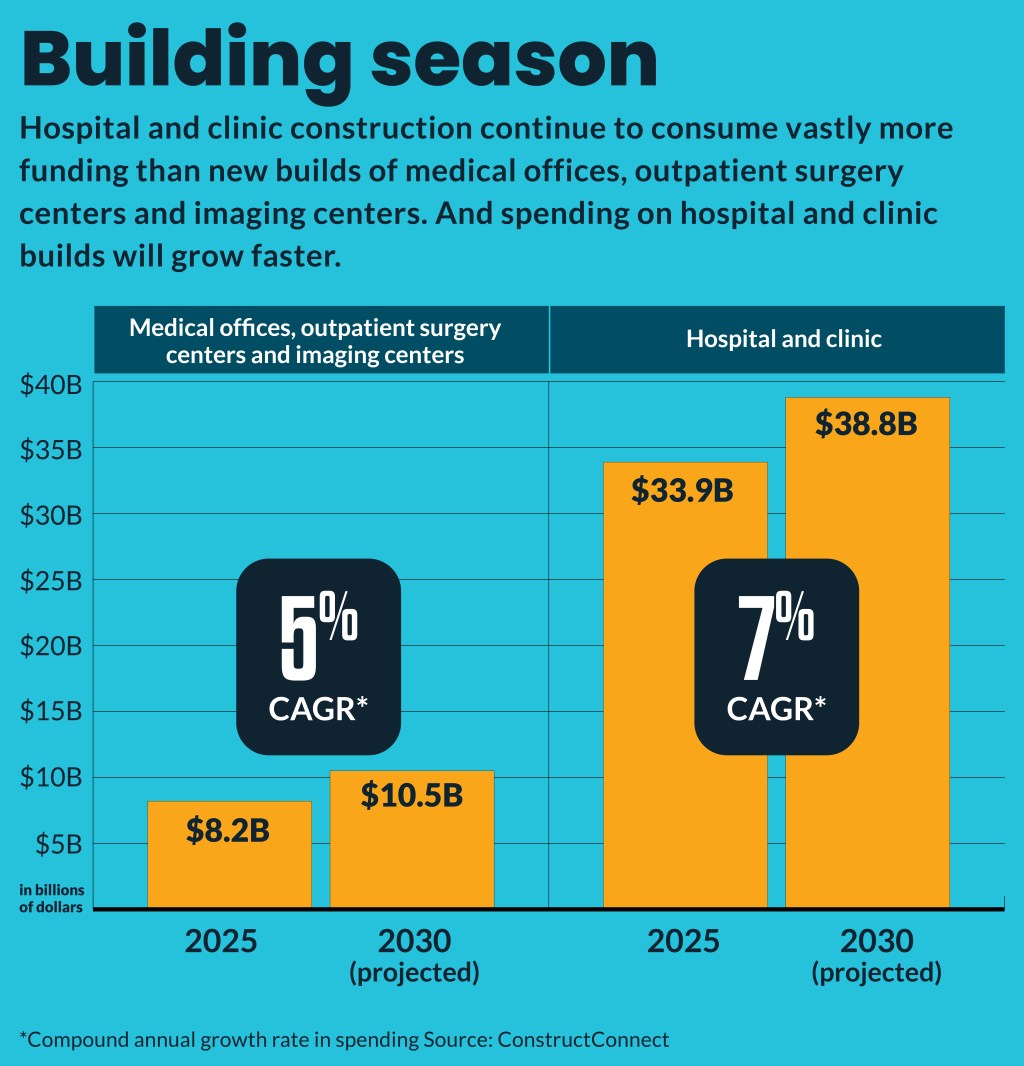
Hospital construction continues to far outpace outpatient facilities and is projected to reach $38.8 billion by 2030, driven by population growth, outpatient care expansion and rising capital investment from financially strong health systems.

Published
March 17, 2026
8:15 am
Although concerns about hospital closures dominate headlines, spending on construction of hospitals — and other healthcare facilities — is moving at a record pace.
Spending on hospital and clinic construction starts in 2026 were expected to jump 11.6% from 2025 to 2026 and reach $30.7 billion, according to ConstructConnect, a commercial construction project data and software company.
This year’s projected spending surge is the highest since the $33.9 billion spent on hospital and clinic starts in 2024, which was a record in ConstructConnect data that goes back to 2009.
“We have seen something amounting to a level shift up in recent hospital and clinic spending,” Michael Guckes, chief economist at ConstructConnect, said in an interview.
The 2026 increase in new hospital spending also was seen in an annual survey of 302 hospital executives by the American Society for Health Care Engineering (ASHE) and Health Facilities Management magazine. Nineteen percent said their organization planned construction of a new acute care hospital within the next three years.
“I was a little surprised by that,” said Jonathan Flannery, ASHE’s senior associate director of regulatory affairs, in an interview. “We haven’t really seen this big of a jump previously in the last 20 years.”
Forty-five percent of executives said their organization was increasing the percentage of their capital budget dedicated to hospital new construction from the previous year.
And the spending on hospital and clinic construction starts was projected by ConstructConnect to increase at a 7% compounded annual growth rate (CAGR) to reach $38.8 billion by 2030, said Guckes. That projected increase was driven by factors like the aging demographics and expected increases in government spending, regardless of the $1 trillion in reduced federal healthcare spending expected over 10 years from the One Big Beautiful Bill Act.
“Any shortfall in public obligations, federal public obligations, we’re not passing judgement on those yet,” said Guckes. “We assume that somehow a solution is identified. And so, our forecast remains robust.”
How many hospitals?
Despite the increased spending in recent years, the total number of hospital and clinic projects, which includes new construction, expansions and upgrades has fallen over the last 10 years, according to ConstructConnect data. For example, in 2015 there were 2,873 total such projects but that steadily fell to 1,573 in 2023. That total somewhat increased to 1,701 last year.
Hospital and clinic new construction, specifically, have hovered around 200 facilities since 2017. Over the seven years before 2017, they ranged between 300 and 400 facilities annually, according to ConstructConnect.
The construction of new hospitals and clinics is concentrated in several large and fast-growing states. Among the 236 new builds started in 2025, Texas led with 27, followed by Florida (18 projects), California (17) and Tennessee (13), according to ConstructConnect tracking, according to Guckes.
Guckes said the highest growth states for hospital and clinic builds were unsurprising since Texas, Florida and California lead across all types of construction.
Beyond hospitals
The current growth engine of healthcare construction spending is ambulatory facilities, which are required by the growing shift to outpatient care, said Tracy Hunt, executive vice president and general manager for Skanska USA Building.
“Health systems are racing to add outpatient surgery centers, clinics and microhospitals in community locations,” Hunt said in emailed comments. “This has also included a growth in providing more options for specialty care, such as in the areas of orthopedics, oncology and behavioral health.”
However, spending on new construction for medical miscellaneous buildings, which includes medical offices, outpatient surgery centers and imaging centers, was projected by ConstructConnect to increase by only 5% CAGR over the next five years. In terms of total annual spending, that’s an increase from $8.2 billion in 2025 to $10.5 billion by 2030.
“The cost of new hospitals on a per-square-foot basis has been growing faster than your simpler — from a construction standpoint — medical office,” Guckes said. “The more expensive it is to build a hospital, the faster your dollar spend growth rate will be, even if the count of projects or total square footage built is at a much lower rate.”
The leading nonhospital healthcare facilities and projects that ASHE survey respondents said were under construction in 2025 were:
- Ambulatory facilities, 13% of respondents
- Central energy plants, 11%
- Physical plant infrastructure upgrade, 9%
- Medical office building, 8%
Microhospitals expand
The facilities that have experienced the most growth recently were microhospitals (6%) and freestanding emergency department (FSEDs) (6%), said Flannery. In previous surveys, less than 1% of organizations typically were planning to build such facilities.
“A microhospital is a lot easier to get going as a project because the overall capital scale is so much smaller, plus some of the things you have to do — the design, the review process — are quicker,” Flannery said. “That seems to be one of the driving factors on both of those.”
And health systems are planning robust ambulatory builds, with planned construction over the next three years including:
- Medical office buildings, 14%
- Ambulatory facilities, 13%
- FSEDs, 7%
More mega-hospitals
Hunt said her company sees a healthcare industry bifurcation. Large, well-capitalized systems are building billion-dollar replacement hospitals and specialty centers — 15 new hospital projects costing more than $1 billion were announced just in 2025 — especially in high-growth states. Meanwhile other systems face financial strain and are focused on renovations, expansions of existing facilities and deferred maintenance, instead of new construction.
“This gap means the bulk of new ground-up healthcare projects in 2026 will come from a relatively small cohort of robust systems, while most others invest conservatively in upgrades and outpatient sites,” Hunt said.
Guckes said $1 billion-plus projects have increased from comprising less than 10% of all construction spending 10 or 15 years ago to nearly a quarter now.
The busiest states for overall healthcare construction that Skanska has seen are the high-growth states of North Carolina, Florida and Texas. Other leading construction activity states are California — driven by looming seismic compliance deadlines — and Oregon, where providers aim to address statewide bed-capacity deficits.
