



Fast Finance
Next reconciliation bill to target healthcare
The size of the reconciliation bill will influence how many healthcare cuts are used to pay for it.

Published
April 7, 2026
2:45 pm
Congressional leaders said they plan to target healthcare spending as part of a new budget reconciliation bill that could be enacted by July.
The chairmen of both the Senate and House budget committees said in recent weeks that they will start crafting the instructions for a new reconciliation bill, according to Congressional Quarterly reporting (subscription required). The last budget reconciliation bill was the One Big Beautiful Bill Act (OBBBA). That measure included nearly $1 trillion in 10-year federal healthcare spending reductions to partially fund tax cuts and other spending.
“I don’t think the prospects [for a reconciliation bill] are particularly good, but it’s still something to keep an eye on, given the implications could be significant if this were to break lease and end up passing,” Chad Mulvany, healthcare consulting director at Forvis Mazars, said in a recent podcast.
A new reconciliation bill has been discussed since last fall. But the congressional push for it recently increased as a way to fund about $64 billion for the Department of Homeland Security (DHS) and about $200 billion for the ongoing Iran conflict. The need for DHS funding stems from an ongoing Democrat filibuster of the department’s funding since Feb. 14, which has caused the longest partial shutdown in history.
“The way healthcare gets wrapped in [reconciliation] is it’s mostly a way to pay for the things that are desired in reconciliation,” Debbie Curtis, a partner for McDermott+, said in a recent podcast. “Depending on how much they are doing probably influences how much healthcare gets involved.”
The path to congressional passage is simpler for reconciliation bills than normal legislation. Reconciliation bills can be passed with a simple Senate majority, unlike other bills, which are subject to a 60-vote threshold to overcome the filibuster.
Healthcare spending cuts
Congress could pay for the second reconciliation bill by targeting fraud in federal programs and by requiring cost-sharing reductions (CSRs) in ACA plans, said Rep. Jodey Arrington (R-Texas), chair of the House Budget Committee, according to Congressional Quarterly.
CSRs, which cover co-pays and deductibles for low-income enrollees, provide federal savings primarily by countering a payer strategy of boosting silver plan premiums, known as silver loading. CSRs would cut premium tax credits that result from silver loading.
Mulvany said a reconciliation package that includes healthcare provisions likely would use proposals included in a January proposal from the Republican Study Committee (RSC) — a fiscally conservative congressional caucus that includes most House Republicans.
Leading 10-year healthcare spending cuts in that report include:
- Barring non-citizens from Medicaid and other government benefits ($231 billion)
- Funding CSRs ($37 billion)
- Implementing site neutral policies in Medicaid ($172 billion)
- Barring federal funding of undocumented immigrants enrolled via hospital presumptive eligibility ($14.1 billion)
- Eliminating Prevention and Public Health Fund ($11 billion)
- Codifying President Trump’s public charge rule ($65 billion)
RSC’S unknown savings
Other RSC proposals did not have specific projected savings attributed to them. Those included:
- Implementing a 20% cut in the federal Medicaid match for states that allow undocumented immigrants in state Medicaid programs
- Expanding individual coverage health reimbursement agreements (ICHRAs)
- Offering two-year, per-employee tax credits for businesses under 50 employees
- Codifying association health plans
- Providing tax parity for health sharing ministries, short-term plans, medical cost sharing and subscription-based medical care
- Requiring payers and providers to disclose cash prices for medical care
- Establishing a separate marketplace from the ACA marketplace with different plan options
- Replacing ACA plan subsidies with payments to enrollees through health freedom accounts
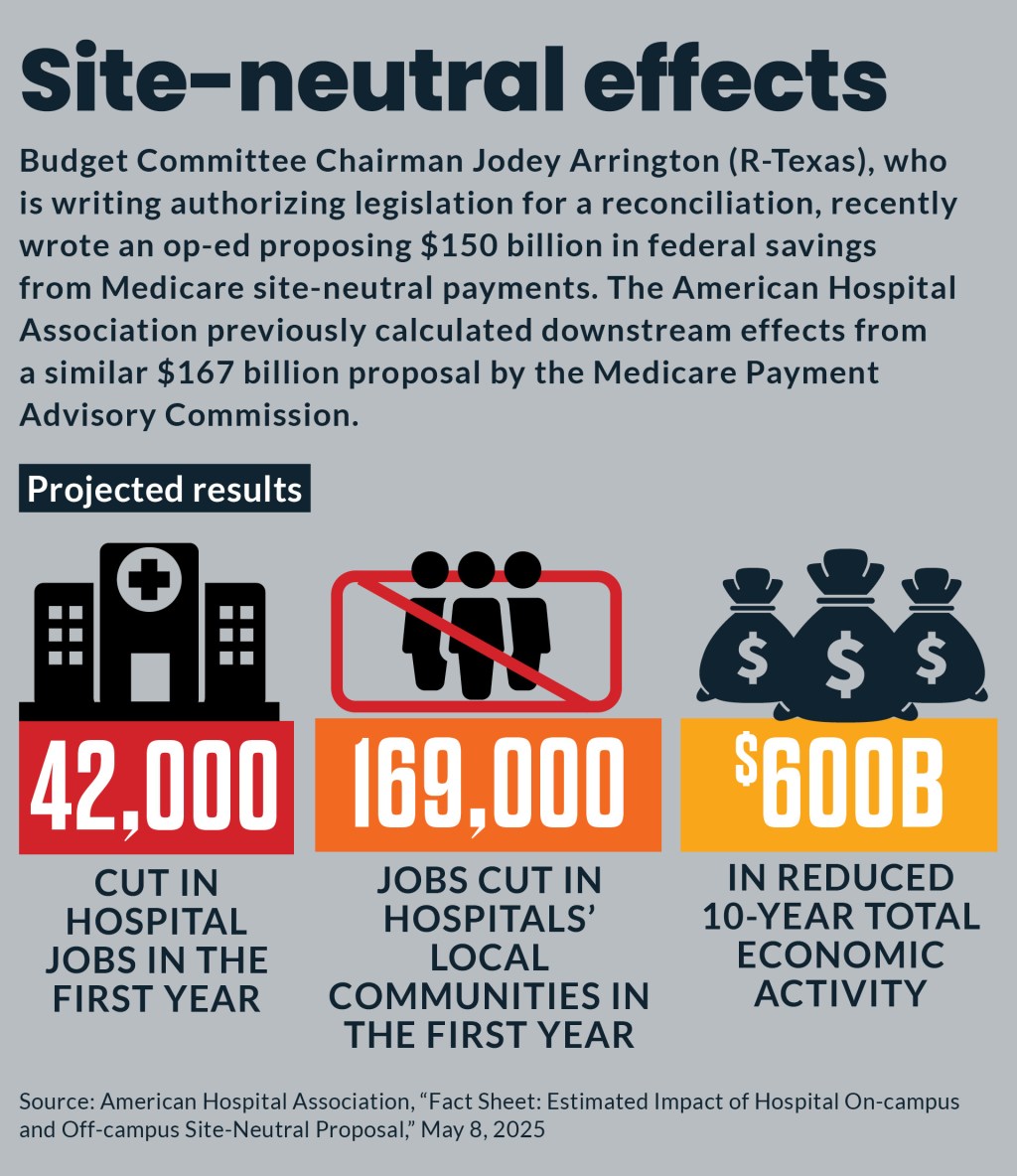
Rodney Whitlock, a healthcare adviser at McDermott+, noted that near the start of the current Congress, Republicans floated a list of $5 trillion in potential federal cuts and only a few were included in OBBBA. Those included extensive healthcare cuts, including $146 billion from comprehensive Medicare site-neutral payments.
Outlook unclear
Rep. August Pfluger (R-Texas), chairman of the RSC, said in a recent interview that healthcare affordability was a central goal of the reconciliation bill. He described a “narrower, more focused package” that should be signed into law by July “to give those policies time to take effect and make a tangible difference for families heading into the fall.”
Whitlock and Curtis said the extremely tight GOP majorities in Congress will essentially require unanimous support from Republicans. And the approaching mid-term elections may make moderate members uneasy about more major healthcare cuts.
“They are going to require unanimous [GOP] support … if someone says I can’t do this, it’s gone,” Curtis said.
Curtis noted that Republican infighting in Congress also has greatly increased since OBBBA was passed, which does not bode well with unanimous agreement on healthcare spending cuts in a reconciliation bill.
Additionally, healthcare spending cuts in the reconciliation bill may not clear procedural hurdles that limit what types of measures reconciliation can include or obtain the necessary scored savings from the Congressional Budget Office.
Mulvany noted that Republican members of Congress will have widely varying levels of motivation to pass another reconciliation bill.
“Conservatives want major policy wins, moderates fear politically risky provisions and many in both chambers question whether a second attempt is even feasible, given the first reconciliation bill’s mixed political results,” Mulvany said.
