


Fast Finance
Hospitals freeze jobs in April
Hospital expenses are elevated in early 2026 compared with those of 2025, while revenues are pressured by an eroding payer mix and remain below sustainable levels.

Published
May 19, 2026
9:03 am
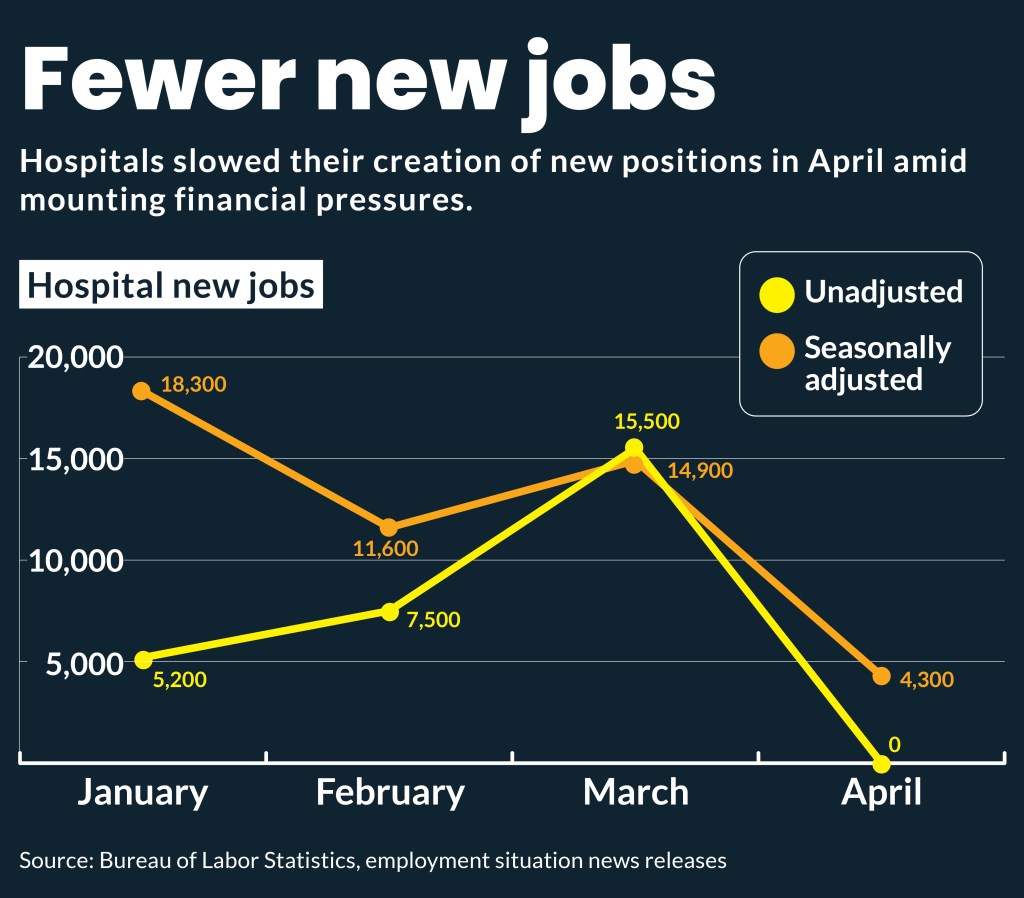
Hospital job creation ground to a halt in April, even as new positions proliferated in the overall healthcare sector.
Hospitals added no new jobs in April, according to unadjusted data from the Bureau of Labor Statistics (BLS). When BLS applied its seasonal adjustment, it counted 4,300 new positions.
That was the first time hospital jobs were flat or negative since June 2021 when hospitals shed 5,500 positions amid a healthcare sector-wide loss of 12,000 jobs.
The hospital job-creation slowdown came as the healthcare sector added 37,000 jobs in April, performing largely in line with its 12-month average of 32,000. The biggest gainers included:
- 14,800 at nursing and residential care facilities
- 10,800 in home healthcare services
- 5,600 at the offices of nonphysician and nondentist providers
Departure from trends
The April new-job freeze was an aberration from the past 12 months, over which hospitals added 143,900 unadjusted positions and 136,800 positions when seasonally adjusted.
In March, they added 14,900 positions, which followed 12,000 jobs added in February.
The rate of new job growth has slowed from last year. In 2025, hospital new jobs averaged 13,600 each month. As of April, the 12-month average of new jobs slowed to 11,400.
The slowdown in hospital new job creation also followed a mild flu season, which was blamed by some health systems for poor financial results this winter.
Hospitals and health systems have announced job cuts this year as some reduced their workforces amid ongoing financial strain. Tracking of 24 of those organizations’ layoffs this year by Becker’s Hospital Review, said executives cited a mix of factors — including lower reimbursement, rising labor and supply costs, and the need to realign operations — as drivers of these decisions.
Financial challenges
Jeff Goldsmith, president of Health Futures and longtime healthcare industry analyst, said in a recent interview that ongoing health system layoffs stem from a cash shortage.
“People need to understand that hospital finance folks aren’t just sitting there saying, ‘Pay us our money and leave us alone,’” Goldsmith said. “They are cutting expenses. They are trying to improve efficiency. They’re trying to use AI to make better use of their existing people, they’re trying to reduce wasted time and motion.”
The median operating margin for hospitals dropped in February to 2.1% from 6.4% in December, according to the latest Kaufman Hall hospital flash report, which uses data from Strata Decision Technology. That report noted that hospital expenses are elevated in early 2026 compared with those of 2025, while revenues are pressured by an eroding payer mix and remain below sustainable levels.
“There’s a bunch of this stuff that no one really understands in the general public because people aren’t telling the story,” Goldsmith said. “Health systems are under tremendous financial pressure right now.”
Hospitals generally have reported decreased labor pressure from its peak in the immediate aftermath of the COVID-19 pandemic, when costly contract labor use surged after many clinicians left those organizations. However, they also report that labor costs have stabilized at a higher level than pre-pandemic.
Effects of job availability
Healthcare overall remained robust with 700,000 hires in March and 1.35 million open positions.
In March, healthcare experienced 645,000 departures — largely unchanged from a year earlier — which included:
- 157,000 layoffs
- 463,000 resignations
The high rate of voluntary departures demonstrates that healthcare remains immune from the broader narrative of a no-hire economy, in which workers are stuck in their jobs because no one else will hire them.
That broad availability of healthcare jobs also has fueled a surge in healthcare strikes, said hospital advisers. There were 51 healthcare strikes called by unions in 2025, up from 31 in 2024 — even as labor strikes decreased across all industries in 2025, according to an annual union activity report from the American Society for Health Care Human Resources Administration (ASHHRA).
Leading issues raised in those strikes included:
- Improved staffing/reducing workloads
- Increased wages
- Improved workplace safety
- Criticized executive compensation
Similar themes were raised in nurse strikes in early 2026, according to one adviser. Demands for higher wages have shifted from a lower issue to a central theme of healthcare strikes.
Recent research found that from 1980 through 2022, earnings of healthcare workers increased nearly twice as fast as those of non-healthcare workers. Nurses’ real earnings increased by 82% in that time, or more than any other type of healthcare job.
