


Fast Finance
Health systems boost front-end collections
Industry data show point-of-service collections improved over the last year, while self-pay after insurance collections decreased.

Published
May 22, 2026
10:20 am
|
Updated
September 1, 2026
10:10 am
Amid rising bad debt, health systems are improving front-end collections, according to surveys.
Pre-service collections as a share of self-pay collections have improved from an average of 16% in 2025 to 21% in 2026, which signals that more organizations are capturing revenue successfully before care is delivered, according to a survey of 205 healthcare revenue cycle leaders by PayZen and HFMA.
That improvement allowed the share of patient collections tied up in open payment plans to decrease from 30% reported in 2025 to 23% reported in 2026, according to the survey.
Overall, health systems reported in 2026 that they collected 31% of total patient billings, which was an improvement from 24% of total patient billings they reported collecting in 2025.
“The clearest path forward is earlier engagement,” Itzik Cohen, CEO of PayZen, said in the report on the survey. “Health systems that connect with patients financially before care is delivered consistently outperform those that wait. Pre-service payment adoption is rising across the industry.”
In 2026, 91.5% of surveyed organizations report either encouraging payment, requiring payment, or collecting a payment method on file during the estimate process, up from 81.3% reporting that in the 2025 survey.
“It’s that health systems are paying more attention to the patient side of the equation,” Tobias Mezger, co-founder and chief revenue officer at PayZen, said in an interview. “If you went back 10 years, I think it was all about the payers and the patient was not a focus for most revenue cycle leaders. I think that’s changed.”
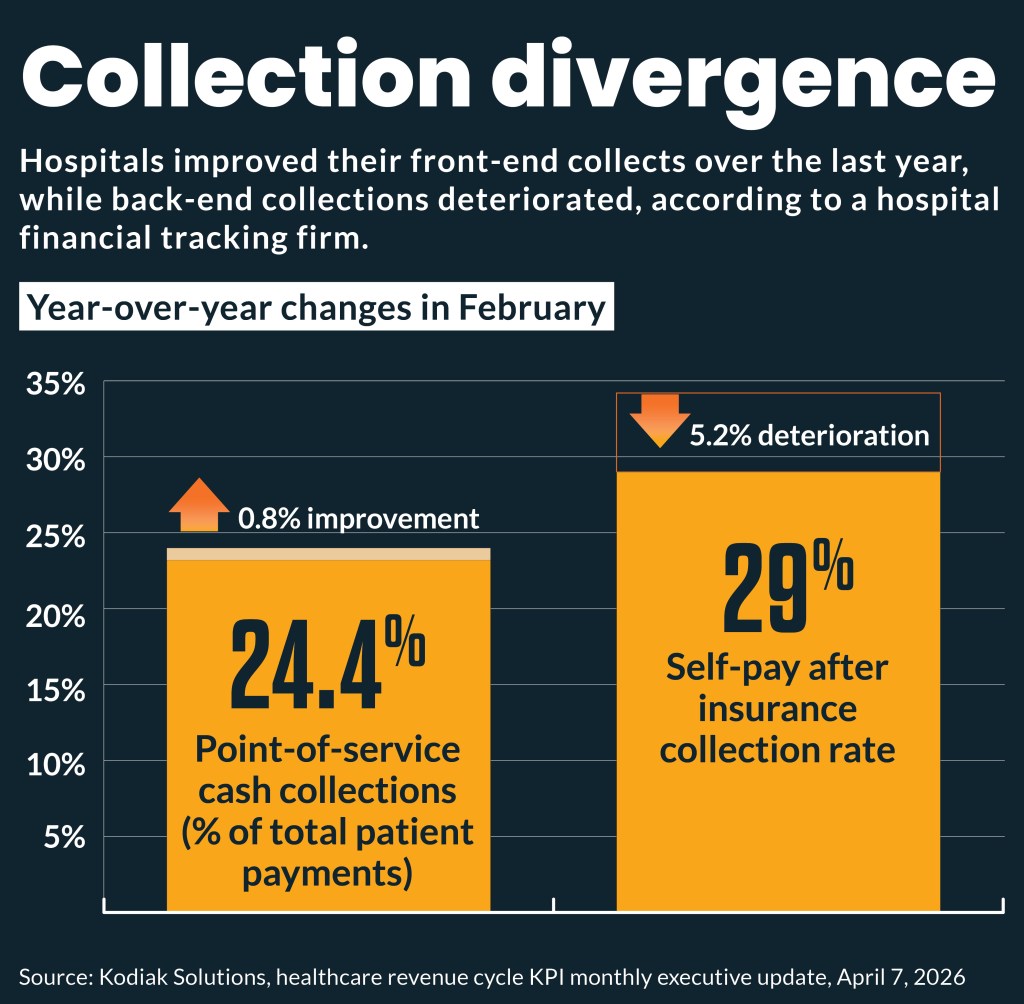
The improvement in front-end collections also was seen in industry tracking data. For instance, point-of-service cash collections was 24.4% of total patient payments in February, according to Kodiak tracking. That was a 0.8% improvement year over year (YOY).
However, the self-pay after insurance collection rate fell 5.2% YOY to reach 29% in February.
” If you collect it upfront, you’re going to not collect the same amount in the back end,” Mezger said. “So, I wouldn’t say we see across our customer base and people we talk to that back-end collections are decreasing. But I think overall patient responsibility is increasing. So, even if the collection rate is the same 30%, it’s still not a great rate for a health system for something that’s now a bigger share of their revenue.”
Pressure trend
The improvements in front-end collections of the patient share of healthcare bills came as payers continue to shift more of the financial burden on their enrollees and hospitals report increases in bad debt.
Bad debt and charity care increased 17.0% YOY and 4.1% from February to March, according to the latest hospital metrics from Strata Decision Technology.
Strata attributed the increase to coverage gaps, patient affordability challenges and evolving policy dynamics.
The uncompensated care increase YOY differed widely by region, including:
- 27.3% increase in Midwestern hospitals
- 15.8% increase in Southern hospitals
- 15.5% increase in Western hospitals
- 3.2% increase in Northeast hospitals
Extended repayment
The PayZen report warned that the reliance on extended repayment continues to introduce both operational complexity and financial risk.
PayZen characterized the small increase in the average pre-service collection rate as a “plateau” driven by a fundamental tension between financial enforcement and the clinical mission.
“Systems are increasingly sensitive to the risk of care avoidance — where strict up-front payment requirements inadvertently discourage patients from seeking necessary treatment,” stated the report.
That tension played out in health systems that increased their willingness to forgo advance payment. Although 17.1% of organizations officially “require” up-front payment, 68% of them ultimately proceed with care even if the requirement is not met, according to the survey. Last year, only 41.7% of systems that required up-front payment were willing to proceed without up-front payment, even if the minimum amount was not paid.
The willingness to forgo advance payment was paired with increasing use of third-party vendors to provide extended-term payment plans. In 2026, 43.8% of health systems used such vendors, up from 38% in 2025.
Some of that increased use of outside vendors to provide those payment plans stems from financially pressured health systems dialing back their own offerings.
“If a health system is carving back what they offer in-house, but they’re bringing in a partner, it’s overall good news for the patient, especially if it’s a right partner,” Mezger said. “If the financial pressure on the health system is so big that they have to carve back what they offer their patients, but without an alternative, I think it puts patients into a tougher spot.”
An emerging trend in patient collections is the use of AI by larger health systems. AI use by health systems with more than $5 billion in net patient revenue includes:
- 20% using AI for patient access and scheduling
- 20% using AI for financial assistance and eligibility workflows
- 10% using AI for call centers or customer service
Collection approaches
Proven collection strategies can help ensure prompt payment, according to an Experian Health post. Those steps include:
Providing clear pricing and flexible payment plans. Four in 10 patients said they would be more likely to cancel or postpone care without an accurate estimate, according to an Experian Health survey. Meanwhile six in 10 said they’d be more confident in their ability to pay for care if they were offered a payment plan that took account of their financial situation.
Helping patients find and understand coverage. Building coverage discovery into the collections process can help. They suggested scanning patient accounts throughout their care journey to uncover alternative payment methods and reduce financial strain.
Easing payments to prevent delays. Experian Health suggested accepting payments at multiple collection points, including mobile devices, kiosks and patient portals.
External pressure
The challenges in patient collections may worsen in the coming years with expected federal payment cuts and employer-sponsored insurance increasing enrollees’ share of healthcare costs.
An additional trend is the growing number of states that place varying limits on patient collections.
In 2025, several states enacted laws to extend charity care requirements, according to a Commonwealth Fund post. That included a Maine requirement for hospitals to provide free care to patients below 200% of the federal poverty level. Vermont and Maryland also enacted laws specifying a percentage at which hospitals must discount certain patients’ hospital bills.
In response to earlier state laws, Trinity Health rolled out a presumptive eligibility screening for charity care for all patients.
“As charity went up, bad debt went down, which is better for the patients and better for the organization to provide charity from a public [view],” Emily Huizenga, vice president of business operations strategy at Healthrise, which is Trinity Health’s enterprise revenue cycle partner, said in a Q&A with FastFinance. “We prefer to provide charity versus writing something off to bad debt.”
Other state laws include several limiting lawsuits as part of collections. Virginia and Rhode Island banned some legal debt collection approaches, including liens and foreclosures on patients’ primary homes as well as wage garnishment.
