



Fast Finance
Policy clarity drives hospitals’ M&A surge
Reimbursement pressure from both public and private payers is pushing weaker organizations to seek partners.

Published
June 1, 2026
4:40 pm
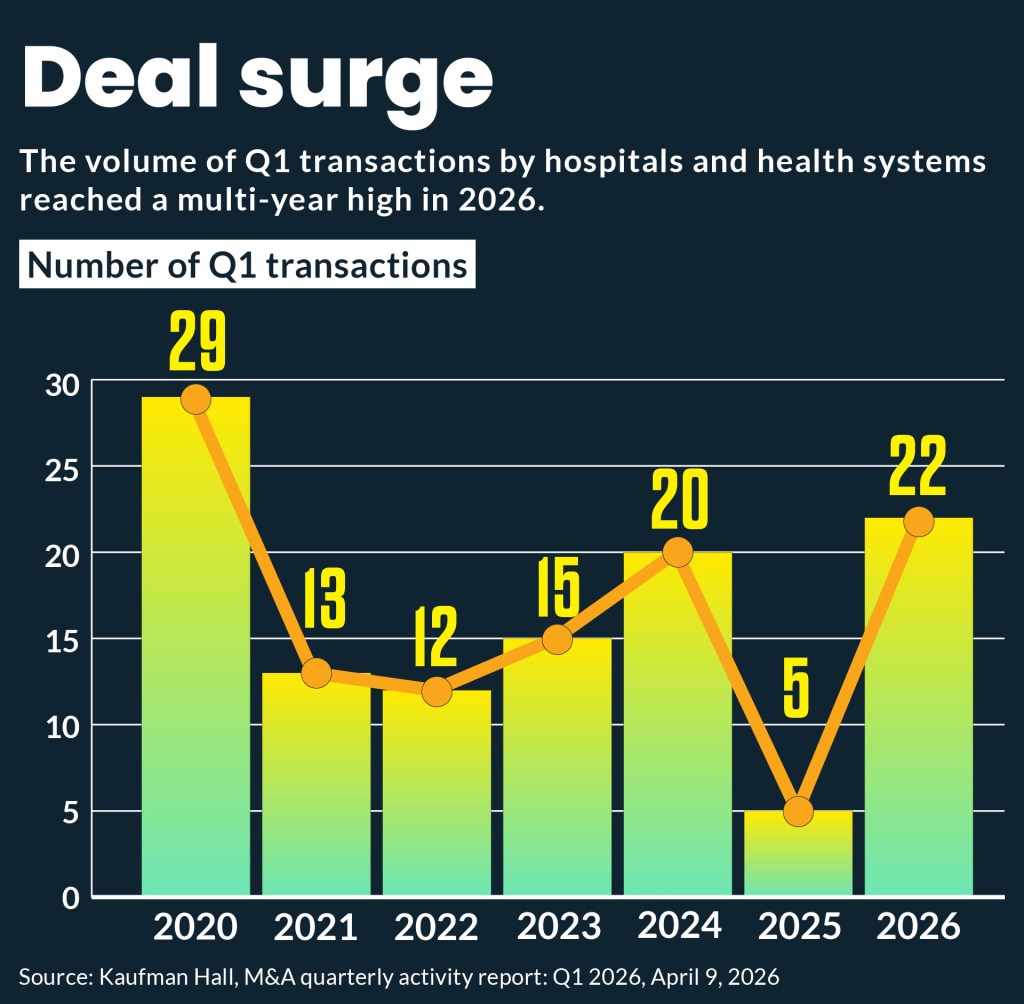
Hospital mergers and acquisitions (M&As) jumped in 2026 to a six-year high amid greater clarity in policies that will affect those organizations.
Hospital M&A activity comes in stark contrast to other parts of the healthcare sector, which have slowed transactions due to higher borrowing costs.
The 22 hospital and health system transactions announced in Q1 was an increase from 17 in Q4 2025 and the highest Q1 activity recorded since 2020, according to Kaufman Hall’s latest analysis.
Kris Blohm, managing director of consulting for Vizient’s Kaufman Hall, said in an interview that stepped-up dealmaking has continued since Q1 and was expected for the rest of the year.
Increased policy clarity is a driver of that deal volume.
“It’s largely, I think, an acceptance that there’s at least some more visibility into the near- and medium-term path forward,” Blohm said.
Although Blohm did not address policy specifics, the One Big Beautiful Bill Act (OBBBA) was enacted in July 2025 — after months of wrangling over the scope of healthcare cuts it would include — and the Trump administration also has issued some of the rules implementing OBBBA.
Reimbursement pressure from both public and private payers is pushing weaker organizations to seek partners.
The Q1 dealmaking was dominated by divestitures (15 of 22 transactions). The Kaufman Hall report identified drivers of divestitures as:
- Underperforming markets
- Inadequate market scale
- Inability to execute on strategic initiatives
- Need to redirect resources for investment elsewhere
The 2026 health system dealmaking push extended beyond hospitals, according to tracking from Levin Associates. Their tracking identified 48 health system transactions of all types in Q1, or a 30% increase in volume compared with that of Q1 2025.
Those acquisitions included 21 deals for physician groups, including:
- 6 in orthopedics
- 4 in internal medicine
- 4 in gastroenterology
Sector divergence
In contrast to hospitals and health systems, the broader healthcare sector pulled back on dealmaking this year, according to KPMG.
Healthcare sector M&A deals totaled $15.8 billion in Q1 2026, down 31% from $22.9 billion in Q1 2025 and down 64% from $43.9 billion in Q4 2025, according to data emailed from the firm. Deal volume also fell to 335 in the sector in Q1 2026, down from 466 in Q1 2025 and 436 in Q4 2025.
The divergence in hospital dealmaking from the that of the broader sector likely stems from differences in financing and the amount of pent-up demand, said Blohm.
“Health systems have been fairly pressured over the past couple quarters, so you’re seeing a rebound, and that rebound is off of a couple of pretty low quarters,” Blohm said.
Additionally, capital market uncertainty and higher borrowing costs have impacted dealmaking this year by for-profit entities, which are much more common in the sector outside the hospital market.
“Not-for-profit health system M&A is typically not as influenced or impacted by cost of capital as more traditional M&A in that borrowing or debt is not the predominant source of funding for these types of transactions,” Blohm said.
Policy change
Federal oversight of hospital and health system acquisition could increase under proposed changes sought by the Federal Trade Commission (FTC) and the Department of Justice (DOJ).
The agencies are overhauling the Hart-Scott-Rodino (HSR) Act premerger notification rules to greatly expand the scope of information parties must submit at the outset of a transaction. The new information would include descriptions of competitive dynamics and more data on ownership and supply relationships.
Supporters say the changes — the most significant since HSR was enacted in 1976 — are a needed modernization, while critics contend that they impose substantial new burdens.
Those critics were joined last week by the American Hospital Association (AHA), which urged the FTC and DOJ to exclude hospitals from the new premerger notification requirements.
Reasons for the needed exclusion, said AHA, included:
- M&A keeps struggling hospitals from closing
- There is no evidence anticompetitive hospitals mergers have evaded FTC scrutiny
- Requirements of the new form are unnecessarily burdensome
“Any changes to the form will impose burdens that outweigh any expected benefits,” wrote the AHA.
The AHA previous submitted an amicus brief in support of a lawsuit to block the HSR form changes, which a federal judge granted but the Trump administration has appealed.
On May 26, the Fifth Circuit granted the government’s unopposed motion to stay proceedings in the case through the end of the year, during which the FTC and DOJ will consider revisions to the form.
