


Healthcare Leadership
Annual Conference 2026, Day 1: Healthcare AI shows promise, but people come first
Corewell Health leaders opened HFMA’s Annual Conference with a discussion of AI, workforce investment, board engagement and strategic prioritization.

Published
June 7, 2026
10:38 pm
|
Updated
June 8, 2026
6:57 am
Sunday video recap: AC26 Day 1 Recap: Celebrating 80 Years of HFMA
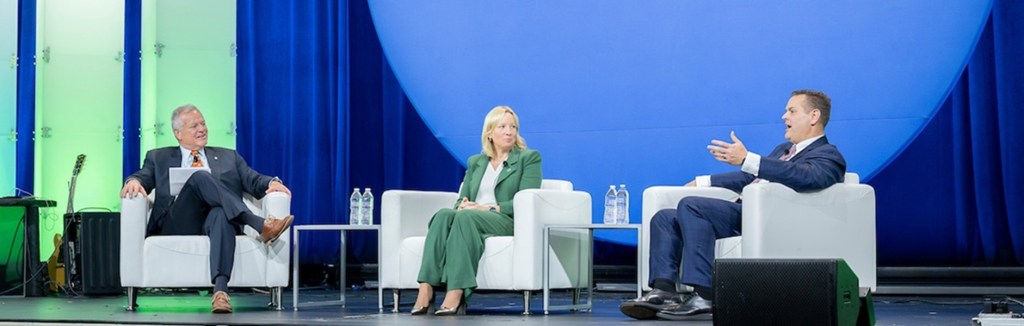
Despite AI’s ample potential to improve healthcare, the top investment priority should be people, according to insights at the opening session of HFMA’s 2026 Annual Conference as the Association began its 80th anniversary celebration.
The best technologies won’t be optimized unless “we continue to educate, to reskill, to upskill, all of those processes,” Tina Freese Decker, president and CEO of Corewell Health, a Michigan-based integrated health system, said during a panel discussion Sunday in National Harbor, Maryland.
The importance of investment in human resources goes beyond specific training. In an industry that increasingly can be described as “brittle, anxious, nonlinear and incomprehensible,” (i.e., the BANI framework), Decker said leaders need to help employees build resilience so that “they can move forward and they understand what the mission and the vision are, and what they need to do for it.”
Demonstrable benefits for clinicians and organizations
Although AI by itself will not optimize healthcare, key use cases have brought major benefits, said Decker and Matt Cox, executive vice president and CFO with Corewell and newly installed National Chair with HFMA. The two leaders shared their perspective during a panel discussion moderated by Joe Fifer, who is a member of Corewell’s board of directors and past president and CEO of HFMA.
“Ambient listening has had a huge impact,” Cox said. “Not only to help us make sure we’re capturing charges and getting the notes right, but it’s made the physicians’ lives better because they’re not doing their notes at 8 p.m. in their pajamas.”
“It’s saved marriages,” Decker said.
Cox said there also are “hundreds of use cases” in the revenue cycle, and more opportunities are constantly emerging throughout the organization.
A key with AI is that the technology “needs to help you think critically,” Decker said. “You can’t just use it and then trust everything that’s coming through.”
Leveraging feedback from the top levels
Decker and Cox said they strive to look past spreadsheets and numbers in executive decision-making. For example, they want to make effective use of board meetings by going beyond polished presentations to focus on unresolved issues and questions.
“Let’s take something that’s unfinished, just take something that’s 50%, 80% done, and get ideas about that,” Decker said.
The organization’s executives provide videos to board members in advance of meetings, allowing the members to better prepare follow-up questions.
“I don’t want [the board] to come in and just listen to us and then to vote and say yes,” Cox said. “I want them to come in and challenge us and bring up new ideas and talk about the struggles that they’ve had in their companies and how it might relate to Corewell Health.”
He’s shortened the time he takes to present to the Finance Committee as a way to increase the opportunity to “just sit back, put down our papers and have real conversations.”
Ensuring alignment within the C-suite
Decker and Cox expressed appreciation for their working relationship, although, not surprisingly, they don’t immediately agree on everything. Cox joked that after some of their talks, he looks around his office considering what he needs to bring home that night in case he isn’t allowed back.
“If there’s no tension between the CEO and CFO, then neither are doing their job,” Cox said.
“The important part of tension is it’s not personal,” Decker said. “There’s going to be tension. [Corewell has] a health plan and care delivery. There is inherent tension in that when you’re trying to keep people out of a hospital for coverage, and people are coming into an ER or a hospital. As we work on value, you can bring that tension together and navigate how you do it.”
From there, she said, “We have to hold people accountable to what they’re saying and what we’ve decided on.”
Prioritizing the right initiatives
One challenge when running an organization is to prioritize initiatives and resource utilization out of the many ideas that may seem appealing.
“I think back to my days of doing the budgets and financial plans, and every year it got harder and harder because there were a few bad ideas, but not many,” Fifer said. “Most of the things that were put on the table, most of those chips were good ideas, things that you wish you could do them all, but you can’t.”
One key is to know when to pull the plug on a concept, Decker said.
“Sometimes we are maybe too kind and we let things fester, we let things continue on when instead we already know the answer and we should just stop it,” she said. “There’s a lot of opportunity for us to stop things, to be clear and be kind, [but] to end processes.”
Corewell’s leaders use the concept of blue chips to triage initiatives and resource utilization.
“Those are the things that make it into our strategic plan,” Cox said. “And those are the things where we invest the most money, whether it be capital or operating dollars. And those are the things that we go back and hold ourselves accountable to delivering.
“There are still all those white chips, those things that need to happen, but those have to fit into the blue chips, not the other way around.”
Navigating a tumultuous time
Fifer asked about leveraging HFMA, which Corewell makes a point of doing with its finance teams through certification and chapter involvement.
“I think it’s curiosity over certainty [in the industry] right now,” Decker said. “Really be curious about what’s next and put yourself out there to try something different. HFMA, with all of the conferences, all of the webinars, all of the networking and connections, is a great place to test different ideas, to ask questions and to brainstorm about new solutions.”
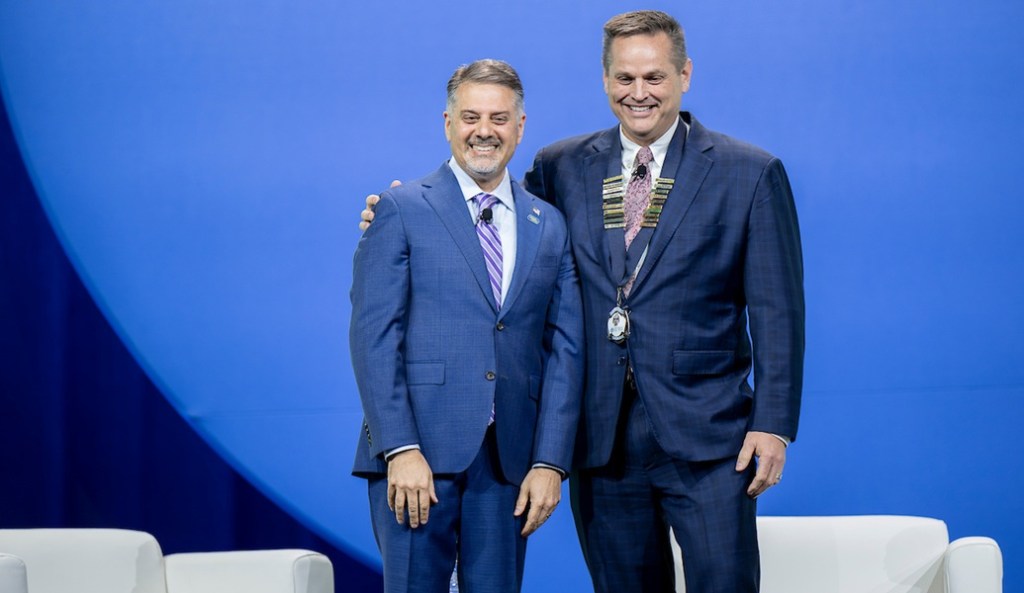
Cox moves into the lead position on HFMA’s Board of Directors
Sunday’s session also marked the ceremonial transition of the HFMA National Chair role from Kiran Batheja (2025-26) to Cox (2026-27).
Cox said the 2026 Annual Conference theme, Dare to Solve, is “about embracing change and facing industry challenges head on with curiosity and creativity. The healthcare finance landscape is constantly evolving, and the need for adaptivity, innovation and collaboration has never been greater.”
The conference is a great springboard for collaboration, Cox said.
“Engage with new ideas, ask questions and share your own expertise,” he said. “But don’t let that end here. Lean on the relationships that you build at this conference as you move forward.”
Cox’s boss at Corewell Health said HFMA is getting a worthy leader.
“HFMA is about to welcome a National Chair who has served in the CFO seat through an integration, a pandemic, a reimbursement crisis, a workforce reckoning, and the early days of an AI transformation all at once,” Decker said. “He understands what this work asks of people. He understands what it costs, and he never loses sight of what the goal is: to make health better for the people we serve.”
For much more on Cox’s background and his plans for his Chair year, see the latest hfm cover story.
Batheja hands off the baton
In farewell remarks, Batheja reflected on the Lead Now theme he adopted for his Chair year. He said the theme “reaffirmed my belief that when we embrace change, every challenge is an opportunity to lead, and that HFMA’s role in helping our members navigate, shape and succeed through that change is more important than at any other time in our careers.”
That approach is embodied in Vitalic Health, an HFMA strategic initiative to advance affordability, financial sustainability and better health outcomes in U.S. healthcare.
“It’s a tangible example and evidence that HFMA is choosing to lead rather than react, to shape the future rather than wait for it to happen,” Batheja said.
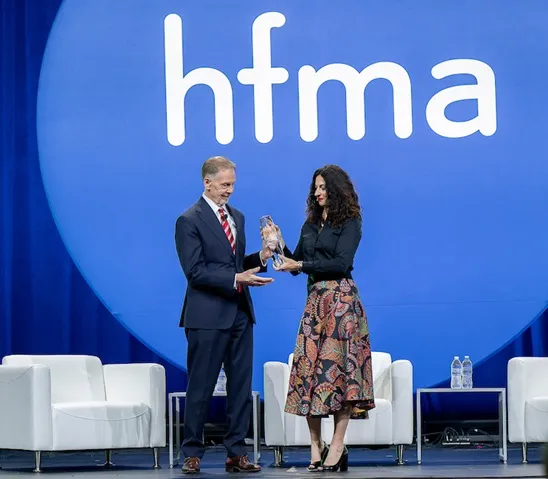
Dahlen honored for his contributions to the profession
Dennis Dahlen, CFO of Mayo Clinic, accepted HFMA’s Richard L. Clarke Board of Directors Award, which annually is presented to an individual who makes significant, positive contributions to the profession of healthcare finance or the financing of healthcare services.
The award, which dates back to 1964, “reflects HFMA’s deepest appreciation for transformative vision, meaningful action and service to the profession,” C. Ann Jordan, president and CEO of HFMA, said while presenting the award to Dahlen.
Before Mayo Clinic, widely recognized as one of the premier brands in healthcare, Dahlen was CFO of Banner Health, a leading integrated healthcare organization.
“Although the organizations are quite different, both organizations were and are driven by that same stewardship ethos that healthcare finance is ultimately about enabling and advancing care and health,” he said. “So behind every budget, capital investment, reimbursement strategy, and financial plan is a patient, a family and a community depending on us to get it right.”
Wisdom for the next generation
Dahlen also is a past National Chair of HFMA. He reflected on the inspiration he has drawn from the resilience and dedication of his fellow finance professionals whom he has encountered during his four decades as a member.
He closed his remarks with a message to ascending healthcare finance leaders.
“Never lose sight of why you chose this profession or your ability to influence the future,” Dahlen said. “The spreadsheets, forecasts and financial models are important, but they are only tools in service of something larger. Our responsibility is to help create sustainable organizations that can deliver exceptional care today and make it even better for generations to come.
“We will continue to evolve. The challenges ahead are real, but so are the opportunities.”
