


Payment
Annual Conference 2026, Day 4: The healthcare policy outlook is sluggish heading into the midterms
As the conference wrapped up in National Harbor, Maryland, highlights included policy discussion, insider perspective on a bold new value-based payment model, and words of inspiration from a decorated athlete.

Published
June 10, 2026
7:50 pm
|
Updated
June 11, 2026
11:52 am
Wednesday video recap:
AC26 Closing Recap: Thank You, National Harbor
Included in this roundup:
The healthcare policy outlook is sluggish heading into the midterms
CMS official gives a primer on access
Succeeding under value-based care
Life lessons from a Hall of Famer
At a time when care delivery pressures are intensifying, the healthcare policy picture does not offer a clear path forward, according to insights from a panel discussion Wednesday at Annual Conference.
With a divided Congress, the primary vehicles for affecting policy are sprawling packages (e.g., the One Big Beautiful Bill Act, or OBBBA; the Consolidated Appropriations Act of 2026), along with executive orders, agency regulations and litigation. The regular legislative process has stalled out, especially in an election year.
“People say things like, ‘Why aren’t we fixing the ACA [Affordable Care Act] subsidies, and why are we not passing healthcare reform?’ It’s really, at this point in this Congress, a pretty tough thing to do,” said Leah Dempsey, co-chair of the financial services practice at Brownstein Hyatt Farber Schreck, LLP.
Providers gird for a struggle
Amid the ongoing and looming cutbacks in the OBBBA, along with the expiration earlier this year of the ACA enhanced subsidies, providers are taking mitigatory steps.
“We’re definitely concerned,” said Tim Rountree, SVP of revenue cycle and strategic business intelligence with Select Medical, a provider of post-acute-care recovery and rehabilitation services. “We’re concerned about getting an initial verification of benefits and then subsequently [finding] out it’s been retro-termed.”
Increasing rates of uninsurance typically translate to greater volumes of emergency department visits, leaving providers on the hook for more bad debt under the Emergency Medical Treatment and Labor Act (EMTALA)..
“The providers have to really focus on: ‘Where can I control what I can control? How can I get better throughput within our facilities? How can I make my clinical and my administrative processes more efficient so I can improve my margin to make up for what I’m going to lose on the bad-debt side?’” Rountree said.
Given the particular vulnerabilities of rural hospitals, a question is whether the OBBBA’s $50 billion Rural Health Transformation Program can help providers avoid outcomes such as service line closures. It’s not clear that the program is adequately funded or appropriately targeted.
“This was very last-minute, not super well-thought-out when they did it,” said Adam Steinmetz, a senior healthcare policy adviser with Brownstein.
States were awarded funding at the end of 2025, but implementation of distributions to stakeholders has “been already pretty chaotic,” Steinmetz said. “Some states have their notices out, some don’t.”
Medical debt reporting policy remains contentious
The prospect of a surge in the uninsured rate, along with the increasing prevalence of high-deductible health plans, heightens the focus on medical debt collection. Litigation successfully blocked a Biden administration rule that would have halted all reporting of medical debt to credit-reporting agencies, and the Trump administration followed by asserting that federal guidelines on debt reporting supersede state laws.
That interpretation is important, if it holds, because some states have passed laws limiting debt reporting. The result is a patchwork of requirements.
In Colorado, the state is defending against a lawsuit regarding its debt-reporting ban by claiming sovereign immunity, Dempsey said. If the state prevails, “think of what else they might be able to do in terms of the accounts receivable space and the medical space,” she added.
Status quo likely to linger
It’s unclear that healthcare policy would change substantively if Democrats win one chamber of Congress (more likely the House) in the midterm elections. The probable outcome would be greater gridlock.
Democrats would vote on restoring the ACA subsidies or rolling back the OBBBA, but any such measure undoubtedly would fall short of the necessary 60 votes in the Senate. Sen. Bill Cassidy (R-La.) drafted a bill to expand health savings accounts as an alternative to the enhanced subsidies, but his recent defeat in the GOP primary has stopped any momentum.
“They’re going to let it sit where it is,” Steinmetz said. “People are going to start just not having insurance and saving up their money.”

CMS official gives a primer on ACCESS
CMS’s highly anticipated ACCESS (Advancing Chronic Care with Effective, Scalable Solutions) Model gets underway in July, with plans to run for 10 years and incorporate additional cohorts over time.
Considered one of the most groundbreaking models to date from the Center for Medicare & Medicaid Innovation, ACCESS is intended to expand the availability of technology-enabled care of chronic conditions.
One goal of the model is to fill in care gaps that go unaddressed in traditional fee-for-service and shared savings models, Jacob Shiff, chief AI and technology officer with CMMI, said during a session Wednesday.
“The dominant incentives in our healthcare environment are to maximize billable activity, volume and intensity,” Shiff said in a conversation with Katie Gilfillan, a director of healthcare finance policy with HFMA. “And that’s where we’re seeing most technology being deployed. It’s nowhere near fulfilling the potential of these technologies to show up for patients, to show up for taxpayers.”
A focus on outcomes over prescribed approaches
The ACCESS model reimburses for clinical outcomes rather than specific activities or calculated savings. Organizations have flexibility in how they improve patient health via modalities such as digital health, AI and remote support, Shiff said.
Prospective participants showing strong interest thus far include digital health companies, virtual provider groups, and some traditional providers, Shiff said.
Even manufacturers of wearables and medical devices “have now said, ‘We can actually add a service layer and take responsibility for hypertension and those types of conditions,’” Shiff noted.
The mechanics of ACCESS
Shiff described the four clinical tracks in ACCESS (cardiometabolic, higher-acuity cardiometabolic, depression and anxiety, chronic musculoskeletal pain).
Participating organizations enroll Medicare beneficiaries into a track, document baseline measures, provide care over a 12-month period, and submit a single monthly G-code. CMS makes monthly payments, with half withheld until outcomes are assessed.
At the end of the care period, CMS evaluates whether patients improved relative to baseline or reached or maintained guideline-based goals. If at least half of an organization’s patients meet the required outcomes, the organization earns the full payment.
If an organization bills an ACCESS code for a given beneficiary, that same organization is prohibited from billing any fee-for-service code for the beneficiary. ACCESS is meant to be “an alternative to, not an add-on [to], fee-for-service,” Shiff said.
Traditional providers kept in the loop
Although ACCESS participants tend to be tech companies, referring or coordinating clinicians will play a role.
For the time they spend keeping tabs on their patients, clinicians can bill Medicare via a co-management code for care coordination, without formally enrolling in ACCESS. While participating companies may collect small monthly copayments from beneficiaries, no cost sharing can be linked to the co-management payment.
“Patients reasonably don’t want to pay for a conversation between two clinicians,” Shiff said.
Participating companies must share care plans and required updates with referring clinicians, including by connecting with a health information exchange or trusted network in which clinicians can access patient information.
“There’s a mandated degree of coordination that exists,” Shiff said.
Day 3 lookback: Success under value-based care depends on operationalizing value contracts
By Jeni Williams, HFMA Senior Editor
Two of the fundamental questions related to value-based payment (VBP) models are: “Is there a credible path to achieving savings at scale?” and “How can policy be translated into changes that improve health outcomes?” a payment expert shared Tuesday.
A friction exists between those questions, and it can be eased by strengthening an organization’s ability to not only accept risk under value-based contracts, but also to manage it, said Joshua Liao, MD, professor of medicine and division chief of general internal medicine for UT Southwestern Medical Center.
“Over time, accepting risk without management — meaning taking the contract on without actually driving an operational change — leads to some measure of disillusionment, and I think it undercuts the ability to keep moving,” said Liao, who presented “Alternative Payment Models: Today and Tomorrow.”
“Risk, in my mind, really is a financial mechanism that should force the system to create value,” Liao said. “It’s not an arbitrage game of percentages and different trends.”
Leaders in this space have both a clinical and operational model for managing risk to support success under VBP contracts, he said.
What lies ahead
During the presentation, Liao offered his predictions for where the VBP space is headed:
- Stability and change for accountable care organizations (ACOs). The Medicare Shared Savings Program (MSSP) remains a durable option, with the newly released Long-Term Enhanced ACO Design (LEAD) Model shaping an advanced lane. “I do not see huge changes in [the MSSP], so if you liked it, you’ll probably like it in the future,” Liao said.
- For bundled payments, mandatory models will become more common. “I think mandatory is the game, and technically nothing is mandatory,” Liao said. “You can just get out of Medicare, but we take the readmission penalty as mandatory. We take DRGs as mandatory. I think here, if we were talking in five to 10 years, these [bundled payments] will basically be mandatory.”
- Benchmarks and target prices will face more scrutiny. “I think benchmarks and target prices are getting a lot more scrutiny for the reasons of deflationary policy and the things that Medicare is doing,” he said.
- Primary care will remain strategic inside ACOs and enterprise risk structures. “I think primary care is strategic, but it will not be strategic as a standalone model,” he said.
- Successful organizations will take a measured approach. “A disciplined portfolio — not a ‘chase every single [model],’ but not ‘avoid every single one’ — is going to be a path forward.”
He implored leaders to “really think about accepting versus managing risk. I can’t holler that enough.”

Life lessons from a Hall of Famer
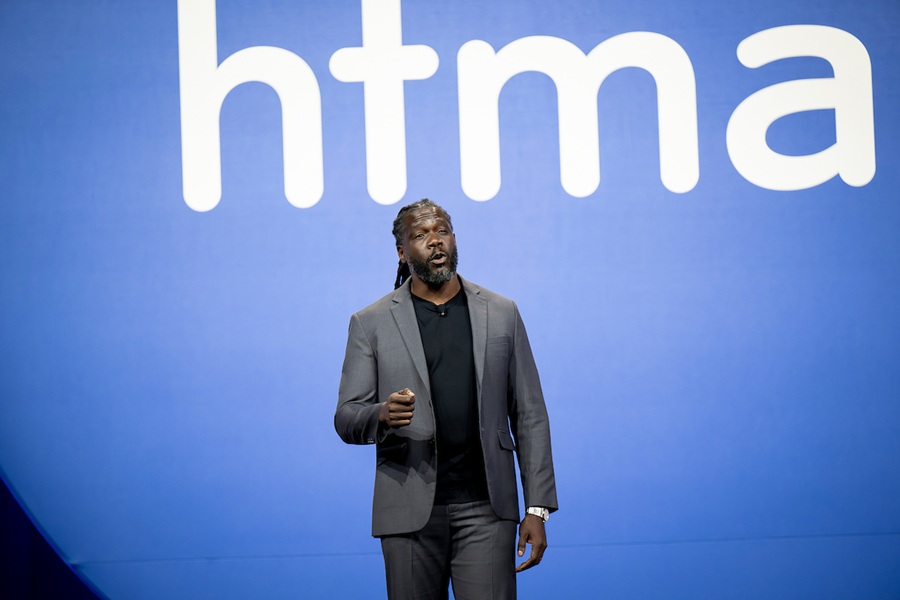
Wednesday’s closing keynote talk by Emmitt Smith, the NFL’s all-time leading rusher, a three-time Super Bowl champion in the 1990s with the Dallas Cowboys, and a member of the Pro Football Hall of Fame, focused on the approaches he used to forge his path. The same principles pertain to anyone’s journey, he said.
One thing Smith learned as he began playing organized football in youth leagues in his hometown of Pensacola, Florida, is that change creates growth. Against his wishes, he was moved from quarterback to running back.
While initially uncomfortable with the idea, he quickly flourished and realized that it does not pay to stay fixated on the role or plan you originally envisioned. A better strategy is to trust new opportunities and the people who see potential in you.
In high school, Smith gave a media interview after a starring performance but neglected to credit his teammates for their role in his success. His coach subsequently drove home the importance of the collective effort, staging a drill at the next practice where Smith received a handoff, only for his linemen to all drop to the ground, leaving him exposed to a crunching tackle.
“No man or woman becomes successful by themselves,” Smith said. ‘It takes the whole entire team doing their part to [allow] each and every one of us to do our part. There is nobody less in the locker room. There’s no one less in any organization.”
Staying grounded on the biggest stages
Lessons that applied in later phases of Smith’s career included the benefit of relentless preparation to be able to capitalize on his first significant playing time at the University of Florida, and blocking out the chatter and staying focused on the mission as the Cowboys advanced to and won their first Super Bowl of the 90s.
He thrived on competition but also on camaraderie, saying a lesson of the COVID-19 pandemic is that most situations are better as collaborative experiences with other people.
“You can’t be isolated and be the very best that you possibly can,” Smith said.
In his post-playing days, Smith gained renown for winning Dancing With the Stars in 2006. He learned, again, that precise preparation reduces stress, and growth can require thinking like a beginner.
“Be willing to step out there on faith and open yourself up to the possibility of becoming better in different areas of your life,” he said.
Invoking legendary college football coach Bear Bryant, Smith concluded his talk with the words, “The price of victory is high, but so are the rewards.”
See you next year …