


Fast Finance
Medicaid programs mull dropping insurers
Some research indicates the option could save states money ahead of federal Medicaid funding cuts.

Published
July 21, 2026
11:01 am
|
Updated
July 28, 2026
9:30 am
Various state Medicaid programs are considering replacing outside managed care plans with in-house management.
Such a reversal of the multi-decade trend to outsourcing overall management of Medicaid plans to various insurers and reverting to fee-for-service (FFS) Medicaid could have major ramifications for hospitals and health systems.
Bruce Greenstein, secretary of the Louisiana Department of Health (LDH), said other state HHS secretaries increasingly have raised concerns to him that they are losing control of their Medicaid programs amid “less than stellar work from their biggest contractors.”
“I’m starting to hear rumblings from my colleagues who are really questioning whether or not using managed care as the organizing and delivery mechanism for Medicaid healthcare services is effective anymore,” Greenstein said in the July 3 episode of the Mostly Medicaid podcast. “Or it’s past its heyday and now it’s become completely commoditized.”
Greenstein said there is little variation in the quality of the various health insurance companies offering Medicaid managed care plans.
“And it’s really just the privatization of the Medicaid provider manual and there’s no difference between the choices that many states have,” he said.
Greenstein’s criticism of Medicaid managed care organizations (MCOs) is especially noteworthy because he led their introduction into the state’s Medicaid program during his previous term as LDH secretary from 2010 to 2013.
Another fundamental problem with MCOs is that they have no incentive to control spending because the more they spend, the more the state gives them, he said.
“There’s never a hook on managing rates or putting some ability, some brake on the rim to slow down the increasing expenditures,” Greenstein said. “And so, we’re caught in a cycle where there is little reason to have long-term arrested growth.”
His concerns with smaller contractors led the state to insource multiple programs within Medicaid, such as a sexually transmitted disease program.
Countertrend
The overwhelming majority of states use a capitated managed care model to deliver at least some of their Medicaid benefits, with approximately 72% of Medicaid beneficiaries enrolled in comprehensive managed care as of 2021, according to the National Association of Medicaid Directors.
States pay MCOs a monthly capitation rate for each enrolled Medicaid beneficiary in exchange for handling a range of functions, including developing a provider network, paying providers and setting utilization management standards like prior authorization.
State spending on Medicaid MCO capitated payments accounts for 50% of total Medicaid spending, which is the single largest outlay of Medicaid dollars nationally, according to a report by the National Conference of State Legislatures. Some states have retained state-administered FFS for high-cost, high-need populations.
States increasingly shifted many or all their Medicaid enrollees to managed care primarily due to the belief that it would help states better control the cost of the program, which is usually the largest line item in state budgets.
However, MCOs are either cost neutral or could end up costing more than traditional FFS programs, according to a 2020 analysis of existing peer-reviewed studies of the fiscal implications of Medicaid managed care.
Hospital impact
Replacing MCOs with FFS Medicaid would have a mixed effect on hospitals and health systems.
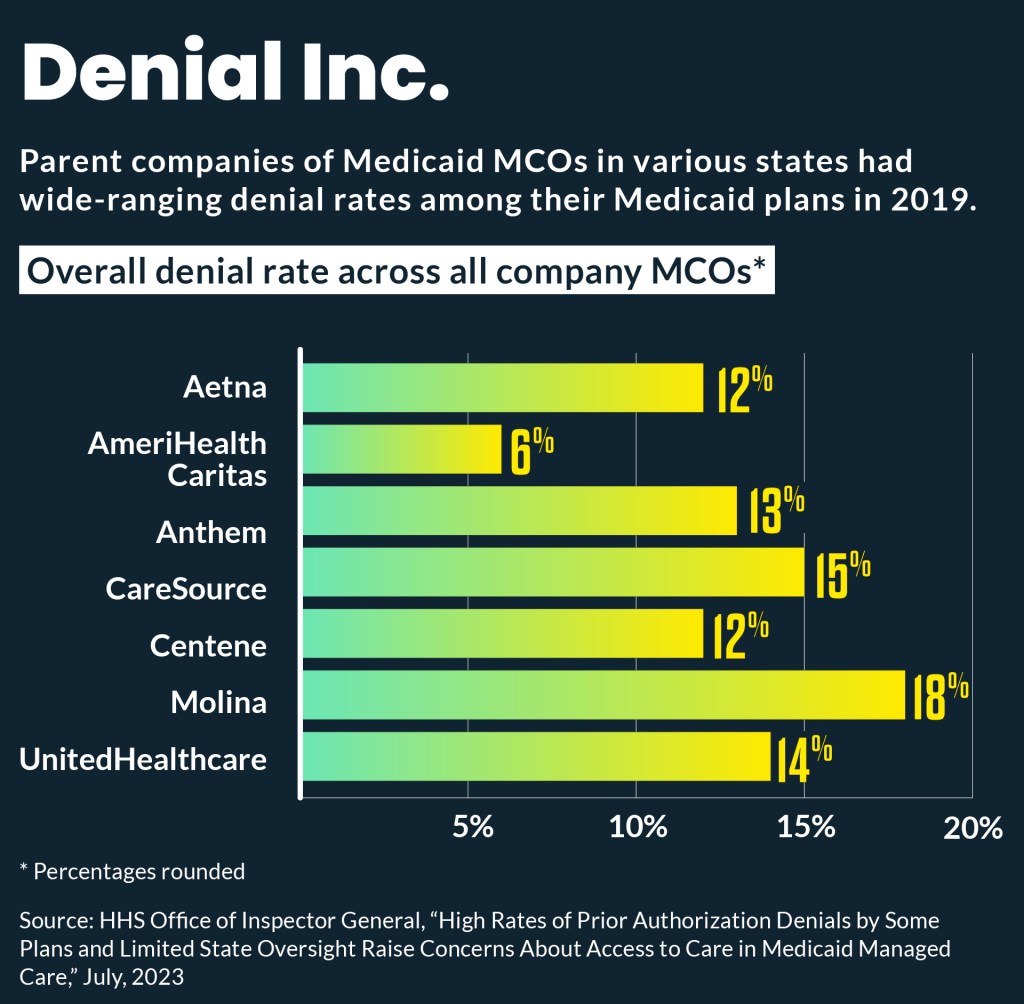
Provider organizations would benefit from the end of MCOs’ restrictive utilization management practices. Those include care denials through prior authorization, which is more common (13% rate) with Medicaid MCOs than it is in Medicare Advantage (MA, 6%), according to a report by the HHS Office of Inspector General.
Additionally, Medicaid MCOs denials are not subject to automatic independent review, unlike MA denials, which are reviewed by an independent review entity.
Providers also have many out-of-network patients who show up for care because MCOs’ provider networks are weakly enforced by states.
Nate Kaufman, managing director at Kaufman Strategic Advisors, recently wrote in a LinkedIn post that Medicaid MCOs extract profits from the program, partially by excess denials. And poor networks of subacute providers lead Medicaid enrollees to flood emergency departments — where they comprise 40% of patients.
Hospitals and health systems also would financially suffer from replacement of MCOs.
For instance, MCO payments to hospitals are exempt from “upper payment limits” on Medicaid hospital fees. Those limits would otherwise limit the federal matching funds for states.
Significant hospital losses would come from the end of state-directed payments, which provide $100 billion annually for MCOs to disburse to hospitals — beyond standard federal matching funds.
Will states act?
The latest rumblings against MCOs come as multiple state legislatures have introduced legislation to jettison their MCOs.
Bipartisan legislation (SB386/HB780) in Ohio would replace its MCO model with an Administrative Services Organization (ASO) framework. The state would pay ASO vendors a flat fee to administer the program without bearing risk, which is standard in MCO contracts.
The bills’ sponsors said the change would reduce overhead and save money.
Similarly, Hawaii legislators introduced a bill this year to move that state from managed care to managed FFS.
Earlier this year, Minnesota Gov. Tim Walz announced plans to combat large-scale fraud in his state’s Medicaid program that partially involved eliminating its eight MCOs, which administer about 80% of the state’s Medicaid care.
MCOs have issued more than $6 billion in Medicaid payments since 2018 in programs identified as prone to fraud, according to a local media review of state data.
The state took over its largest MCO, UCare, in 2025 due to massive losses. Medica subsequently absorbed it in January.
In April, Nebraska enacted a law to return care management for patients with special needs to the state’s Medicaid FFS program when they require care at a designated special needs facility.
However, many states are unlikely to switch from MCOs because doing so would reduce their access to federal funds, wrote Chris Pope, a senior fellow at the Manhattan Institute. Specifically, payments to MCOs are exempt from normally tight limits on fees and services that states can use to claim federal matching funds, he wrote in a recent analysis.
“By routing payment for Medicaid services through private insurers, states can greatly inflate the funding they obtain from Washington,” Pope wrote.
