


Fast Finance
Biggest SDP recipients raise concerns about implementing rule
Hospitals in some states could see much bigger impacts from coming federal Medicaid cuts.

Published
July 28, 2026
9:55 am
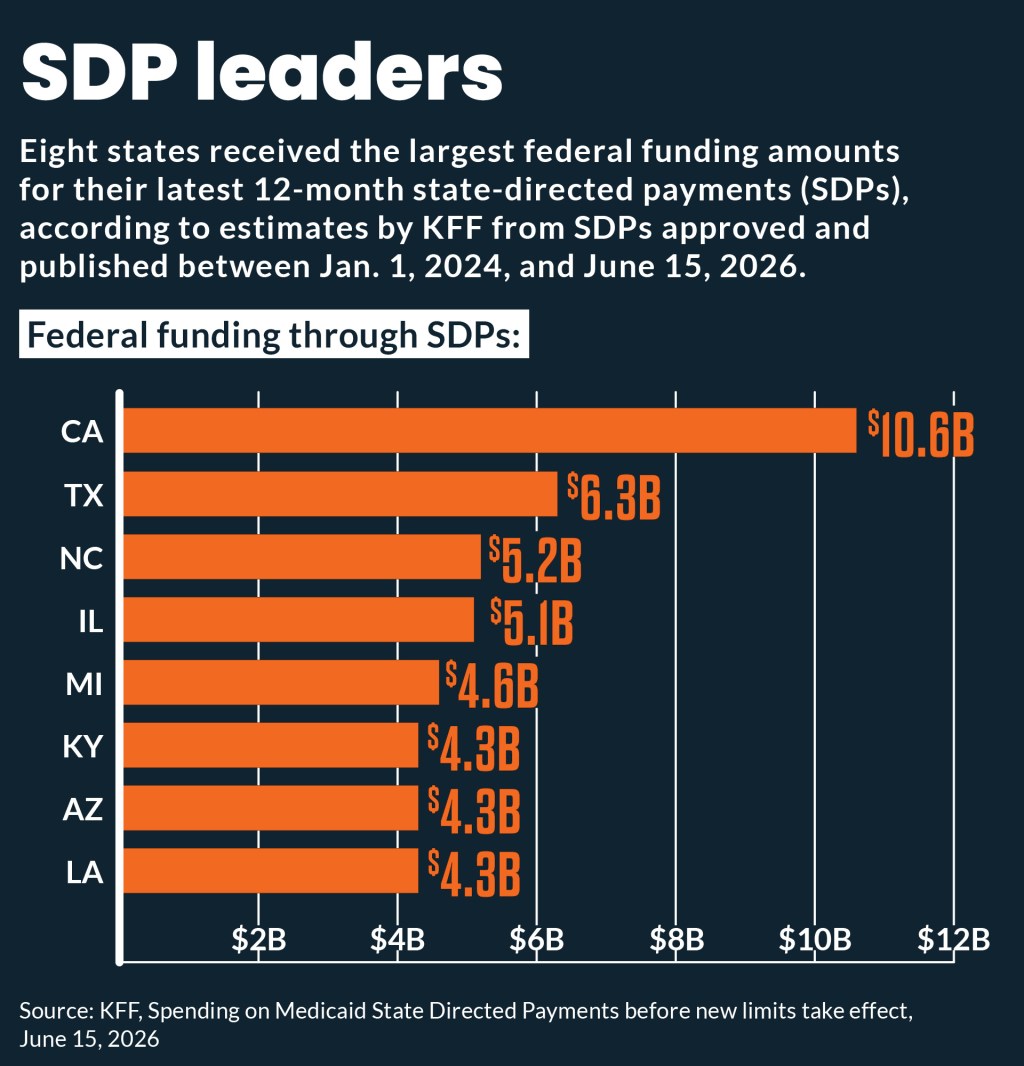
Hospitals in the states that receive the most funding from state-directed payments (SDPs) identified the range of impacts from a proposed rule and suggested alternative approaches.
The comments from hospitals and hospital advocacy groups came in response to a proposed rule implementing SDP provisions of the One Big Beautiful Bill Act (OBBBA).
OBBBA, enacted a year ago, included SDP changes that would cut nearly $150 billion from them over 10 years, according to projections by the Congressional Budget Office. However, the rule implementing those provisions would increase those federal funding cuts to $510 billion over 10 years, according to CMS estimates in the rule.
That increased cut and the various proposed policies that would achieve it — both of which go beyond what was in the statute — was a common concern across hospitals.
“Specifically, CMS is proposing to cut 3.4 times more in federal funding for the healthcare system nationally than Congress intended,” wrote Melanie Landrum, interim CEO of the Kentucky Hospital Association (KHA). “Resource reductions of this magnitude could lead to service losses and hospital closures, which would impact everyone in our community, not just those individuals who are served by the Medicaid program.”
Although Kentucky is only the twenty-sixth most populous state, its $.3 billion SDP is tied with two other states as the sixth largest, according to a KFF tracker. Medicaid cuts are especially significant in Kentucky because Medicaid is the second largest payer for inpatient stays and the third largest for outpatient services.
Landrum wrote that SDPs are used to address chronic underpayments in Medicaid by managed care organizations (MCOs).
“They also provide predictability, especially in light of ever-changing policies implemented by the MCOs, many of which result in payment delays or denials,” she wrote.
Common concerns
Hospitals raised many similar concerns with the provisions of the proposed rule. Some of the leading ones highlighted by the American Hospital Association included:
Benchmarking Medicaid payments to Medicare rates. The proposed rule would extend the statutory requirement to limit SDPs for certain services to either 100% or 110% of Medicare rate — depending on Medicaid expansion status — to additional payment types.
Per-service or discharge Medicare limit. The rule would apply the Medicare payment limit at the individual service or discharge level. That would change the historic approach of applying the SDP payment ceiling at the aggregate level for each class of providers eligible for payment.
Phase down of SDP limit. Beginning Jan. 1, 2028, OBBBA requires phasing down total funding for a grandfathered SDP by 10 percentage points annually until it reaches the applicable Medicare rate. No time frame was included in the law. The rule would apply an annual 10% cut in the original grandfathered total until SDPs reach the Medicare level.
Elimination of uniform increase SDPs. The rule would bar new uniform dollar or percentage increase to a class of providers or renewed non-grandfathered uniform increase SDPs. Instead, states could only use three permissible SDP methodologies: minimum fee schedule, maximum fee schedule and value-based payment SDPs.
Hospitals were pleased the rule would delay a prohibition on separate payment terms for grandfathered SDPs, which were barred by a 2024 rule.
America’s Essential Hospitals (AEH), which represents large safety-net organizations, estimated OBBBA will increase hospital uncompensated care costs by $466 billion over 10 years.
“Cuts of this magnitude will devastate essential hospitals’ ability to provide high-quality care to the patients and communities they serve,” AEH wrote in comments to CMS.
State impacts
Hospitals identified ways the rule’s policies would play out in their respective states.
For instance, Sweetwater Hospital in Tennessee, said the rule’s SDP phase-down approach to Medicare rates would cut more than $320 million annually from hospitals in the state.
“If finalized as is, the minimized phase-down will destabilize the TennCare program as a whole and will threaten the Sweetwater Hospital Association’s [SHA’s] ability to continue serving TennCare beneficiaries at current levels,” wrote Andrea Henry, CEO of the SHA, which owns the hospital.
Louisiana is the twenty-fifth most populous state and tied for sixth largest SDP ($4.3 billion). It covers 30% of its population through Medicaid.
Paul Salles, president and CEO of the Louisiana Hospital Association, wrote that the rule’s cuts would “inevitably force hospitals to reduce services, defer capital investments, delay workforce initiatives or reconsider access points that are already financially vulnerable.”
OBBBA was projected to cut annual payments to hospitals by more than $3 billion once the phase-down is complete, according to Louisiana Essential Healthcare Partnerships (LEHP).
LEHP urged CMS to change the rule to allow the use of commercial rates in cases where commercial payers determined that Medicaid payments were insufficient. Such cases include neonatal intensive care services.
Arizona is the fourteenth most populous state and tied for the sixth most SDP funding. It uses SDPs to supplement Medicaid funding for many of the 1.8 million residents on Medicaid.
SDPs “help address long-standing gaps between Medicaid payments and the cost of providing care; support workforce recruitment and retention; and sustain services that often operate at a financial loss,” wrote Helena Whitney, senior vice president of policy and advocacy for the Arizona Hospital and Healthcare Association (AzHHA). “They also provide needed predictability in a managed care environment in which payment delays, denials, and administrative burdens can interfere with providers’ ability to serve Medicaid beneficiaries.”
In addition to urging changes to many aspects of the rule, AzHHA said it failed to address critical issues. Those include how states should calculate the payment limit when Medicare does not cover an equivalent service or population.
Michigan, which is the tenth most populous state and has the fifth largest SDP, will see its hospitals lose more than $6.5 billion through 2034 under OBBBA, according to the Michigan Health & Hospital Association (MHA).
The MHA urged CMS to reduce the phase-down by starting with the grandfathered amount as the baseline for the first year of the phase-down until the SDP reaches the Medicare-based payment limit. That approach would allow the SDP to reach the Medicare-based payment limit in Year 7, rather than Year 5 under the CMS proposal.
“This change would protect vulnerable hospitals in rural communities and provide more time for hospitals to plan for and adapt to the significant funding cuts,” wrote Laura Appel, MHA’s executive vice president of government relations and public.
