


Healthcare Finance and Business Strategy
Is this the last year of peak hospital growth?
Hospital finances have stabilized since the pandemic, but the next phase of growth may be far harder to sustain.

Published
July 31, 2026
10:50 am
|
Updated
September 29, 2026
3:51 pm
Recovery for inpatient acute care providers has been promising in recent years, but new headwinds are raising concerns that 2026 could mark the peak of the recent hospital rebound. Whether measured by margins or market expansion, the ride may soon get bumpier.
“[Going forward] I don’t think we’re ever going to get back into the current environment the way we’re currently structured,” said Kevin Holloran, CHFP, senior director of U.S. public finance at Fitch Ratings. “I just don’t see it.”

(Photo: Marshall Clarke)
With $1 trillion in reduced federal healthcare spending anticipated over the next decade under the One Big Beautiful Bill Act (OBBBA) — most of which is slated to take effect later in that period — the road ahead is expected to be challenging. Although analysts issued a neutral outlook for 2026, citing a temporary boost from pre-2027 preparations, the longer-term picture points to significant margin compression, particularly for safety-net and rural health providers.
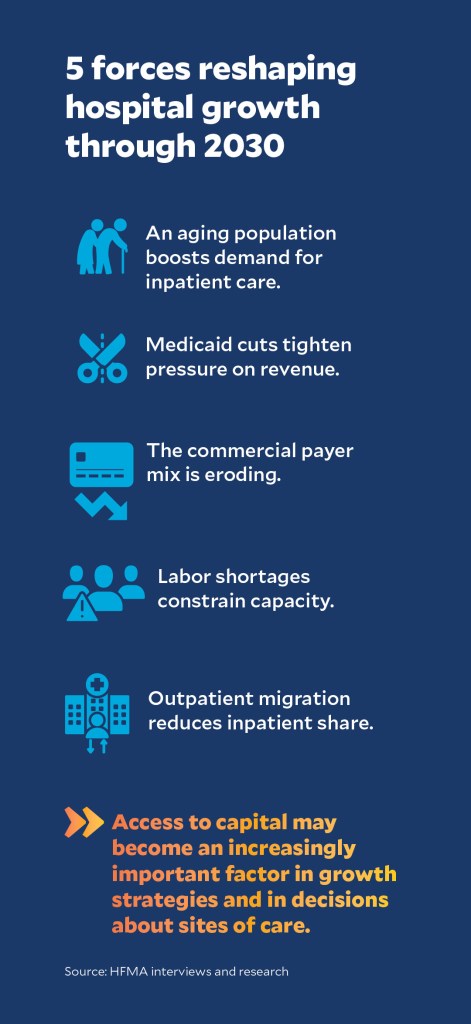
Still, reimbursement pressure is only part of the story. Demographic trends such as an aging population will likely continue to fuel strong inpatient demand, but hospitals may find it harder to translate that volume into stronger financial performance amid a worsening payer mix, Medicaid cuts, labor shortages, site-agnostic incentives and uncertainty around the trajectory of the underinsured. Meanwhile, the ROI from major AI-related capital outlays remains unclear.
For many systems, this uncertainty is already prompting leaders to rethink how growth strategies are built.
“I think we are called to be more agile as an organization and in our planning processes,” said Jim Cotelingam, MSHA, executive vice president and chief strategy officer at Cleveland Clinic. “The days of five-year strategic plans all mapped out for activity into the future are gone.”
He also pointed to certain “tectonic” shifts in the environment: “The ground is moving beneath the feet of the whole industry, and it’s not going to go backward. It’s going to keep moving in the same direction. And so, we can continue to focus on those areas and plan for them over a longer horizon with the initiatives we pursue and the goals we have. Plans might be updated more frequently, but the underlying pressures we’re trying to address directionally aren’t necessarily changing every year.”
Several of those pressures are already taking shape.
Headwinds hitting hospitals
A Premier analysis projects that the OBBBA will significantly depress U.S. hospital operating margins starting in 2026, with an estimated $68.6 billion in revenue impact over 2026 and 2027. Premier anticipates much of the impact will be driven by sharp increases in uncompensated care and reductions in Medicaid revenue.a
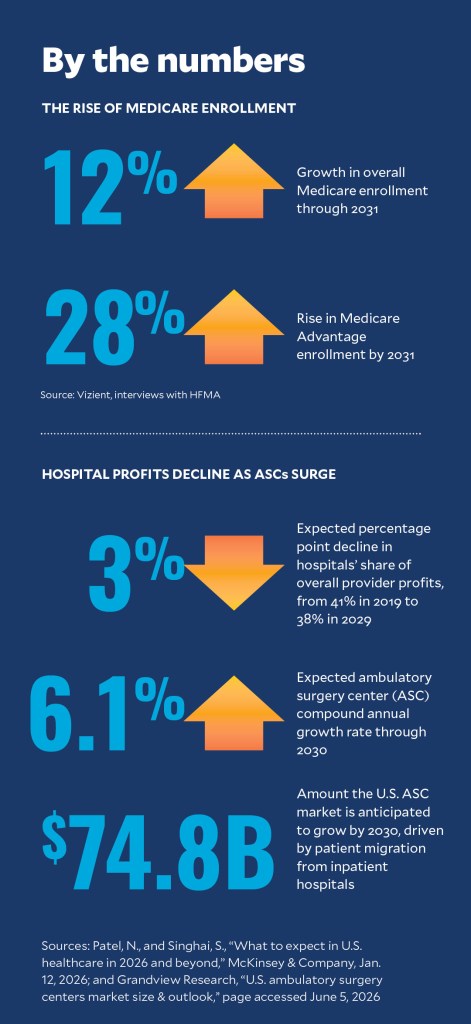
At the same time, the aging population is shifting coverage away from commercial plans toward lower-paying Medicare and Medicare Advantage (MA). The latest analysis from Vizient predicts Medicare enrollment will grow by 12% through 2031, with a 28% rise in MA, according to Brian Esser, vice president of enterprise strategy intelligence with Vizient.
Esser notes that commercial enrollment is projected to remain stagnant over the next five years, with a 1% decline, while uninsured populations are expected to rise.
“Ongoing growth of high-deductible health plans is really driving the commercial segment, and we’re waiting to see how rising deductibles influence behavior,” he said.
“Even though the commercial side is stable, the number of individuals feeling underinsured is growing. As costs rise in areas like housing and food, the squeeze on consumer wallets for healthcare dollars becomes very real. Organizations looking toward the commercial segment for sustained growth need a more nuanced approach.”

Competing projects in this more challenging environment may also affect growth. Health system finance leaders rank investment in service lines and technology, including AI and improved IT, as a higher priority than market development or facility builds, an Advisory Board survey found.b
“A lot of people already are doing a significant amount in preparation for the challenges that are coming,” Holloran said. “We think you’ll see FTE reductions and other belt-tightening that will probably make 2026 look better. And then after that, the stress is going to start to rear its ugly head, so to speak, and that probably will start to bring things down.”
Those same margin pressures are accelerating a broader shift in where care is delivered.
The decline of hospitals and the rise of ASCs
Some see the time ahead as a pivot point where traditional inpatient expansion slows while outpatient, technology-driven and ambulatory care volumes grow. Hospitals’ share of overall provider profits is expected to decline from 41% in 2019 to about 38% by 2029. This decline will result from a shift in care delivery toward lower-cost, freestanding sites, reducing the relative profitability of hospital-based care.c
Some of this shift is already underway. The U.S. ambulatory surgery center (ASC) market is expected to grow at a 6.1% compound annual growth rate (CAGR) through 2033, reaching $72.7 billion. The hospital-owned segment is anticipated to grow at the fastest CAGR over the forecast period, driven by patient migration from inpatient hospital settings to hospital-owned ASCs.d
Notable among providers making this strategy shift is Dallas-based Tenet Healthcare, which has been reducing its acute care portfolio to focus on ambulatory care following the divestiture of 14 hospitals in 2024.
Meanwhile, Tenet has continued to shift its focus toward its United Surgical Partners International (USPI) ambulatory surgical segment. USPI’s portfolio has grown from 86 centers in 2021 to 541 by 2026, including seven ASC acquisitions in Q2.
A similar multiyear strategic move away from a traditional hospital-centric model is underway at St. Louis-based Ascension Health. Since 2022, Ascension has reduced its portfolio from 139 hospitals to 90 wholly owned or consolidated facilities, mostly by reducing its presence in markets with lower margins or high competition. At the same time, it acquired AmSurg, with plans to add more than 250 ASCs in 34 states.e
Some of the growing appeal of ASC ownership stems from CMS’s removal of inpatient-only restrictions on many procedures and complex surgeries (e.g., cardiology and spine care) this year. This has opened the door to ambulatory settings and corresponding better margin performance. Commercial payers are also pushing site-of-service optimization more aggressively.f
Another appeal of the ASC setting is that it is not subject to the same burden of loss leaders that community hospitals face. As the American Hospital Association notes, more than half of hospital costs (56%) are tied to service lines where reimbursements fall short of the cost of care, including behavioral health, obstetrics, infectious disease and burns and wounds.g
“Executives are asking, ‘Where can I get the best return when I invest my capital?’” Holloran said. “By capital, it’s physical capital, but it’s also mental capital in terms of people and focus. They want a light investment for good-sized returns. We’re seeing a renewed flight to the ambulatory and outpatient space because it’s far cheaper to build and operate there, with a much better return. So, asset-light, return-rich.”
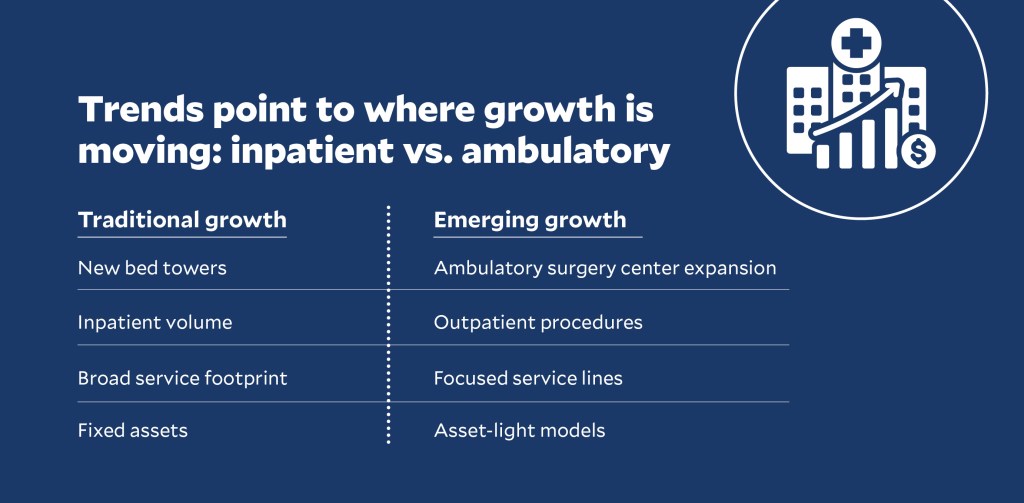
The optimal configuration of sites and services will differ based on local demand, patient demographics, competitive dynamics and geographic considerations, notes recent guidance on site-of-care strategy from consultancy Kaufman Hall.h
“What works in highly competitive urban markets may not be feasible — or necessary — in rural settings, where ensuring access and care continuity may take precedence over site-of-care optimization,” the authors wrote.

At Cleveland Clinic, there are no immediate plans to divest from inpatient acute care. Cotelingam stresses the health system’s interest in ASCs while maintaining hospital-based care.
“We are aggressively investing in the shift toward ambulatory and outpatient care, and we already have a sizable outpatient footprint, as more than half of our patient care revenue already comes from outpatient services,” Cotelingam said. “We’re blessed to have the footprint we have, and we’re also looking to expand into ambulatory surgery centers and other immediate-care sites to improve access.
“Having said that, we are also continuing to consider inpatient services. Recapitalization and growth of those assets are important to meeting our communities’ needs. People look to the Cleveland Clinic for complex care, and that care is often still delivered in an inpatient setting. So, we’re not ignoring that part of our portfolio.”
As hospitals prepare their capital strategies for the period ahead, executives are weighing several factors while keeping a close eye on portfolios, balance sheets and market dynamics.
Planning dynamics to watch
Access to capital may become an increasingly important factor in growth strategies and in decisions about sites of care.
The industry is likely to shift from trifurcation to bifurcation over the next three years, given the available levers, Holloran said. Currently, some organizations seem to do well regardless of what happens. Others — the majority — are those that have access to capital, but are merely keeping pace with challenges, and those that have consistently struggled to access capital, such as many rural health systems, he said.
From 2027 through 2028, Holloran anticipates a bifurcation between have and have-not hospitals based on three factors, some of which are beyond hospitals’ control.
Location. Growth tends to be strongest in geographic areas with high patient volumes, a strong commercial payer mix and broad workforce availability. Holloran points to Arizona, Texas, Georgia, the Carolinas and Tennessee as examples.
Willingness to act. “There needs to be a culture from the board down where there is willingness to make the hard calls on mission versus margin,” Holloran said. He points to Ascension’s divestiture path as an example of disciplined growth in practice, noting that the health system has shed inpatient assets when it couldn’t gain a critical edge in the market and has focused on areas where it is best able to thrive. “It’s recognizing you can’t be all things to all people in all places,” he said.

Ability to realize opportunities. “They don’t leave any stone unturned from an operational standpoint. They question whether they can find other avenues to eke out even a little higher margin,” Holloran said.
Chad Giese, vice president of service line strategy intelligence at Vizient, believes operational opportunity will increasingly rely on system optimization, service distribution and patient access.
“It’s going to be less about good versus bad volume and more about whether the patients are being treated in the right site of care by the right provider and with the right treatment,” Giese said.
“A patient might need hospital-based services, and they may actually be a high-acuity patient, but that doesn’t necessarily mean they need to be at the downtown medical center, which is already at capacity.”
Continuous performance improvement is also integral to any strategy grounded in hospital-based services. Some of these improvements are already being realized, Giese noted, citing figures from Vizient’s clinical database. Over the past year, inpatient discharges increased by 1% and emergency department (ED) visits by 3.2%. This growth was enabled by an average inpatient length of stay (LOS) decrease of 1.3% and average ED LOS decrease of 17%. These improvements will play an important role in organizations’ ability to capture the projected 7% growth in inpatient discharges over the next decade.
“The only way that health systems can achieve those numbers in such a short period is through operational efficiency, site-of-care coordination and quality initiatives that allow patients to flow through the system in the most appropriate way and that enable operational scale,” Giese said.
“So when we look at adding capacity, it’s going to require investing in those areas where there is an opportunity, strengthening your operational excellence and acting as a system to truly optimize across the care continuum.”
This philosophy is top of mind at Tenet Healthcare. Despite a high-acuity service focus across its hospitals, it reduced its average LOS by 8.8% in Q4 2025 and early 2026. On an April 2026 earnings call, Saum Sutaria, Tenet’s chairman and CEO, discussed the deliberate strategy that ties operational efficiency to managing high-acuity capacity. i
“We’re pleased with the fact that we are managing overall length of stay to something better than even break-even in terms of our reported length of stay because that’s creating capacity in our hospitals,” Sutaria said. “I would remind everybody that part of the strategy, of course, is capital avoidance on [creating] additional capacity. That’s really not necessary when you can improve productivity that way.”
Footnotes
a. Premier Inc., “Premier data shows OBBBA will trigger a $68 billion hospital revenue impact,” blog, Dec. 15, 2025.
b. Nives, M., and Trigonoplos, P., “Survey insights: Health system capital spending trends,” Advisory Board, 2025.
c. Patel, N., and Singhai, S., “What to expect in U.S. healthcare in 2026 and beyond,” McKinsey & Co., Jan. 12, 2026.
d. Grandview Research, “U.S. ambulatory surgery centers market size & outlook,” 2026 (page accessed June 5, 2026).
e. Ascension, “Ascension named fifth largest health system in the nation, reflecting strategic, mission-aligned growth,” news article, March 16, 2026.
f. Holly, R., “Top ambulatory surgery center trends for 2026,” Ambulatory Surgery Center News, Feb. 10, 2026.
g. American Hospital Association, Costs of Caring: Challenges Facing America’s Hospitals as They care for Patients in 2026, report, March 2026.
h. Clementi, L., Close, S., and Pritikin, J., “The site-neutral era is here. Is your ambulatory strategy ready?” Vizient | Kaufman Hall, April 17, 2026.
i. “Tenet Healthcare Corporation (THC) Q1 FY2026 earnings call transcript,” Yahoo Finance, April 30, 2026.
The new rules of hospital growth
Regardless of where organizations stand on growth goals, capital access and service distribution, leaders can take steps now to prepare for the shifts ahead.

1 Identify potential resource needs before effects are felt. Cleveland Clinic keeps a close eye on market projections and is proactive in its efforts. For example, Jim Cotelingam, MSHA, executive vice president and chief strategy officer at Cleveland Clinic, points to population aging and efforts to develop supportive services while also focusing on sustainability at Medicare rates. In certain markets, Cleveland Clinic has pursued accreditation for geriatric EDs.
“All of these emergency departments have special screening, treatment protocols, care plans, special care coordination and outpatient follow-up to address the special needs of seniors,” he said, noting that operational optimization is also monitored.
The organization has also focused heavily on strategic workforce planning.
“We’ve expanded programs to attract, develop and retain our caregivers,” he said. “So, we’re moving forward as an organization with our plans and building the foundations of our workforce to enable us to succeed in those plans.”

2 Include clinical leadership in strategic planning. Health systems should align their financial, operational and clinical functions, said Chad Giese, vice president of service line strategy intelligence at Vizient.
“Having your clinical leaders constantly communicating and planning alongside the C-suite — the CFOs, the COOs and the CSOs — helps ensure your strategic decisions and resources are being put in the right place by the clinical service line,” he said. “That kind of leadership buy-in, coordination and collaboration go a long way toward creating a site-agnostic world, where patients can enter at any point in the system and be directed to the right site for treatment.”

3 Expand the set of metrics used to examine paths for market and margin growth. Brian Esser, vice president of enterprise strategy intelligence with Vizient, says assessments of growth strategies should go beyond traditional measures, such as local market dynamics, financial performance, competitive landscape, and utilization and demand forecasts. He stresses the importance of also considering consumer preferences and operational effectiveness measures, such as the percentage of new patients seen within a certain time frame and the time from screening to procedure.
“Identifying friction points can lead to strategic prioritization,” he said.
Esser added that it’s increasingly important to examine peripheral economic indicators that might impede growth, such as housing prices in a given geographic market that could limit workforce availability.
Cleveland Clinic’s Cotelingam emphasizes the importance of not being daunted by the challenges ahead. Those pressures should sharpen strategy rather than stall it.
“We’re not looking at the pressures as a reason to stop planning,” Cotelingam said. “We’re using them as a reason to push through and become even better in the service of our communities.”
