


Fast Finance
340B policies in OPPS rule draw hospital concerns
Average hospitals face $600,000 in paybacks stemming from an earlier 340B cut.

Published
3 hours ago
A proposed cut in Medicare payments for 340B drugs and an acceleration in repayments related to a previous 340B cut are leading concerns for some hospitals and health systems.
The two 340B policies in the proposed rule for the outpatient prospective payment system (OPPS) were among a range of provisions in the 299-page rule issued July 2. For some organizations, those 340B provisions dominated their concerns in comments sent to CMS ahead of the Aug. 31 deadline.
The primary 340B focus was the proposed cut to Medicare reimbursements for 340B-acquired drugs next year by $4.55 billion to $4.85 billion, which also would cut $1.15 billion in payments from beneficiary coinsurance.
Jefferson Hospital in Louisville, Georgia, a rural hospital with about 42% of its patients covered by Medicare, warned about the effects of cutting 340B payments from the average sale price (ASP) +6% to ASP -33.4%.
“To survive a nearly 40% revenue loss, we would have to freeze hiring, cut pay and lay off critical clinical and support staff,” Wendy Martin, CEO of Jefferson, wrote to CMS.
Willis Knighton Health, a five-hospital health system in northwest Louisiana, stated that it will lose $14.9 million from the 340B pay cut.
“These payment reductions threaten the foundational health services for our entire region,” said Jaf Fielder II, president and CEO of Willis Knighton Health.
Medicare rate cut
State hospital groups projected a range of financial losses from the proposed Medicare pay cut for 340B drugs, including:
- $50.5 million in losses for West Virginia hospitals
- $25 million annual cut for Maine hospitals
- $95 million cut for South Carolina hospitals
“Put simply, the proposed 40% reimbursement reduction will seriously harm all of South Carolina’s 340B hospitals,” wrote J. Thornton Kirby, president and CEO of the South Carolina Hospital Association.
The Vermont Association of Hospitals and Health Systems (VAHHS) stated that most of the state’s PPS hospitals are classified as rural sole-community hospitals, which CMS would exempt from the 340B cut. However, one-third of Vermont’s PPS hospitals are not exempt because they are either a sole-community hospital, a Medicare-dependent hospital or participating in the Rural Community Hospital Demonstration project.
VAHHS stated that CMS needs to clarify whether the exemption applies to nonrural sole-community hospitals and, if not, expand the exemption to include them, Medicare-dependent hospitals and hospitals participating in the Rural Community Hospital Demonstration project.
Cancer impact
Leaders of some organizations said the cut would hit their cancer programs especially hard.
Asante, a two-hospital regional health system in Oregon and Northern California, stated that the 340B cut would produce a $38.5 million annual loss, with about 95% of the impact concentrated in cancer services.
“The ultimate consequence will not be lower drug prices,” wrote Kristen Roy, chief public affairs officer, and David Jacobson, associate general counsel of Asante. “It will be reduced access to cancer care for the very patients Congress intended the 340B program to support.”
Jefferson Hospital officials said it recently rejoined 340B to support its newly launched oncology program. The proposed cut means that program would have to close, said Martin.
Deeper cut
Importantly, the reduced Medicare payment for 340B drugs is budget-neutral, which would redistribute those savings to all inpatient PPS hospitals through higher nondrug service rates.
However, the CMS plan also would cut 340B drugs payments to ASP -33.4% at nonexcepted, off-campus provider-based departments (PBDs). That provision is not budget-neutral and would cut $735 million in Medicare spending and $185 million in beneficiary copays next year.
“If CMS chooses to finalize its policy to pay for 340B drugs at nonexcepted, off-campus departments at the reduced rate of ASP minus 33.4%, which it should not, it must at least do so in a budget-neutral manner,” the American Hospital Association (AHA) wrote in its comments to CMS.
‘Unlawful’ approach
AHA opposed all the 340B cuts as “unlawful” for a range of reasons. One objection stemmed from an “invalid” drug cost-acquisition survey of hospitals that it conducted earlier this year.
CMS’s survey garnered data from less than a quarter (23.1%) of 340B hospitals and less than a third (29.8%) of total hospitals, which made its sample too small to provide reliable information, stated the AHA.
Offset acceleration
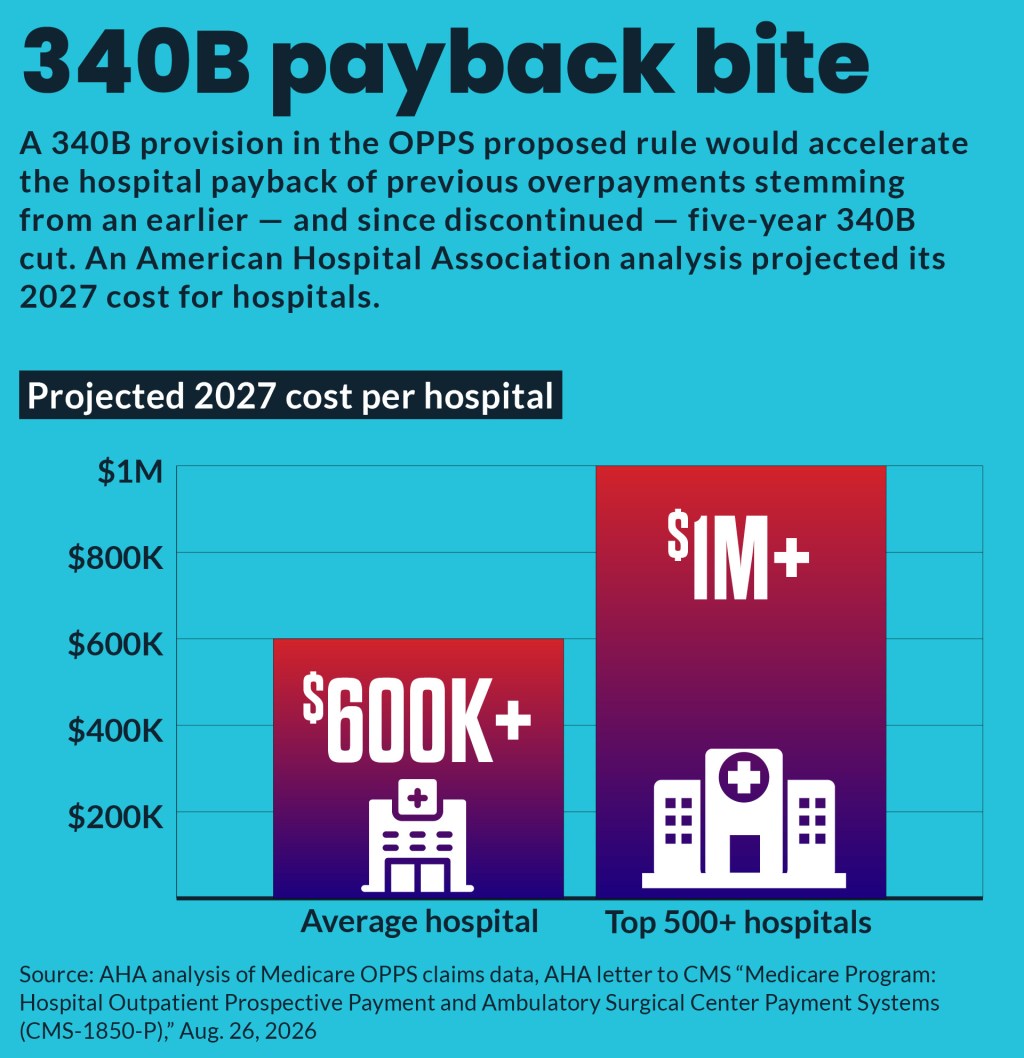
The other major 340B provision in the OPPS proposed rule was an acceleration in the hospital payback of previous overpayments stemming from an earlier discontinued five-year 340B cut.
That previous 340B cut, which CMS implemented from 2018 to 2022, was struck down on procedural grounds by the U.S. Supreme Court. CMS issued a lump sum payback of the cuts to 340B hospitals but also required repayment to Medicare of the commensurate extra payments the agency distributed to all PPS hospitals under budget-neutrality rules. The OPPS proposed rule would accelerate those clawbacks in 2027 from 0.5% of payments to 3.0%.
An AHA analysis concluded that the provision would require a $600,000 average hospital repayment, while more than 500 hospitals will owe more than $1 million each next year.
The combination of the clawbacks and the 340B rate cut could have big impacts, according to hospitals and health systems.
For instance, Asante said the clawback would cost it $6 million per year and when added to losses from the 340B rate cut would produce a total $44.5 million loss.
“To add perspective, Asante is a $1.5 billion net revenue system with hopes of breaking even in fiscal year 2027, thus a $44.5 million loss of revenue would yield a negative -3.00% margin,” Roy of Asante wrote.
CMS will include its decisions on the proposed 340B changes when it issues its OPPS final rule, which is generally released by late November.
