


Fast Finance
Physician union drive picks up steam
Practical steps can reduce the chances a hospital's physicians will unionize, say advisors.

Published
6 hours ago
Physician unionization efforts have expanded this year from a previous focus on those in training to established clinicians.
The latest physician unionization actions included:
- An August union filing by more than 240 primary care physicians and clinicians at Banner Health in Arizona
- An August union election petition filing by primary care physicians and other clinicians at Samaritan Health Services in Oregon
- A July ratification of first union contract by about 2,200 resident physicians at Temple Health and Jefferson Health in Philadelphia
- A July campaign launched to organize nearly 10,000 attending physicians across six public hospitals in California
“The worrisome aspect of this developing trend is that it seems to be accelerating,” Chris Cimino, CEO at Chessboard Consulting Inc. and a hospital labor advisor, said about physician unionization.
A building trend
This year’s unionization push was preceded by successful efforts over the past four years to organize residents, interns and fellows, Cimino said. For instance, the Service Employees International Union-Committee for Interns and Residents (SEIU-CIR) more than doubled in size (from 17,000 to 40,000 members) in those four years.
Cimino said the SEIU has launched a national strategy to organize “post-residency” attending physicians, including the push at California public hospitals.
“As witnessed with interns and residents, once this trend catches on, organizing may happen very rapidly,” he said.
The efforts of unions are gaining traction because of a range of recent trends in healthcare, said Dan Shapiro, PhD, a senior partner at the Chartis Center for Burnout Solutions.
Those include a huge increase in the hospital employment of physicians since enactment of the Affordable Care Act and an increasingly positive public view of unions. Driving factors at hospitals and health systems include the push for clinical standardization, administrative demands, compensation dissatisfaction and increasing burnout.
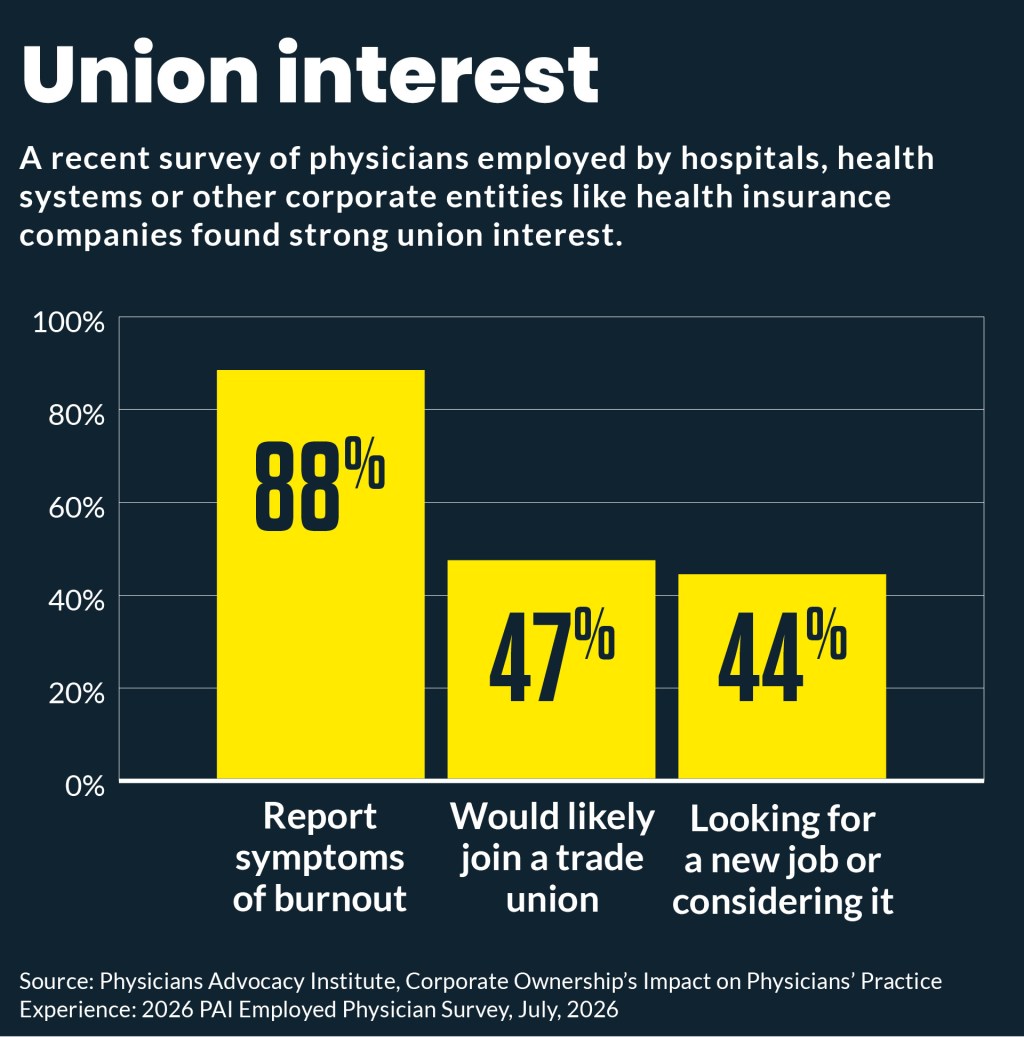
Eighty-eight percent of employed physicians report some level of burnout and nearly half (47%) said they would consider joining a trade union, according to one recent survey.
Technology is both helping and hurting. Ambient listening and AI use for documentation is reducing burnout, but a surge in patient communication through digital portals is a growing physician time burden, Shapiro said.
Shapiro also said it’s not yet clear to him whether physician unionization is momentarily popular or the start of national trend.
“I do think if some of these things aren’t addressed, and the reason that our group focusing on burnout solutions is popular, is because there is a deep concern that it is going to increase and spread,” Shapiro said.
High-profile cases
The push to unionize physicians at Banner Health caught labor observers off guard, in part, because Arizona is a right-to-work red state. That contrasted with the traditional focus of many previous and ongoing healthcare unionization efforts in Democrat-led states.
“I wouldn’t have predicted the Banner unionization effort in advance if you’d said, ‘OK, here’s the situation at Banner. Do you think they’ll unionize?’” said Shapiro.
The California push also stood out as notable, he said, because it involves a large number of physicians. It also was notable for targeting a publicly owned health system, which placed jurisdiction over that union drive under California’s union-friendly labor laws. Union organizing at privately owned facilities is overseen by the majority-Republican National Labor Relations Board.
Cost concern
Successful unionization and subsequent contracts increase hospital and health system costs because a common result is usually compensation increases.
“There’s a limited number of things that the union contracts can really address. Frequently it’s just compensation,” Shapiro said.
For example, labor leaders involved in the recently ratified physician union contracts with Temple Health and Jefferson Health highlighted the contract’s salary increases of around 20%, according to published reports.
“Unionization’s very expensive and I’m sympathetic because in the last five to six years we have watched labor budgets really inflate dramatically,” Shapiro said.
Prevention steps
Key areas to address to reduce the physician urge to unionize, according to Shapiro, include:
- Limiting patient portal communications to recent patients
- Designating other staff to respond to patient portal queries
- Shifting as much paperwork to other staff as possible
- Reducing physicians’ prior authorization responsibilities
- Addressing scheduling problems
- Eliminating work that is below physicians’ licenses
- Creating a culture of “yes”
Too many CFOs and other executives enforce a “culture of no,” said Shapiro. That means their reflexive response to physician complaints is to reject them. Executives can better help their organizations by either looking for ways to address those concerns or by ensuring that physicians at least feel that their concerns were heard and taken seriously.
“The ironic thing is that what’s in the chief financial officer’s interest and what’s in the physician’s interest actually overlap dramatically,” Shapiro said.
For example, hospitals and health systems can greatly increase the value of their physicians by eliminating their below-license work.
“If physicians had that time to actually be face-to-face with patients, they would generally like it,” he said. “That’s the stuff they want to do.”
Similarly, Cimino said physicians want a greater say in what expectations an employer will place on them and how that organization operates.
“Unless physicians feel they have a real voice in clinical decision-making and strategic planning, and more clinical/clerical support, they will continue to see unionization as a way to regain control over the professional practice and gain greater work-life balance,” Cimino said.
