


Fast Finance
SDP cuts will start with $8.7 billion in 2028: study
The published analysis was conducted before a May proposed rule greatly expanded the scope the provision, which could lead to much larger cuts.

Published
5 hours ago
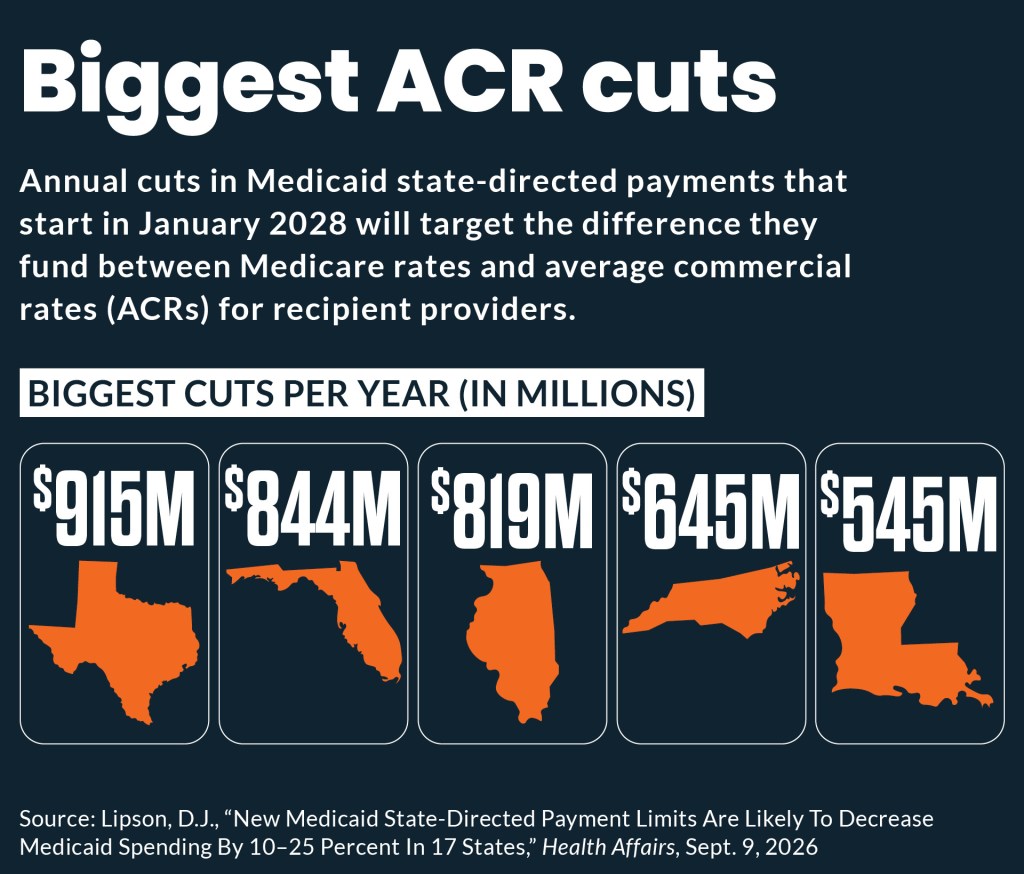
Federal cuts in state-directed payments (SDPs) will begin with an $8.7 billion cut in January 2028, according to a new study.
The research, which was published Sept. 9 in the journal Health Affairs, examined the impact on state finances of federal SDP cuts included in the One Big Beautiful Bill Act (OBBBA).
The cut in 2028 SDP funding would come from the start of OBBBA provisions requiring 10% reductions in the share of Medicaid rates that are more than Medicare rates. Thirty-nine states use SDP funds to boost Medicaid payment rates higher than Medicare rates. The study estimated that annual SDPs spending to boost provider pay to at or near the average commercial rate (ACR) was $86.8 billion.
“State cuts to provider reimbursement levels will likely increase uncompensated care costs and Medicaid shortfalls — the difference between Medicaid payments and the cost of caring for Medicaid patients — causing financial strain,” wrote Debra Lipson, MHSA, the author and a former senior fellow at Mathematica Policy Research. “In response, providers receiving lower Medicaid revenue might try to limit the number of Medicaid patients served, diminishing access to care.”
Overall, the Congressional Budget Office (CBO) projected the OBBBA provision targeting SDP payment rates will decrease federal Medicaid spending by $149.4 billion from 2025 to 2034. However, a proposed rule issued in May to implement the provision, was projected by the agency to reduce federal Medicaid spending by $360.7 billion more than CBO’s original estimate.
Even with the aggressive limits to SDPs, HHS projects spending on them will increase from $111 billion in 2026 to $208 billion in 2034, instead of $318 billion without OBBBA.
The author noted that required cuts “could be many times more than this study’s estimates” because it was conducted before CMS issued the SDP proposed rule, which would add new restrictions on SDPs.
HFMA previously identified key considerations hospitals and health systems can use to evaluate SDP program revenue for each step under OBBBA.
State divergence
Wide variations in the size of the reduction will occur among states based on how high their ACRs were, how high they set their Medicaid rates using SDPs and how many providers were receiving the boost.
The study’s estimated $8.7 billion annual cut in SDPs that would start in 2028 is only 1% of total FY24 Medicaid spending across all affected states. However, the cut is more than 2.5% of total Medicaid spending in nine states. Those requiring the largest cuts in their total Medicaid spending were Nebraska (3.85%), Louisiana (3.22%) and South Carolina (2.71%).
The authors noted that the required cuts could increase from relatively small shares of total state Medicaid budgets if states don’t renew previous SDPs with the higher rates or if CMS does not grant state SDPs temporary grandfathered status, which allows them to spread the reductions over time.
If either happens, then the SDP cuts would increase to between 10% and 25% of Medicaid budget among 17 states because the cuts would occur in one year instead of phasing in over multiple years.
The study also noted the average commercial rate–to-Medicare ratio for each state that uses SDPs to boost their Medicaid rates to at or near ACRs. In 2022, those ranged from less than 185% in Mississippi to more than 335% in Florida and West Virginia. The national average commercial rate–to-Medicare ratio was 254%.
Beyond ACR-related cuts
Other provisions of OBBBA were expected to add to the SDP cuts identified in the study.
SDP cuts will increase due to the law’s limits on provider taxes, including a requirement that Medicaid expansion states begin ratcheting down provider taxes in October 2027, from the maximum threshold of 6% of net patient revenue to 3.5% by FY32.
The Congressional Budget Office estimated that all OBBBA provider tax provisions will cut federal Medicaid spending by $191.1 billion over 10 years.
“Because about a third of SDP arrangements that pay above Medicare rates are financed with provider taxes, this will impose further reductions in states’ SDP spending,” Lipson wrote.
Eighteen Medicaid expansion states tax hospitals above 3.5% of net patient revenues, with seven above 5.5%.
Four of the states with the highest provider taxes (Arizona, Michigan, Rhode Island and Virginia) also pay providers more than Medicare rates.
Those combined elements will result in “compounding the fiscal challenge in these states and requiring more severe cuts to their Medicaid programs and to provider reimbursement rates,” Lipson wrote.
Lipson said understanding the effects of the SDP cuts will require tracking several developments:
- State Medicaid budget actions
- Changes to provider payment and tax policies
- Beneficiaries’ access to care
- Providers’ Medicaid revenue and uncompensated care
- Providers’ responses to SDP reductions
