


CMMI head: WISeR should serve as model
Hospital advocates previously urged delaying the launch of the model to address outstanding concerns.

A new, controversial Medicare prior authorization (PA) pilot should serve as a model for use in other areas of federal healthcare programs, said the leader of federal healthcare innovation.
Abe Sutton, director of the Center for Medicare and Medicaid Innovation, acknowledged provider pushback on the Wasteful and Inappropriate Service Reduction (WISeR) model, which launched early this year. But he said the targeted nature of the model in areas vulnerable to waste could serve as a template for future initiatives.
“This is actually something that should serve as a model for other lines of business in how to approach authorization for services in a way that is rapid — within 72 hours [which is the required time frame for responses to PA requests] — in a way that is based off of clinical evidence [and] in a way that has the right incentive structure in place,” Sutton said. Sutton addressed WISeR during a Sept. 3 webinar hosted by Paragon Health Institute.
Provider pushback on WISeR led to a failed congressional push this year to revoke the model. After a House panel voted unanimously to cut off funding the model, the Senate in July narrowly voted to preserve it.
Before WISeR launched, the American Hospital Association raised a range of concerns about it and urged CMS to delay its launch.
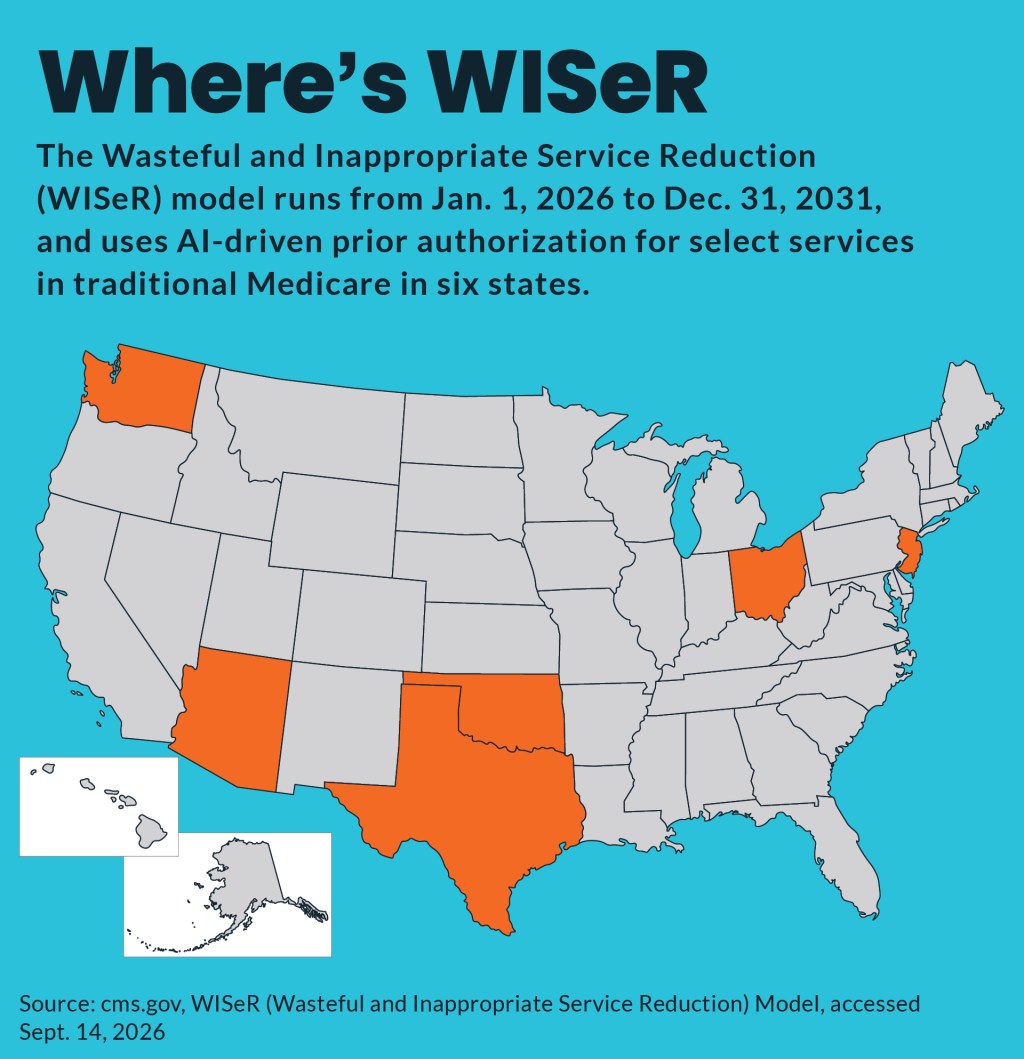
Sutton said CMMI has engaged with both physician groups and members of Congress over concerns about the program. The pilot uses AI-assisted PA to review select services in traditional Medicare in six states to reduce waste and low-value care.
“My hope is that we have been able to reassure folks that this has been, one, well-designed and that the team in the center that thought of this went after targeted clinical areas that really stand to benefit from this,” Sutton said. “And also, that we are going to closely monitor it and learn from its lessons before we look to expand.”
Sutton said CMMI plans to release in the last quarter of this year an “early snapshot of how it’s rolling out” based on data from the first six months of the program.
“My hope is seeing that data will give the public the certainty [it] needs to trust that this has been thoughtfully designed for the benefit of beneficiaries and in line with our statutory mission,” Sutton said.
One group sued the federal government under the Freedom of Information Act and obtained documents it says that showed “WISeR has resulted in widespread delays and denials of care, operational chaos and reports of patient harm.”
MA focus
Sutton said his office increasingly is looking to focus its efforts on the Medicare Advantage (MA) sector because of its size and growth.
“We’ve been explicit that we’ve gone to a world where a majority of enrollees are not in the original Medicare program; they’re in [MA],” Sutton said. “And having thoughtful reforms in place to help address some of the issues there, advance the ball and move the system in a free-market direction makes sense. So you could expect to see action from us in that space.”
Sutton also highlighted what he described as the greater affordability of MA.
“There’s a lot that is good in Medicare Advantage, and I think that too often in conversations like this, that is overlooked — like just looking to the affordability measure, which I think is a good measure to have of a program,” Sutton said.
To support the greater enrollee affordability provided by MA plans, Sutton cited a 2023 Employee Benefit Research Institute study. It found that couples using an MA plan will need to have saved $184,000 to have a 90% chance of covering their health care expenditures in retirement. In comparison, couples enrolled in a Medigap plan with average premiums will need to have saved $318,000 to have a 90 % chance of covering their medical expenditures in retirement.
He also pushed back on MA critics, who say that a private version of Medicare greatly increases spending over the traditional program.
A previous CMS analysis found a 1.5% to 2.0% of “uncorrected” coding in MA relative to original Medicare in 2022 after accounting for statutorily mandated payment adjustments and changes to the MA risk-adjustment model.
“When you’re in a 2% margin range, that’s pretty close,” Sutton said. “So there’s a lot that is good in Medicare Advantage, though it is worth looking at reforms in that space, given how much of the program is now really MA and not original Medicare.
Critics, like the Medicare Payment Advisory Commission, estimate that upcoding will produce a 4% increase this year relative to original Medicare.
Hospitals also have increasingly raised concerns about the aggressive use of administrative restrictions in MA, which has led a growing number to terminate MA contracts.
Mandatory defense
Sutton also defended the use of mandatory models, which also have drawn criticism from hospitals.
“There are folks who have a viewpoint of ‘We shouldn’t do any mandatory.’ I’m like ‘Well, mandatory is a tool.’ If you want this to run on a mandatory basis in perpetuity when certified, then you have to run it in a mandatory basis to do the test,” Sutton said.
Hospitals are girding for the national rollout of the mandatory Comprehensive Care for Joint Replacement Expanded Model (CJR-X) on Jan. 1, 2028. Hospitals in certain regions also were required to participate in the Transforming Episode Accountability Model (TEAM), which launched Jan. 1, 2026.
He cited previous analysis by the Congressional Budget Office that concluded voluntary models attract participants who “anticipate favorable financial outcomes for themselves.”
Specifically, for CJR-X, Sutton said its precursor model already provided Medicare with more than $100 million in savings, so it is “a good payment structure change to have made.”
