


Fast Finance
Uncompensated care improvement uneven
Uncompensated care is surging at hospitals in the Great Plains and the South.

Published
6 hours ago
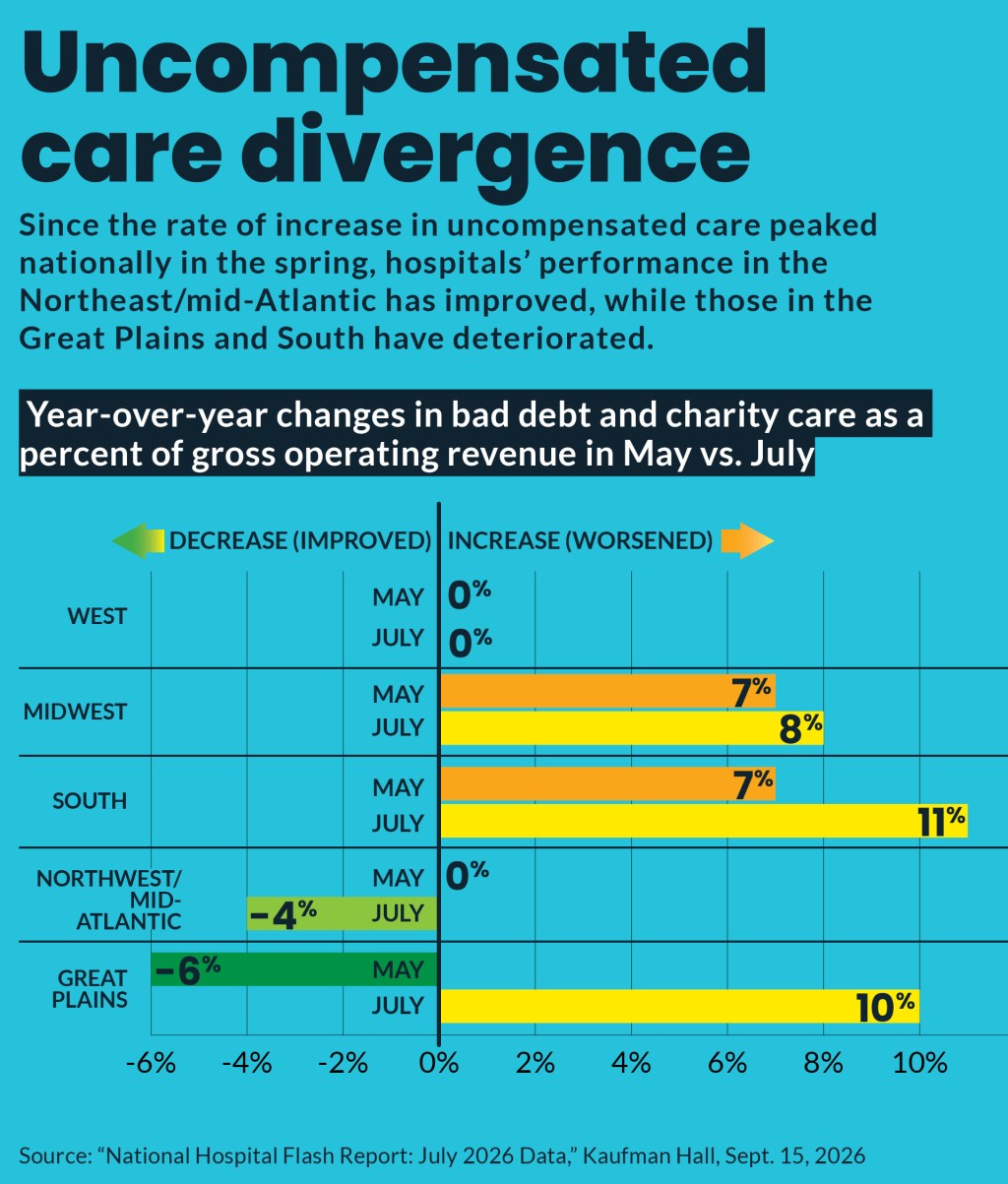
Uncompensated care costs at hospitals have improved somewhat since their spring peak but the national trend wasn’t seen in all regions.
Hospitals had smaller year-over year (YoY) increases in their bad debt and charity care as a percentage of gross operating revenue. Those decreased from a 7% jump in May to a 5% increase in July, according to the latest Kaufman Hall Hospital Flash Report. The finding is based on Strata Decision Technology data for more than 1,300 hospitals.
Bad debt and charity care per day also ticked down from a 16% YoY increase in May to a 14% YoY increase in July.
Regional variation
Regional YoY variations in the bad debt and charity care as a percentage of gross operating revenue since the spring included improvement in the Northeast/mid-Atlantic and deterioration in the Great Plains and South.
May versus July regional variations in that metric included:
- West: 0% vs. 0%
- Midwest: 7% vs. 8%
- South 7% vs. 11%
- Northeast/mid-Atlantic: 0% vs. -4%
- Great Plains: 6% vs. 10%
Changes in the metric by hospital bed size were limited among smaller hospitals but were significant among some larger ones. The YoY changes in May versus those in July for bad debt and charity care as a percentage of gross operating revenue included:
- 0-25 beds: -3.4% vs. -3.7%
- 26-99: 8.6% vs. 7.6%
- 100-199: 14.8% vs. 8.2%
- 200-299: 6.6% vs. 0.8%
- 300-499: 0.2% vs. 16.9%
- 500+10.8%: vs. 6.1%
The small improvements in overall uncompensated care costs came amid an overall deterioration in hospitals’ margins, according to the report. Median operating margins fell to 1.4% in July, which was the lowest since February but flat YoY.
Regional YoY changes in median operating margins included:
- West: 5%
- Midwest: 4%
- South: -14%
- Northeast/Mid-Atlantic: 1%
- Great Plains: -12%
Uncompensated care priorities
Amid the ongoing uncompensated care and operating margin challenges, the leading front-end revenue cycle priorities include a push to bolster front-end screening for Medicaid eligibility, increase up-front collections and preparation for Medicaid work requirements, according to Dan Clark, a managing director at Forvis Mazars.
“Organizations are now taking a hard look at all of their front-end policies, financial assistance policies and converting [self-pay] patients to Medicaid,” Clark said in an interview. “The screening methodology [for Medicaid conversion] matters.”
They aim for conversion rates of 30% to 40% in Medicaid expansions states, while non-expansion states have lower targets.
More hospitals also are doing post-care follow-up of Medicaid patients they helped in the program when they were patients to ensure that they submit subsequently required information to continue their enrollment.
Additionally, more hospitals aim to boost front-end collections.
“There seems to be a lot of movement behind requesting payment ahead of service,” Clark said.
One way they are doing that is by hiring patient financing vendors who can offer longer-term loans for medical debt and retain a share of the payments in exchange for relieving hospitals of those collection costs.
“I believe that we can certainly prove out that they are doing a better job up front, particularly in the balance after insurance [metric] [and] will lift overall margin associated with balance after insurance and patient liability,” he said.
One challenge is the large number of patients who “fall into a gray area” between Medicaid eligibility and eligibility for financial assistance.
Work requirement challenge
Hospitals also are looking to avoid large losses of Medicaid patients, due to work requirements that start in 2027 under the One Big Beautiful Bill Act (OBBBA). If they lose enough Medicaid patients, it would end their eligibility for Disproportionate Share Hospital payments and 340B revenue.
“Really maximizing your potential there to preserve those regulatory [revenue] sources is very, very important,” Clark said.
Hospitals have started to hire care managers and social workers to identify patients who will be subject to work requirements, contact them and work with them to ensure that they meet the requirements and maintain coverage.
“There’s a lot more rigor around those processes that is very important,” he said.
“We find organizations, in their treatment of charity care and bad debt, really vary quite a bit.
Individual policies at hospitals can produce uncompensated care costs either much higher or lower than industry benchmarks.
