


Fast Finance
Trump administration affordability push features SDP cuts
Finance leaders should know what's on the menu if the administration doubles down on SDP cuts as part of its affordability drive.

Published
6 hours ago
Voters are demanding action to improve healthcare affordability ahead of the midterm elections. The Trump administration sees an aggressive push on state-directed payments (SDPs) as a way to respond to that demand.
This year, healthcare affordability and availability were the most important issues to Americans for the first time since 2020, according to Gallup polling.
Polls rarely ask whether respondents want policymakers to prioritize healthcare coverage or affordability. One poll this year showed that the top healthcare issue respondents wanted Congress to prioritize was lowering healthcare costs (39%), while only 12% wanted legislators to prioritize increasing insurance coverage.
The Trump administration and members of Congress have responded by increasingly highlighting how their favored policies could improve healthcare affordability.
Democrats have focused largely on expanding enrollment in Medicaid and renewing COVID-era subsidies for ACA marketplace enrollees.
Republicans have flagged policies driving a recent reduction in prescription drug prices, increasing rural healthcare funding and enforcing fraud and corruption.
“Making healthcare affordable is so fundamental to who we are as Americans,” Mehmet Oz, MD, administrator of CMS, said Sept. 9 in comments posted from the GOP midterm convention.
But a lower-profile policy push also was identified recently by administration officials as an affordability tool: clamping down on SDPs.
SDP affordability role
Coming changes to SDPs and provider taxes will address affordability by driving down healthcare prices outside of Medicaid, according to an August HHS report. It was authored by senior administration officials, including Casey Mulligan, the administration’s healthcare affordability czar.
Those changes will come through provisions of the One Big Beautiful Bill Act (OBBBA, also known as the Working Families and Tax Cut Act [WFTC]), which was projected to provide 10-year federal savings of:
- $149 billion from restricting SDPs
- $191 billion from reduced provider taxes
The federal savings expected from just the SDP provisions ballooned to $510 billion, according to CMS actuaries, based on the administration’s approach in the proposed rule, issued in May, to implement that part of the law.
The recent HHS report concluded that the two provisions will now provide $891 billion in 10-year federal and state savings.
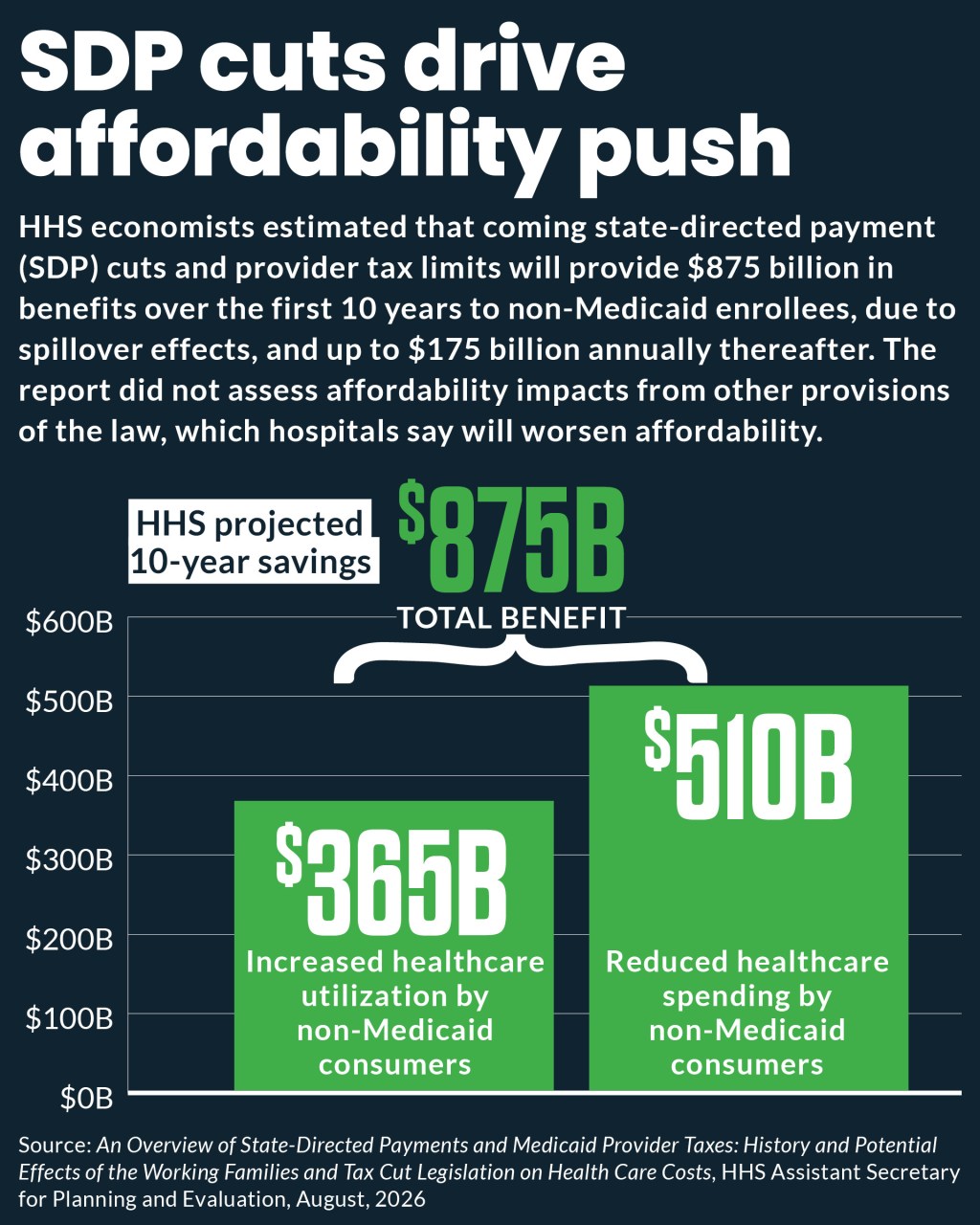
The report also estimated that the two provisions will provide up to $875 billion in benefit for non-Medicaid consumers over 10 years and $100 billion to $175 billion annually thereafter. The benefits were expected from $510 billion in reduced prices and $365 billion worth of increased access to care for non-Medicaid enrollees.
Those lower prices would come from the end of SDP funding for Medicaid provider rates at or near average commercial rates (ACR), which OBBBA phases out, stated the report. Linking Medicaid rates to ACRs incentivizes providers to push up commercial rates, which increases costs for commercial enrollees. Additionally, providers need to pass along the costs of their provider taxes to commercial plans, which also adds to the costs paid by commercial enrollees.
“This significant reduction in government health expenditures will come with reduced prices and increased health care utilization for nearly 280 million Americans (82% of the population), highlighting the value of this policy change,” the report stated.
That’s an argument that backers of OBBBA/WFTC, including its supporters in Congress, have echoed.
“This isn’t just savings for taxpayers; [HHS] projects the changes to provider taxes and state-directed payments under the WFTC could lead to reduced premiums in commercial insurance markets, making employer-sponsored insurance and marketplace coverage more affordable for Americans than they would have been without the WFTC,” health policy leaders in the House of Representatives said in a joint statement.
Affordability pushback
The HHS report did not examine the affordability impacts of other Medicaid provisions, such as the creation of work requirements (known as community engagement). Hospital advocates said the projected losses of Medicaid coverage and increases in uninsurance will worsen affordability for those patients.
Some healthcare analysis has warned that the SDP and provider tax provisions are likely to increase costs for commercially insured patients. That’s because those provisions will reduce revenue from Medicaid patients and leave providers with severe underpayments, which will require hospitals to cost shift through increased charges to commercial plans.
The HHS report authors countered that due to market supply and demand for healthcare services based on prices or compensation rates, “cost shift does not occur on aggregate.”
Hospitals also have challenged the SDP proposed rule’s approach because it will produce cuts more than 300% larger than projected by the Congressional Budget Office (CBO) when the law was enacted.
For instance, the Kentucky Hospital Association (KHA) stated in comments to CMS that the $510 billion in cuts in the SDP rule was “a remarkable escalation from the changes to SDPs Congress authorized.”
“Resource reductions of this magnitude could lead to service losses and hospital closures, which would impact everyone in our community, not just those individuals who are served by the Medicaid program,” KHA warned.
A recent analysis by the Paragon Health Institute, a think tank closely aligned with the Trump administration, concluded that the larger SDP cut in the proposed rule was driven by the underlying spending and not a desire to further clamp down on SDPs.
Paragon wrote that the higher cut stemmed from CBO significantly underestimating the federal cost of SDPs when OBBBA was passed. The newer HHS report included 2025 SDP spending, which was much higher than CBO projected. That higher baseline reset the 10-year growth in SDP spending and the amount subject to OBBBA cuts, according to the think tank.
Further SDP cuts?
If the Trump administration wanted to increase SDP cuts further as part of its affordability agenda, Paragon identified ways it could do so. Those included:
- Accelerating the phased reduction in SDP limits
- Scrutinizing intergovernmental transfers and banning higher payments for publicly owned providers
- Evaluating providers’ total Medicaid reimbursement, not individual payment streams
- Reserving the authority to reopen, modify or terminate previously approved SDPs
