


Fast Finance
Medicaid tax rule goes beyond the statute, say hospitals
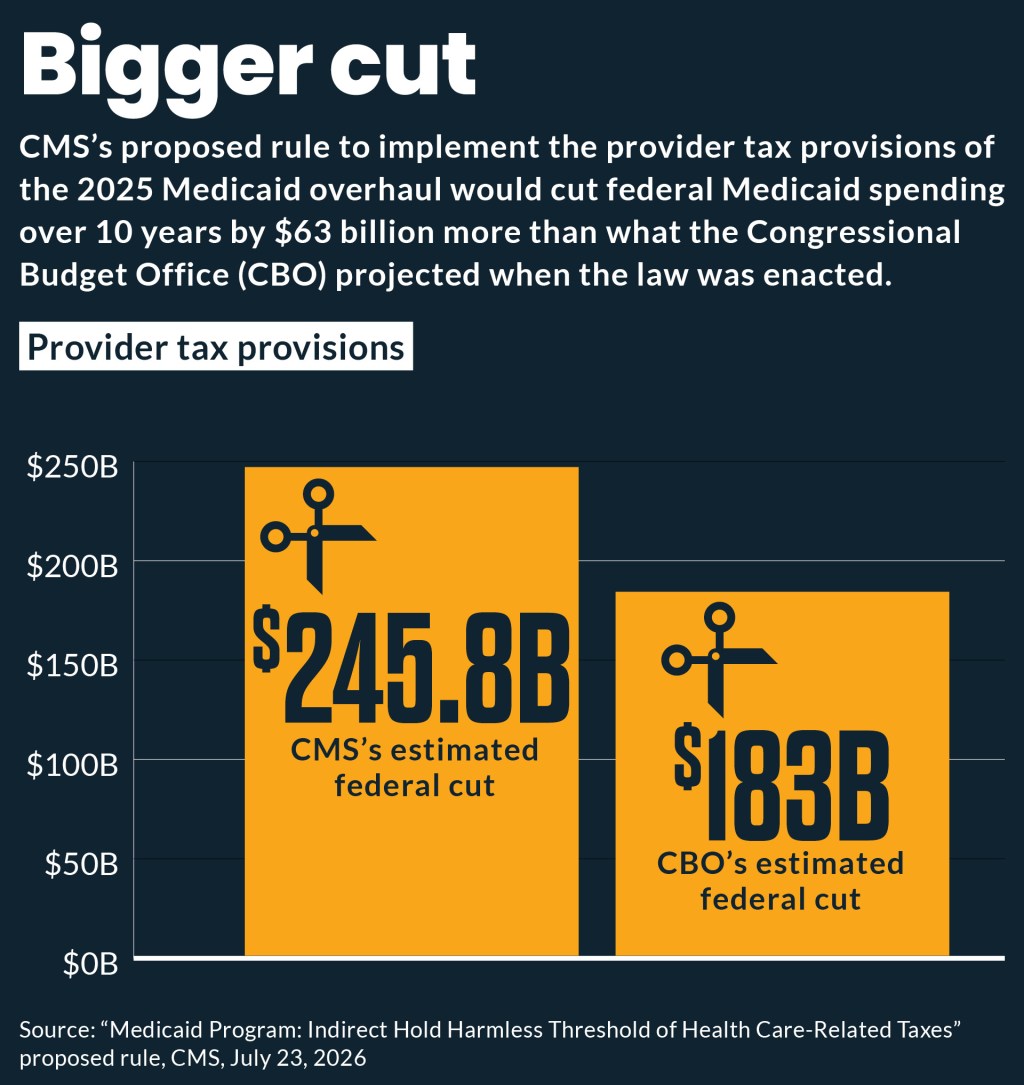
CMS projected federal savings of about $246 billion from the proposed rule. That would exceed the $183 billion in savings projected from those provisions when the law was enacted.

Published
4 hours ago
A proposed rule to implement provider tax provisions of the 2025 Medicaid overhaul would be far more restrictive than that law required, say hospital advocates.
Hospitals raised those concerns in responses to a July 21 proposed rule, which is part of the One Big Beautiful Bill Act (OBBBA), also called the Working Families Tax Cut Act (WFTC).
Among provisions implemented by the proposed rule were details on its freeze and reductions in hold harmless threshold. That is the maximum percentage of net patient revenue that states can collect from healthcare provider taxes without triggering federal penalties or federal matching fund cuts. The law freezes those percentages where they were when the law was enacted on July 4, 2025, and then requires annual reductions in Medicaid expansion states to 3.5% by federal FY32.
“We are concerned, however, with several key elements of this proposal that go far beyond the WFTC legislation,” Danne J. Howard, president and CEO of the Alabama Hospital Association, wrote in comments on the proposed rule. “If finalized as proposed, these provisions would create significant instability in Alabama Medicaid financing and could potentially result in a funding crisis that would impact every citizen.”
Jolene Calla, a vice president of the Hospital and Healthsystem Association of Pennsylvania (HAP), noted CMS projected federal savings of about $246 billion from the proposed rule. That would exceed the $183 billion in savings projected from those provisions when the law was enacted.
“This significant increase reflects the broader restrictions and requirements included in the proposed rule and raises concerns that CMS is exceeding the scope and intent of the underlying legislation,” Calla wrote.
Hospitals criticized the rule for implementing the new tax rate cap by creating what the Louisiana Hospital Association called a “sweeping new regulatory regime” around initial reporting, interim tax limit thresholds, final thresholds, remediation procedures and enforcement timelines.
Overall concerns
The American Hospital Association (AHA) stated that it was particularly concerned about the rule’s proposed retrospective reconciliation of actual tax collections and net patient revenue. That approach “will create significant unpredictability for state Medicaid programs, as well as unnecessary and costly administrative burden for states, providers and the agency,” wrote the AHA.
Changes to the rule sought by the AHA included:
- Preserving the prospective, estimate-based approach for ongoing compliance monitoring and limiting the retrospective actual-data requirement to the one-time threshold calculation mandated by statute
- Delaying the Dec. 31, 2026, interim reporting deadline to allow CMS to deliberate on comments, finalize the rule and issue the detailed guidance necessary for accurate and complete data submission
- Reversing its sunset of the 75/75 test because doing so exceeds CMS’s statutory authority
- Allowing states flexibility to align the administrative calendar year used as the basis for the threshold calculation with other state administrative calendars
Calls to delay provisions of the law have precedent, including CMS’s past decision not to enforce a No Surprises Act requirement for providers to issue good faith estimates for uninsured and self-pay patients, said Chad Mulvany, a director for Forvis Mazars.
“I don’t think though that CMS is going to provide that much leeway in this instance, just given that … this is an issue that some at CMS are very interested in pursuing,” Mulvany said.
Backwards cut
A provision that concerned many hospital advocates was the rule’s implication that it would invalidate the entire provider tax for a given provider class if the provider taxes collected exceeded its applicable threshold.
“These types of results are unfair, unintended and were not contemplated by the WFTC or CMS’s existing rules on this matter,” Howard wrote.
Meanwhile, the proposed rule did not address any options states have if they don’t collect all their approved provider taxes, Mulvany said.
SDP impact
The provider tax rule also will directly impact state-directed payments, said Mulvany.
Overall, CMS projected the proposed rule, combined with other OBBBA rules, would reduce future SDPs by $774.8 billion over 10 years, of which 55% to 75% is financed through provider taxes, noted the National Rural Health Association (NRHA).
“You kind of have [to ask], ‘Is there a point where provider tax collections are even below what the OBBBA reductions in SDP levels are?’, meaning that there aren’t provider taxes there to support the SDPs, even at a lower level,” he said.
Hospital advocates also said that if states cannot backfill the lost hospital taxes with state general revenue, hospitals could see a substantial decrease in payment rates.
“The premise that states can simply substitute other financing sources does not reflect the reality in many states, particularly those with constrained general fund capacity,” wrote NRHA officials.
Compounding effect
The provider tax proposed rule is the third major Medicaid financing regulation issued this year. In January, a final rule tightened provider tax structures under pre-OBBBA requirements, while a May proposed rule implemented OBBBA provisions focused on SDPs.
Many hospitals and their advocates urged CMS to step back and consider the rules’ combined overall effects.
“These three rules are not independent,” leaders of the Greater New York Hospital Association wrote to CMS. “A hospital experiences these three regulatory changes as one compounding reduction, and a state designing a compliant financing structure must satisfy all three simultaneously.”
The pile on of regulatory changes have overwhelmed many hospitals, and they increasingly must hire outside consultants to keep them abreast of the changes, Susan Feigin Harris, co-head of healthcare for Norton Rose Fulbright, said in an interview.
“There’s not a recognition of the workforce and the support needed to comply with all of this and keep up with it, and the providers are doing it all with consultants like us and others and their trade associations,” Feigin Harris said in an interview. “At the end of the day, it means that all of these institutions are not going to receive payments — reimbursements that they were counting on or that they predicted.”
Paperwork burden
The proposed rule would require quarterly revenue reporting, which means that states must obtain quarterly data from hospitals. The AHA urged CMS to instead obtain those data from Medicare cost reports to minimize the burden on hospitals.
Although the administrative burdens in the proposed rule are secondary to direct financial losses it outlines, those can add up, said Mulvany.
“The [compliance] burden impact shouldn’t be underappreciated, given everything else that’s going on, and there aren’t a lot of dollars running around to support additional administrative work,” he said.
