


Cost Effectiveness of Health
No surprise that the No Surprises Act is driving medical inflation

Published
11 hours ago
Healthcare inflation has come roaring back. PwC projects that commercial medical costs will increase 9% in 2027, the highest rate in 17 years.a For a family with a $25,000 annual health insurance premium, 9% inflation adds $2,250 in just one year. Compounding does the rest.
At that rate, the cost of health insurance will double in eight years.
PwC identifies five principal forces driving this medical inflation:
- AI-enabled revenue optimization
- Provider reimbursement pressure
- Rising pharmacy spending
- Escalating behavioral health utilization
- No Surprises Act’s arbitration process
The first four are familiar. But the fifth is a stunner. PwC now calls the No Surprises Act’s arbitration process a “reimbursement inflator.” Healthcare’s convoluted economics once again defy gravity by transforming a desired benefit into a value-depleting revenue opportunity.
The No Surprises Act became law with strong bipartisan support. It addressed genuine abuse. Without their knowledge or consent, patients would receive treatment from out-of-network providers who charged outrageous prices for their services. For many unsuspecting patients, these “surprise medical bills” became untenable financial burdens.
After prolonged debate, intense lobbying and legislative tinkering, Congress passed the No Surprises Act on Dec. 21, 2020, during a lame-duck session. President Trump signed the bill into law six days later. The new law’s provisions took effect on Jan. 1, 2022.
Contrary to expectations, the new law did not eliminate the costs of “surprise” out-of-network billing. Just the opposite. Through its independent dispute resolution (IDR) process, the legislation’s mechanics redirected those costs into a new and very expensive baseball-style arbitration system. Patients no longer receive surprise bills directly. Instead, they pay the costs of out-of-network billing indirectly through higher health insurance premiums, reduced wages and rising healthcare costs.
Congress solved the surprise-billing problem and created a medical-inflation problem. Healthcare Inc. played inside baseball and won big. The rest of American society is paying the price.
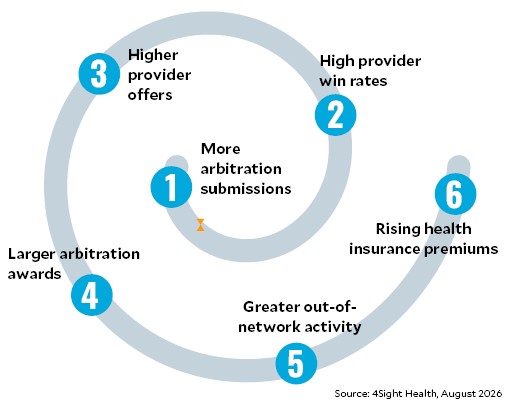
The No Surprises Act’s inflationary spiral
Patient protection with price gouging
The political battle over surprise billing was never about whether patients deserved protection. Nearly everyone agreed they did. The real fight was over payment mechanics. Insurers favored a benchmark tied to median in-network rates. Provider organizations favored arbitration, which offered the possibility of higher payments. Under pressure, Congress adopted a convoluted compromise containing both concepts.
Under the law, patients pay only their applicable share of an in-network bill. Insurers make initial payments to providers. If the parties cannot agree on final payment terms during a 30-day negotiation period, either payers or providers can initiate arbitration to resolve the dispute. In reality, providers and facilities file almost all the claims.b Physicians, other care providers and/or their representatives initiate 80% of total provider-filed claims.
Each side submits a final payment offer to an approved arbitrator, who selects one of the two offers. Similar to baseball arbitration, the arbitrator cannot split the difference or determine an independent price.
The law directs arbitrators to consider the qualifying payment amount, generally the insurer’s median in-network rate. It also allows them to consider other information. Federal regulators initially tried to make the qualifying payment amount the system’s center of gravity. Provider groups successfully challenged those rules in court. Arbitrators gained discretion. Providers saw opportunity.
The Congressional Budget Office (CBO) expected arbitration awards to cluster around median in-network prices. CBO projected that the law would reduce commercial insurance premiums by 0.5% to 1%. Its forecast assumed eliminating surprise bills would reduce the negotiating leverage of hospital-based specialists.
Talk about a swing and miss. Rather than reducing medical costs, arbitration has turbocharged providers’ negotiating leverage and ignited medical inflation.
Applying rationality to healthcare’s irrational economics
In theory, baseball-style arbitration encourages moderation. Since an arbitrator must select one of two offers, each party risks losing by submitting an unreasonable proposal. Applying logical economic theory to healthcare is dangerous because the industry operates outside of traditional supply-demand dynamics. Contrary to Congress’s intent, the resolution of surprise medical bills is fraught with unintended negative consequences.
According to PwC, providers prevailed in 88% of the 2.6 million disputes filed in 2025. Several large, experienced physician organizations and arbitration representatives won more than 90% of their cases. When providers win nine out of 10 times, moderation disappears. The number of provider-initiated claims and their proposed settlement offers has skyrocketed.
A July analysis of federal data by the Niskanen Center found that the median winning offer from providers in 2025 was four times the qualifying payment amount.c It rose to five times that benchmark in the fourth quarter. The Wall Street Journal estimates that arbitration payments totaled $14.85 billion in 2025, more than triple 2024’s $4.08 billion.d
Contrary to its intended purpose, surprise-billing arbitration has institutionalized medical inflation. High win rates encourage higher offers. Higher awards encourage more filings. Growing volume creates economies of scale for organizations that learn how to work the system. Favorable awards give providers a profitable alternative to joining insurer networks. That strengthens their ability to demand higher in-network rates. Round and round it goes. Costs go only one way: Up.
A new healthcare arbitration industry
The volume of surprise-billing arbitration is breathtaking. The federal government expected the IDR process to receive about 17,000 cases annually. Providers filed more than 2.5 million disputes in 2025 — almost 150 times the original estimate. By May 31, 2026, cumulative filings had exceeded 6.3 million.e Disputes continue to grow by several hundred thousand per month. That isn’t a rounding error. It is an epic policy miscalculation.
This explosive growth has created a new arbitration economy. Specialized companies identify eligible claims, assemble submissions and file disputes by the thousands. A small group of provider organizations generates a disproportionate share of cases. A mechanism for resolving payment disagreements has morphed into an industrialized revenue strategy that shows no signs of slowing.
Arbitrators receive payment for each dispute they adjudicate. Those payments totaled $1.2 billion in 2025. Three economists highlighted the problem with this volume-driven payment model in a January 2024 Brookings report.f Noting that arbitrators seek to process cases economically while remaining acceptable to parties selecting them, they conclude that “there is no reason to expect these incentives to lead arbitrators to make the ‘right’ decisions.”
Surprise-billing arbitration has become the economic equivalent of digging holes and filling them back up with rocks. It creates activity divorced from value creation. Perverse incentives rule. Productivity declines. Healthcare becomes an even bigger drag on the overall economy.
Defective solutions have consequences
The No Surprises Act increases the systemic costs of out-of-network billing. Arbitration awards, filing expenses, legal costs and higher negotiated rates flow into and increase commercial health insurance premiums. In turn, rising health premiums suppress wage growth and make access to necessary healthcare services even more unaffordable for far too many Americans.
Healthcare’s financial surprises have moved from higher medical bills for some patients to higher renewal payments for all those with commercial health insurance. Imposing surprise bills on unsuspecting patients is unconscionable. Imposing a jury-rigged solution that institutionalizes Healthcare Inc.’s profiteering is equally unconscionable.
The larger lesson is familiar. U.S. healthcare loves complex intermediaries, opaque prices and third-party payment. Each new layer creates another revenue pool for insiders to harvest. Every party participating in surprise-billing arbitration benefits except for the purchasers and consumers who fund its ever-growing cost.
The No Surprises Act protected patients from an indefensible business practice. Good intentions, however, are no substitute for sound policy design. Congress eliminated surprise bills. It did not eliminate their costs. It hid them in plain sight.
Footnotes
a. Hunzinger, G., et al., “Medical cost trend is expected to hit 9%, highest in 17 years. Can cost management strategies bend the trend?” PwC, June 11, 2026.
b. Hoadley, J., et al., “The No Surprises Act IDR process: An early look at 2025 data,” Georgetown University Center on Health Insurance Reforms, March 30, 2026.
c. Mansell, L. and Gallamore, C.R., “New data, same problem: No Surprises Act arbitration abuse persists,” Niskanen Center, July 30, 2026.
d. Mathews, A.W.Q., and McGinty, T., “Medical billing arbitration paid out $15 billion to providers in surprise bill disputes,” The Wall Street Journal, July 22, 2026.
e. CMS.gov, “Independent dispute resolution reports,” page last modified Aug. 21, 2026.
f. Ippolito, B., Fielder, M., and Adler, L., Assessing Early Experience with Arbitration under the No Surprises Act, Brookings, Jan. 16, 2024.
