



Colorado hospitals see decline in ED utilization, a rare trend amid national surge
Halting ED volume increases came despite huge surge in charity care at hospitals.

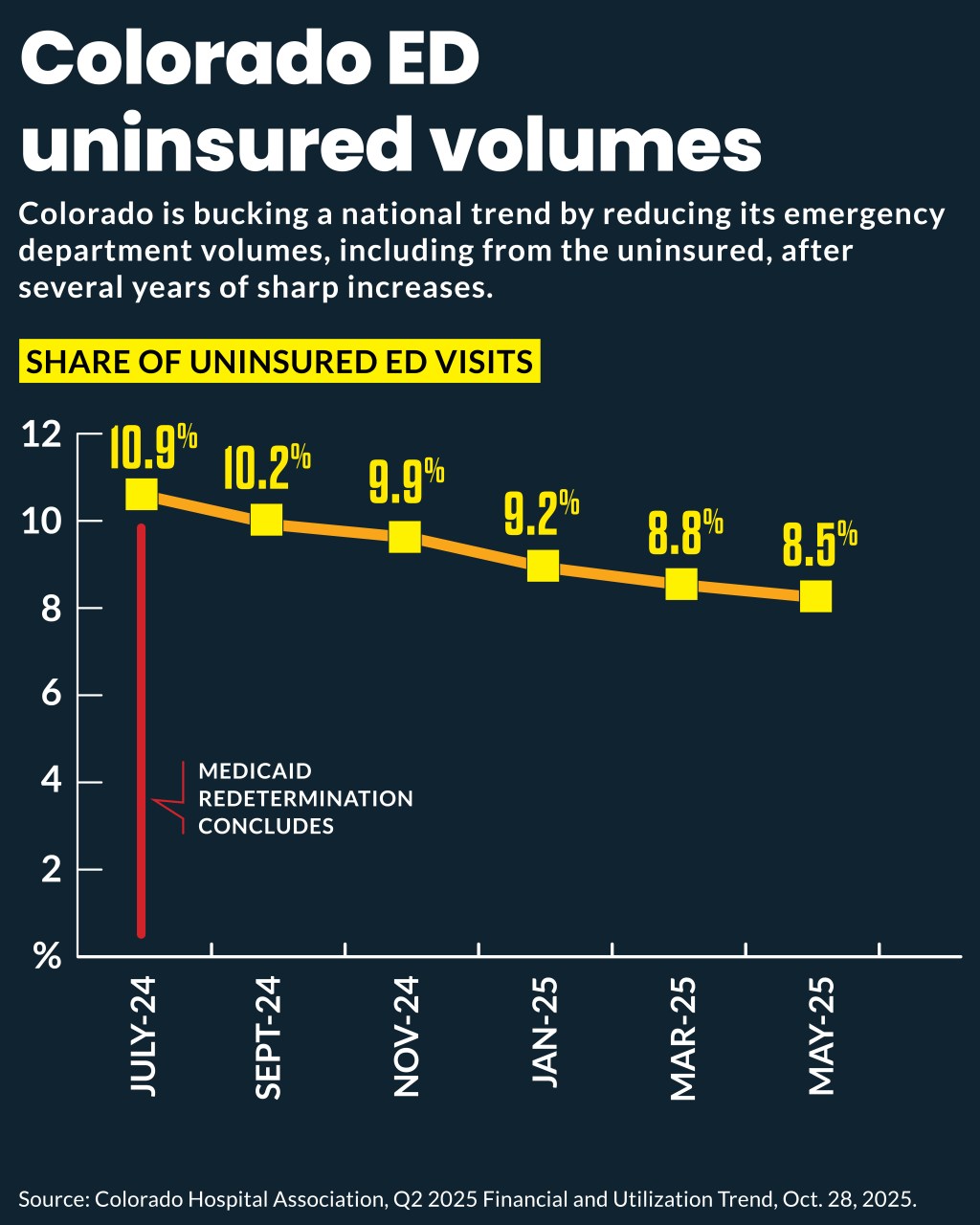
Emergency department utilization has shot up since the pandemic nationally but one state has been able to dial it back.
Colorado hospitals saw their ED volumes decrease in 2024 — their first reduction since 2020. ED volumes increased 31% from 2020 to 2023 before decreasing 1% in 2024. New data indicate that volume cut was helped by steadily decreasing ED visits by the uninsured since the middle of 2024.
Tom Rennell, a senior vice president for the Colorado Hospital Association (CHA), credited the decrease in uninsured visits, specifically, to Medicaid redeterminations ending mid-2024 and the ability of some residents who lost coverage to regain either Medicaid or other state coverage. For example, the state offers a disability buy-in program and the Kaiser Permanente Colorado Bridge Program for residents under 30 who earn less than 300% of the federal poverty level.
Colorado’s Medicaid and CHIP enrollment increased 3% from July 2024 to July 2025 to total 1,194,665 enrollees, according to CMS data.
In recent years, Colorado hospitals have seen “soaring charity care trends,” Rennell said. Charity care costs increased 81% from 2021 to 2025, according to a recent CHA report.
Rennell said the surge stemmed from challenges the state had in its Medicaid redetermination process, which saw many enrollees dropped, and effect of Colorado’s hospital discounted care program, which took effect in September 2022 and defined which patients qualify for charity care.
“Colorado also experienced a fairly sizable increase in migrant growth in early 2024 and that shot some of our trends up,” Rennell said.
Amid a historic surge in undocumented immigrants during the Biden administration, Colorado expanded health coverage to immigrants, including undocumented immigrants, through two programs. Now the Trump administration is investigating Colorado Medicaid spending on undocumented immigrants, according to local reporting.
National ED trend
Nationwide, ED visits per calendar day are 6% higher this year than they were year-to-date in 2022 and 2% higher year over year compared to 2024, according to the latest Kaufman Hall hospital flash report, which uses data from Strata Decision Technology. Erik Swanson, managing director for Kaufman Hall, said he expected further increases in demand for EDs amid coverage uncertainties.
Hospitals now face a “dual bottleneck,” according to a post from Vizient-Kaufman Hall.
“Critically ill patients wait too long for inpatient beds, while low-acuity patients — who often lack access to primary or urgent care — flood the ED for conditions that could be addressed elsewhere.”
Sg2, a healthcare consulting firm recently found adult ED visits have increased over the last three years, although the increases slowed 6% to 4% year-over-year by mid-2025. Emergent cases increased to 65% of all ED visits from mid-2024 to mid-2025.
“While urgent visits have stabilized, continued efforts to redirect low-acuity patients to alternative care sites remain essential to improving ED throughput and preserving capacity for higher-acuity cases,” said the Sg2 report.
The firm projects ED volumes will increase 5% over the coming decade “largely driven by rising clinical acuity and barriers to timely care access.”
Coming pressure
Colorado hospitals have faced growing pressure since the pandemic from inflationary costs and the state’s policies, Rennell said. And now they expect revenue losses from Medicaid due to provisions of the One Big Beautiful Bill Act (OBBBA), which will ramp up in 2028.
“Going into these scenarios where cuts are coming, we are planning for the whole continuum of what hospitals may have to be choosing,” Rennell said.
Recently one behavioral health hospital in the state closed and other hospitals have dropped obstetrics service lines last year and this year.
“A real rationalizing of what services can financially be sustained for their communities is going to happen,” Rennell said.
To account for that expected lost revenue, hospitals are looking at both expense cuts and revenue increases, such as commercial rate increases when they can get them.
“We’re not in a great place where we got a lot of cushion or margin to sustain some of the big challenges ahead of us and it has all of us incredibly concerned,” Rennell said.
State-directed payments
The OBBBA Medicaid cuts are concentrated in federal funding provided through state-directed payments (SDPs) and the use of provider taxes that fund SDPs. That has led hospitals to press the state to increase efficiency in its Medicaid program and its SDPs.
“In Colorado our Medicaid expansion costs have been running at incredibly high trend and as a result of that it’s put pressure on the provider fee program and crowded out supplemental payment side of that to hospitals,” said Rennell. “So, ‘Is there a way to rebalance that program such that we’re still paying for Medicaid expansion, but those costs are better rationalized?’ That allows the provider side of Medicaid to be a little bit more sustainable.”
Colorado is still waiting to hear from CMS on a new SDP it submitted before OBBBA’s July 1 cut-off, after which lower rates will be required. That law will require rates in existing SDPs to start ratcheting down provider rates that they fund from commercial rates to Medicare rates, starting in 2028.
OBBBA also will ratchet down the amount of provider taxes states can use to fund the state-share of SDP costs. CHA projects just the reduction in allowed provider taxes to cost Colorado hospitals $10.4 billion in federal funds from 2028 to 2032.
