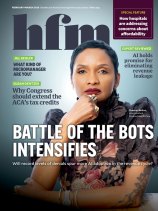



HFMA’s Consumerism Maturity Model provides an opportunity for healthcare organizations to assess their consumer readiness
Provider organizations can assess and improve their consumerism readiness using HFMA’s Consumerism Maturity Model.
The new hfm is (re)designed to help you get what you need faster and easier
A new, next-level design makes hfm easier to read and more useful than ever.
Health plan-owned PCP clinics steer members to lower-cost sites-of-service
Hospitals and health systems need to be able to deliver high-quality outcomes in a cost-efficient manner to ensure they are not implicitly tiered out of a health plan's network.
Not-for-profit hospital status coming under increasing scrutiny
Despite tax-exempt hospitals providing $95 billion in total benefits to their communities in 2016 alone, it's anticipated that hospitals' tax-exempt status will see additional scrutiny.
The 5 keys leaders need to transform their organization’s culture
More than simply updating office decorations or rewriting a mission statement, transforming a company's culture requires addressing deep-seated assumptions.
HFMA gathering aims to arm CFOs for coming challenges
Inaugural HFMA Financial Sustainability Summit, April 16-17 in Denver, will bring together more than 200 hospital and physician practice CFOs to learn and share strategies.
HFMA and CareCredit conduct survey on consumer-centric strategies being used to drive patient-centric healthcare
Consumerism emerged as a top concern among healthcare executives in a survey conducted jointly by HFMA and CareCredit.
St. Luke’s Health System decides to allow carefully monitored, specific-payer access to its EHR after buy-in from all internal stakeholders
Idaho-based St. Luke’s Health System is allowing payers to access patient records directly through their EHR.
Don’t allow risk aversion to get in the way of innovation
Failure to act can be failure to innovate.
Advice from a hacker: How to safeguard medical devices from cyberattacks
The vulnerability of many medical devices to cyberattacks presents a serious safety concern for hospitals and health systems.