


Healthcare Finance Leadership
10 ways health systems can reduce risk when investing in innovation
Health systems face difficult choices on where to invest limited capital amid an abundance of options. Key to success: a decision-making process that is disciplined and strategic.

Published
March 27, 2026
2:30 pm
|
Updated
May 27, 2026
9:01 am
Michele Cusack, executive vice president and CFO at Northwell Health, was at a crossroads. She had to choose between two potential innovation investments, both of which clearly aligned with the system’s strategy and were backed by strong internal champions.

One provided a more traditional opportunity to reinvest in core clinical infrastructure with a clear, near-term payback. The other would involve building a new business to parlay the system’s virtual emergency care capability into an entirely new market: aviation.
Cusack chose the latter, with the hope that investing in a start-up to support flight crews in managing in-flight medical emergencies would ultimately yield a greater ROI.
“It was not an easy decision,” Cusack recalled. “However, our experience has taught us that to generate the meaningful returns that ultimately support and enable our mission, we need to be willing at times to choose opportunities that stretch us beyond our traditional comfort zone.”
Cusack’s bet paid off. The company, MD Onboard, launched in September 2025, and she says it continues to gain traction with commercial airline and private aviation partners. In just over 12 months, MD Onboard secured contracts with several sizeable carriers and operators, and the company expects to announce new partnerships and milestones publicly in the coming quarter.
Northwell’s experience underscores what is perhaps the most fundamental challenge for health systems that are just beginning to develop an innovation investment strategy: deciding how to balance limited resources with a tremendous array of opportunities.
Omosede Ogiamien, a partner at Deloitte, suggested that making big innovation bets in an era of persistent uncertainty in healthcare is the biggest challenge CFOs and other innovation strategists face.
“This cripples a lot of leaders,” she said. “They think, ‘If I put all of my eggs in one basket, what happens if the other idea ends up being better?’”
Or worse yet, what happens if a trusted innovation partner goes under?
Developing a disciplined innovation framework
There is no escaping the risks involved in committing to innovation initiatives. But there are ways to mitigate them. Organizations that approach the process deliberately and include the following steps, where possible, will improve their prospects for long-term success.a
1 Build a dedicated investment arm. Northwell Health exemplifies this approach. In his role as president and CEO of Northwell Holdings, the corporate venture and investment arm of Northwell Health, Richard Mulry has overseen various innovation projects at the health system. In the past five years, these efforts include the creation of health technology companies focused on:

- AI-enabled retinal imaging technology that uses noninvasive photos of the eye to rapidly screen for early signs of ophthalmic and systemic disease
- Use of AI on real‑world evidence to unlock clinical insights and advance patient care, leveraging one of the largest federated medical imaging data platforms
- Workflow automation using an agentic AI framework
- Patient digital navigation enabled by a modular AI platform
Mulry said he believes having a separate investment arm is key to success.
“While Holdings sits inside Northwell and is tightly aligned with the system’s needs, it is built to source opportunities, partner with outside investors and scale businesses that drive margin,” he said.
2 Consider a partnership approach. Northwell Holdings didn’t build these companies alone. Rather, it partnered with a health tech venture capital firm (Aegis Ventures) to perform a broad internal needs assessment across clinical and business units. The assessment sought input from operators, clinicians and service line leaders on operational inefficiencies, unmet clinical needs and market gaps that directly impacted patient care, staff productivity and financial performance. These efforts generated business ideas that Mulry knew would be beneficial to pursue.
The partnership allowed Northwell to focus on generating ideas and building and testing models, while the venture studio provided the initial infrastructure, recruited the management team and initiated fundraising.
3 Look for opportunities to build companies from the ground up. Often, health systems are presented with solutions that don’t adequately address the problems they face. In these instances, building from within could offer a faster path to innovation with better ownership economics, Mulry said.
“We knew that if we took the time and effort to build a company, we could generate value in the short term for the health system via internal ROI and would eventually share in a financial return on exit when the company was acquired,” Mulry said.
He noted that when health systems create their own companies, there’s typically a four- to six-year cycle from launch to acquisition.
Through investment in the new company, we create a dual value stream: measurable operating ROI for our clinical enterprise and attractive return on invested capital as the business scales externally,” he said.
4 Use AI to perform first-pass reviews of potential investment opportunities. Northwell Holdings receives more than 2,000 pitches annually from innovation companies and invests in only a small fraction of opportunities. The sheer volume of pitches prompted it to build its own AI tool to automate the first-pass review and quickly assess strategic fit.
Mulry cautioned, however, that measuring ROI in AI-native solutions can be complex because operational efficiency does not always translate directly to cost savings — and because in their current form, these solutions rely on powerful and expensive AI models to function. Moreover, he said, legacy systems may limit analytics and be incapable of tracking or analyzing AI performance effectively.
5 Establish internal work groups to guide investment decisions. When it comes to making critical decisions about where to deploy limited capital, having a partnership between finance leaders and the investment team is critical, Cusack said.

“The finance team must be a strategic partner with the investment and operations teams when taking a solution from concept to commercialization, ensuring the investments are fiscally responsible and scalable,” she said.
Lindsay Mersereau, senior expert at McKinsey & Company, agreed.
“Collaboration between CFOs and chief innovation officers, chief transformation officers and chief AI officers is critical,” she said. “Their decisions are so closely integrated. They need to be in lockstep to identify the near- and far-term strategic bets they want to place so they can evaluate them holistically.”
6 Be intentional in vetting options for investment. Melinda Hancock, CFO at Sentara Health, said the array of available innovative solutions combined with competing capital constraints continually inspires the health system to be more intentional and less opportunistic about investments in innovation.
“We’ve changed the way we vet the opportunities, how we monitor [performance] and how we participate to ensure where we’re investing and aligning is fully in support of our strategy, with our consumer being our North Star,” she said.
Recently, Sentara Health invested in strategic AI partnerships centered on virtual nursing, a patient self-service platform and an integrated virtual care management platform. The healthsystem also deployed copilots to pioneer innovative approaches to whole-person care.

Sentara maintains a dedicated annual investment allocation for innovation. To instill discipline in innovation investment, the health system also established a venture and innovation office, led by a chief venture officer who established a scoring rubric to evaluate investment opportunities.
This work is further supported by a cross-functional executive committee, real-time performance monitoring and a formal governance structure.
With this framework in place, Sentara Health is exploring agentic AI solutions, revenue cycle automation, care model support partnerships and clinical predictive analytics.
“This discipline has been very helpful,” Hancock said. “My biggest piece of advice is to centralize a common intake process. This helped us streamline what we want, how we structure and how we prioritize.”
Health systems also need a thorough process for vetting which investments make the cut. Deloitte’s Ogiamien said health systems are beginning to assess proposed initiatives from the standpoint of how well they position the organization to survive worst-case scenarios and to achieve measurable outcomes.

7 Set clear priorities. Prioritizing innovation efforts can be challenging, but this work is necessary to create value, said Sanjiv Baxi, partner at McKinsey & Company.
“The biggest mistake organizations make is that they perform countless pilots and try to drive small, incremental value across many areas,” he said. “What happens is that they fragment and get bandwidth constraints. The most successful organizations have been those that go back to their foundational mission and let that guide their decisions. They define a clear end state and work backward strategically, concentrating on one domain at a time.”
8 Ensure that innovation-focused efforts have adequate governance. Ogiamien said organizations should create a formal governance structure around innovation to ensure they can:
- Create a transparent capital allocation framework that clearly defines which investments are funded at the corporate level versus the local level
- Determine the ROI
- Easily pause, pivot or abandon underperforming investments, especially as technology advances rapidly
- Ensure there is ongoing performance monitoring, especially for projects with a long-term ROI
- Establish clearly defined decision rights, particularly during periods of mergers and acquisitions
- Pinpoint guardrails for innovation spending
- Identify and mitigate barriers to success
“Making sure organizations have a mechanism to hold their leaders accountable is absolutely critical,” Ogiamien added.

9 Be mindful of the pace of change. Experts agree that one of the biggest challenges for health systems investing in innovation is keeping up with how fast technologies are changing.
“We’ve seen private equity-backed firms go up and down very quickly,” said Timothy Kinney, leader of the health segment payer/provider practice at Guidehouse. “These are firms with smart people that see the problem they’re solving and then a year later, the solution becomes obsolete or an EHR puts it into their technology.”
His advice? Find value-aligned firms, partners and thought leaders who are committed to continual evolution.
10 Foster a larger culture of innovation. Sometimes the most innovative ideas with the greatest potential for ROI might not even be on a CFO’s radar, McKinsey’s Mersereau said. It’s one reason empowering team members to share their ideas for innovation as well as their top pain points is so important.
“It’s about encouraging teams and creating forums to problem solve and think through how to improve daily operations,” she said. “These are the small building blocks that can bubble up to strategy. Cultivate ideas from the end users.”
The larger goal
Why do health systems invest in innovation to begin with? This question lies at the heart of every investment a health system makes. And the answer is typically that it comes down to mission.
Mulry summed up the role of innovation this way: “Sustainable innovation requires the same rigor we bring to every financial decision — discipline, alignment and accountability. By looking for operational impact and long-term return, we’re not just investing in companies. We’re investing in the future of care and the ability to deliver on our mission.”
Footnote
a. The points listed here are intended as a guide, with the understanding that each organization’s circumstances will dictate the feasibility of adopting them all.
Key questions to consider when investing in innovation
1 Does the investment address an unmet need internally, within the larger healthcare marketplace, or both?
2 Does it align with the organization’s mission and strategy? Does it support the impact we’re trying to create in our community?
3 Can the organization demonstrate meaningful results? When will we expect to see ROI, and what specific metrics will we monitor?
4 Does our culture support the solution? What values and beliefs, if any, must we change to enable adoption
and ROI?
Note: The questions are distilled from the collective comments by industry experts interviewed for this article.
The big buckets: Where today’s healthcare innovation dollars are flowing
As healthcare CFOs strive to achieve sustainable growth in 2026 and beyond, many are exploring initiatives that blur the boundaries between healthcare and other industries. Sixty-three percent of surveyed executives expect strategic partnerships and joint ventures to become a higher priority in 2026, including with partners from other industries, according to Deloitte’s 2026 U.S. health care outlook report.a
Where are the top areas of focus, given that capital constraints force hospitals to think more critically about what to prioritize and when to start? It’s not just about joint ventures and strategic partnerships. The most common areas for exploration include new tech solutions, virtual care models and data infrastructure. Here are perspectives from three industry experts.
Lindsay Mersereau, senior expert at McKinsey & Company, said CFOs have increasingly focused on revenue cycle optimization as a foundational element of their larger innovation strategy.
“Revenue cycle can actually be an accelerant to improve near-term margins and capacity so you can then unlock opportunities that are long-term plays,” she said.
A report by McKinsey found that generative and agentic AI is another prominent area for investment, noting that 85% of healthcare organizations are pursuing initiatives involving gen AI or have already implemented solutions.b Among those implementing gen AI, 61% intend to partner with third-party vendors to develop customized solutions.
Where health systems are focusing their investment dollars
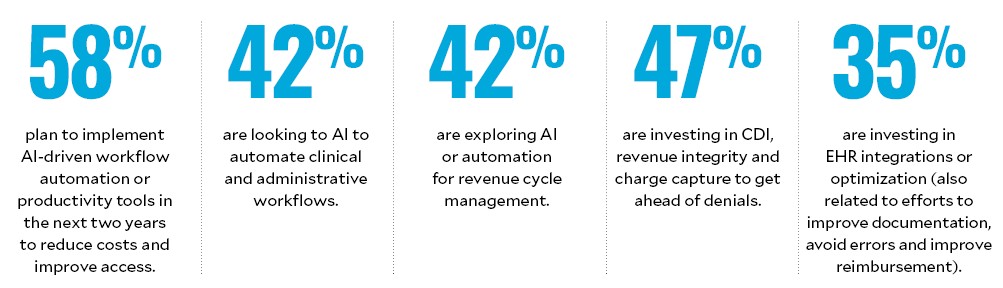
Timothy Kinney, leader of the health segment payer/provider practice at Guidehouse, said organizations focused purely on financial sustainability are tending to invest in AI, automation and managed services solutions that can help them reduce costs and get paid faster and in full.
“That includes automated financial clearance, clinical documentation improvement, revenue cycle automation and AI solutions.” he said.
Omosede Ogiamien, partner at Deloitte, said hospitals are also increasingly investing in virtual nursing, workforce management and ambulatory care site optimization.
Footnotes
a. Janisch, A., Gerhardt, W., and Shukla, M., 2026 US health care outlook, Deloitte Center for Health Solutions, Dec. 11, 2025.
b. Patel, N., and Singhal, S., “What to expect in US healthcare in 2026 and beyond,” McKinsey & Company, Jan. 12, 2026.
