


Healthcare Finance Technology

Automated payment reconciliation emerges as critical gap in healthcare revenue cycle

Published
March 31, 2026
2:19 pm
Sponsored by Wells Fargo & Company
Despite strong integration and automation across patient care and general financial systems, healthcare providers still face a significant blind spot in banking integration — one that continues to cost time and money. According to a Wells Fargo survey conducted by HFMA, fully automated reconciliation remains out of reach for many organizations.
The survey, conducted in September 2025, focused on reconciliation practices, pain points and strategic opportunities for improvement. It also highlighted the reconciliation challenges organizations of varying sizes face, including staffing hurdles at small organizations and data inconsistency within mid-sized and large entities.
The survey recorded responses from 241 healthcare executives or directors from hospitals (51%), health systems (38%) and medical groups (11%). While automation has advanced in areas like accounting, operations, finance and patient financial services (PFS), revenue cycle processes continue to lag, with over 41% of healthcare organizations still relying primarily on manual workflows.
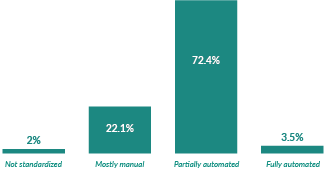
Digging deeper, 72% of respondents shared that their payment reconciliation processes are only partially automated, while more than 22% still rely on mostly manual workflows for reconciliation. Just 3.5% of respondents reported that their reconciliation processes were completely automated. This demonstrates a significant gap and a major opportunity for transformation, according to Tyler Siegfreid, CRCR, MHA, executive director of healthcare product management for Wells Fargo.
“What I found most surprising from the survey is how little integration these organizations have with their banks,” Siegfreid said. “This is a missed opportunity to experience bottom line value.”
Reconciliation processes mostly characterized by partial automation
How would you describe your organization’s current reconciliation process across the revenue cycle?
Integration is critical among EHR, ERP and banking systems
Overall, 77% of healthcare organizations represented in the survey report at least partial three-way reconciliation among electronic health records (EHRs), enterprise resource planning (ERP) and banking systems, which can reduce manual processes and errors while improving overall operations. While ERPs support a wide range of functions, the general ledger (GL) remains the core financial record, underscoring the need for tighter alignment between these systems.
The level of integration depends on an organization’s size, with 23.5% of the largest healthcare organizations reporting full integration, compared with just 3% of those with less than $500 million revenue. However, across participants, partial or full integration hovers around 70% for accounting, revenue cycle administration/operations and revenue integrity. Higher levels of integration are seen in finance (77.3%) and PFS (86.8%).
Not surprisingly, respondents from organizations of all sizes point to the EHR as being the most critical technology to their reconciliation efforts. They also believe that seamless three-way integration (EHR, ERP and banking systems) should be a priority, with 46.5% expressing that sentiment, ranking above end-to-end automation of reconciliation workflows (26.4%), advanced analytics and real-time dashboards (14.6%) and staff training/process standardization (10.4%). Results were consistent across financial processes and organization size.
Payment posting and reconciliation to an EHR represents the largest reconciliation challenge, cited by 44.4% of survey respondents. It was also the top challenge across finance departments and by organization size, defined by net patient revenue. Other challenges mentioned include bank matching and treasury controls (14%), ERP reconciliation (12.9%) and patient payment collections (15.8%).
A standardized Bank Administration Institute (BAI) file from a financial institution can reduce manual processes by sending data directly to an ERP or GL system.
“Obviously, revenue cycle and finance are the main departments dealing with this, but so are PFS, clinical departments and non-patient services teams — everything from the cafeteria and gift shop to the parking garage,” Siegfreid said. “Cash management is incredibly complex, but there are ways to make it easier and reduce frustration for financial teams, such as by eliminating the use of spreadsheets and the need to manually key in data through automated bank data file integration.”
Reconciliation pain points and workarounds
When asked about their biggest reconciliation pain point, over one-third of respondents noted data inconsistencies across systems and vendors. Staffing limitations and the cost of dedicated reconciliation teams followed at 31.4%, with lack of real-time visibility close behind at 20%. This is one area where organization size made a difference, with 40% of the smallest companies pointing to staffing issues as their primary pain point, while the largest organizations struggled most with data inconsistency.
Staffing issues at smaller organizations play a role in how reconciliation errors occur, with nearly 36% reporting issues with manual data entry and postings. In contrast, larger organizations unanimously pointed to complex contracts and varying reimbursement rules as the top reason for errors. And when it comes to resolving discrepancies, providers with under $10 billion in revenue primarily use manual adjustments, while the largest providers rely on vendor platforms or third-party reconciliation solutions.
“Regardless of whether a provider is a three-physician clinic or a 200-bed hospital, they have to do the same financial activities, but with a different level of revenue, technology and staff to do it,” Siegfreid said. “There is a misperception that small organizations will not greatly benefit from reconciliation. However, we see organizations of all sizes experiencing efficiency gains they couldn’t have forecasted. In other words, automating reconciliation opens the door to increased efficiency and reduced cost for healthcare organizations of all sizes.”
Despite hiccups, confidence in financial data is strong
Reconciliation errors reverberate throughout organizations and can impact financial operations and strategic decision-making. However, only 10% of companies say those impacts are significant, with 43% indicating only occasional impact and the rest reporting rare or minimal impact on operations.
Likewise, confidence is high across organizations in their ability to maintain accurate and timely reconciliation across systems. Nearly nine out of 10 respondents expressed moderate or high confidence in their reconciliation processes. The largest organizations were 100% confident, while organizations in the other revenue tiers reported 85% confidence.
“There is a lot of opportunity for more automation and integration in healthcare from a reconciliation and revenue cycle perspective,” Siegfreid said. “The survey underscores the importance of the EHR to this process, but it also points to the need for tight integration with financial institutions to provide a record of truth that can reduce errors and improve reconciliation efforts.”
Conclusion
Organizations of all sizes are actively working to improve processes through increased automation, but each market segment has its own challenges. Smaller providers struggle with staffing and resource challenges that perpetuate manual data entry and reconciliation, while larger organizations note data discrepancies and integration gaps among technologies. The largest providers are in the best shape to strengthen reconciliation, technology-wise, but integration challenges still prevent full automation.
About Wells Fargo & Company
Wells Fargo & Company (NYSE: WFC) is a leading financial services company that has approximately $2.1 trillion in assets. We provide a diversified set of banking, investment and mortgage products and services, as well as consumer and commercial finance, through our four reportable operating segments: Consumer Banking and Lending, Commercial Banking, Corporate and Investment Banking, and Wealth & Investment Management. Wells Fargo ranked No. 33 on Fortune’s 2025 rankings of America’s largest corporations. News, insights, and perspectives from Wells Fargo are also available at stories.wf.com. Additional information may be found at wellsfargo.com.
This published piece is provided solely for informational purposes. HFMA does not endorse the published material or warrant or guarantee its accuracy. The statements and opinions by participants are those of the participants and not those of HFMA. References to commercial manufacturers, vendors, products, or services that may appear do not constitute endorsements by HFMA.
