


Healthcare Revenue Cycle

The KPIs that define revenue cycle excellence
A practical guide to understanding HFMA MAP Keys and how leading organizations are using them to benchmark, improve and win.

Published
April 10, 2026
3:48 pm
|
Updated
April 13, 2026
2:24 pm
Sponsored by CareCloud
Today’s revenue cycle leaders are operating in one of the most demanding financial environments in healthcare history. Shrinking reimbursements, rising denial rates and operational complexities have made it clear that gut instinct and basic reporting are no longer enough. Most organizations believe they understand their revenue cycle performance. Many are measuring it differently, making true comparisons and improvement nearly impossible. To drive meaningful improvement, organizations need a shared language, a consistent, objective framework for measuring what a high performer looks like.
That framework exists. It’s called the HFMA MAP Keys.
The industry standard for revenue cycle performance
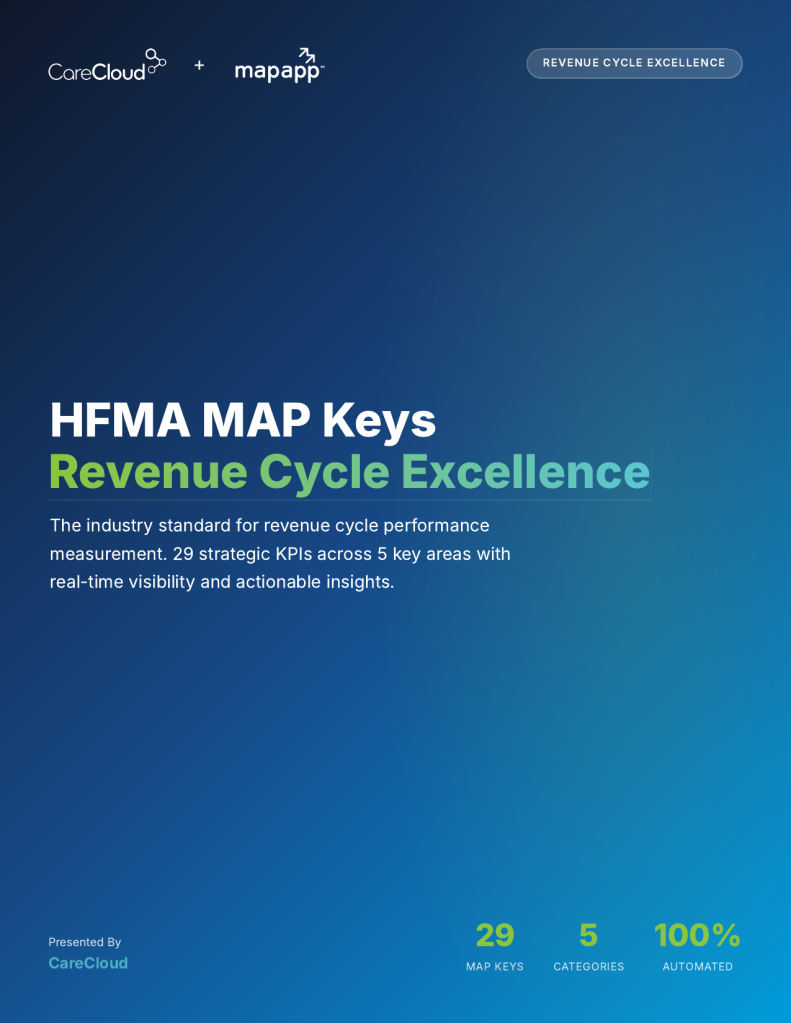
Developed by HFMA and used across hospitals, health systems, ambulatory providers, physician organizations and post-acute care settings, the MAP Keys are 29 strategic KPIs organized across five critical domains:
- Patient access
- Pre-billing
- Claims
- Account resolution
- Financial management.
They represent the most widely recognized standard for revenue cycle benchmarking in healthcare, providing a clear, consistent and unbiased view of performance regardless of the systems or technology an organization uses.
For revenue cycle leaders, the MAP Keys are a step toward answering the questions that matter most: Are they collecting what we should at the point of service? How long are claims sitting unbilled after discharge? How does cost-to-collect compare to peer organizations? These aren’t just metrics; they are operational indicators with direct ties to cash flow, financial health and organizational sustainability.
From measurement to meaningful action
What makes the MAP Keys particularly powerful is their specificity. Each KPI comes with a standardized equation, defined data sources and precise points of clarification that eliminate any ambiguity. Knowing the MAP Keys is only the starting point. The real challenge is operationalizing them consistently and comparing performance against meaningful benchmarks. This is where solutions like MAP App come into play. Automated data collection eliminates manual reporting burdens. Dashboards surface trends before they become problems.
Whether evaluating pre-registration rates (MAP Key PA-2), monitoring days in total discharged not final billed (PB-1) or tracking your remittance denial rate (AR-5), the MAP Keys give every stakeholder a common baseline for evaluating performance and prioritizing improvement. And peer benchmarking through MAP App provides organizational performance in some context, not just against internal historical data but against the broader market.
A resource built for revenue cycle leaders
For organizations looking to build or sharpen their benchmarking strategy, understanding the MAP Keys in depth is the essential first step. That means knowing not just what each KPI measures, but why it matters, what drives it, what to include and exclude in your calculations and where the data lives in your systems.
The complete HFMA MAP Keys guide, developed in collaboration with CareCloud, helps organizations turn standardized metrics into actionable performance insights. It’s a practical reference built for revenue cycle professionals who are serious about performance measurement and want a reliable foundation for benchmarking conversations across their organization.
Whether launching a new benchmarking initiative, preparing a strategic planning cycle or simply looking to ensure the team is aligned on how key metrics are defined and calculated, this guide is designed to help set the standard for revenue cycle excellence in the healthcare industry.
Download the complete MAP Keys guide
Get the full breakdown of all 29 MAP Keys, including definitions, equations and data requirements, and start benchmarking RCM with confidence.
