


Healthcare Finance Technology

How to protect revenue in a digital-first ecosystem

Published
May 12, 2026
9:00 am
Sponsored by Solventum
As the hospital of the future evolves into a more digitally enabled, connected ecosystem, revenue cycle operations must evolve in parallel. HFMA’s reporting points to a “digital-first, patient-centric ecosystem” that extends beyond hospital walls and leans on predictive, proactive insights. In that world, the revenue cycle can’t be built primarily around downstream correction. It must become a continuous discipline of prevention, validation and learning embedded across the care continuum before issues surface as avoidable financial risk.
A practical starting point is to treat data integrity as a financial control, not an IT project. Automation and AI can reduce administrative burden, but only when the underlying data are trustworthy. Otherwise, organizations scale rework instead of eliminating it. This is especially true in areas where small upstream gaps produce outsized downstream consequences: medical necessity signals, authorization requirements, documentation completeness and denials.
HFMA survey findings highlight both the speed of technological change and the affordability imperative reshaping healthcare. For finance leaders, that means building an operating model where revenue integrity is proactive and measurable, grounded in clear ownership and closed-loop feedback. Instead of asking teams to chase denials after the fact, organizations can use patterns to identify root causes and hardwire fixes into workflows, so issues are prevented before they become revenue leakage.
This requires governance as much as technology. HFMA emphasizes that leaders need to understand what AI can do and what it can’t before scaling tools because trust is difficult to earn and easy to lose. A lightweight, repeatable approach is to:
- Define the decision points where prediction or automation is truly helpful
- Establish performance metrics tied to financial and operational outcomes
- Embed human review where risk is highest
- Continually retrain people and processes based on results
As hospital priorities shift toward AI strategies and revenue cycle transformation, the winners will be those who connect the dots by aligning data, workflows, accountability and technology so revenue protection becomes part of everyday care delivery not an after-action cleanup effort.
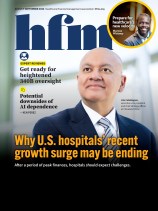
Learn more about how success depends on technology and strong governance, measurable accountability and continuous learning that align financial operations with patient care delivery in HFMA’s The Hospital of the Future Part I report.
