


Fast Finance
Providers not seeing prior authorization improvement
Payers are pushing providers to switch to electronic submissions to cut response times.

Published
June 1, 2026
4:21 pm
Amid promises from health plans that they have dialed back their use of prior authorization, hospitals and health systems are not seeing any reduction in their use, say advisers.
In April, health plans announced that they eliminated 11% of prior authorizations (PAs) across a range of medical services, representing 6.5 million fewer PAs for patients. Additionally, plans reported cutting more than 15% of PAs in Medicare Advantage (MA), where PA has drawn growing provider concerns.
That accomplishment stemmed from a voluntary pledge in June 2025 by nearly 50 health insurance companies to reduce prior authorization requirements, standardize processes and expedite response times. The pledging payer companies were led by the Blue Cross Blue Shield Association and AHIP, a national insurance company trade group.
“Health plans have taken important initial steps to support patients and are working toward the shared goal of delivering answers at the point of care whenever possible — a goal that will require both plans and providers to eliminate manual processes and adopt real-time electronic data sharing,” said Mike Tuffin, president and CEO of AHIP.
Not seeing it
But hospitals and health systems are not seeing any prior authorization reduction — especially in MA, say industry advisers.
“No, and quite the opposite, there’s still significant administrative burden in the MA space,” Mike Ruiz, senior director of financial transformation advisory services at Premier, said in an interview regarding PA reductions.
Shawn Stack, director of healthcare reimbursement consulting for Forvis Mazars, said in an interview that he has heard some MA plans claim improvements in PA.
“But keep in mind, MA is still heavily managed by prior authorization,” Stack said. “That’s the whole utilization management piece of MA. So, it is still significant.”
Stack said some plans have stated that they are doing away with PA on certain services but are increasing them on other services.
“Pull up the hood and really take a look at what that all-inclusive list of prior authorization requirements [is] for MA and managed care,” he said.
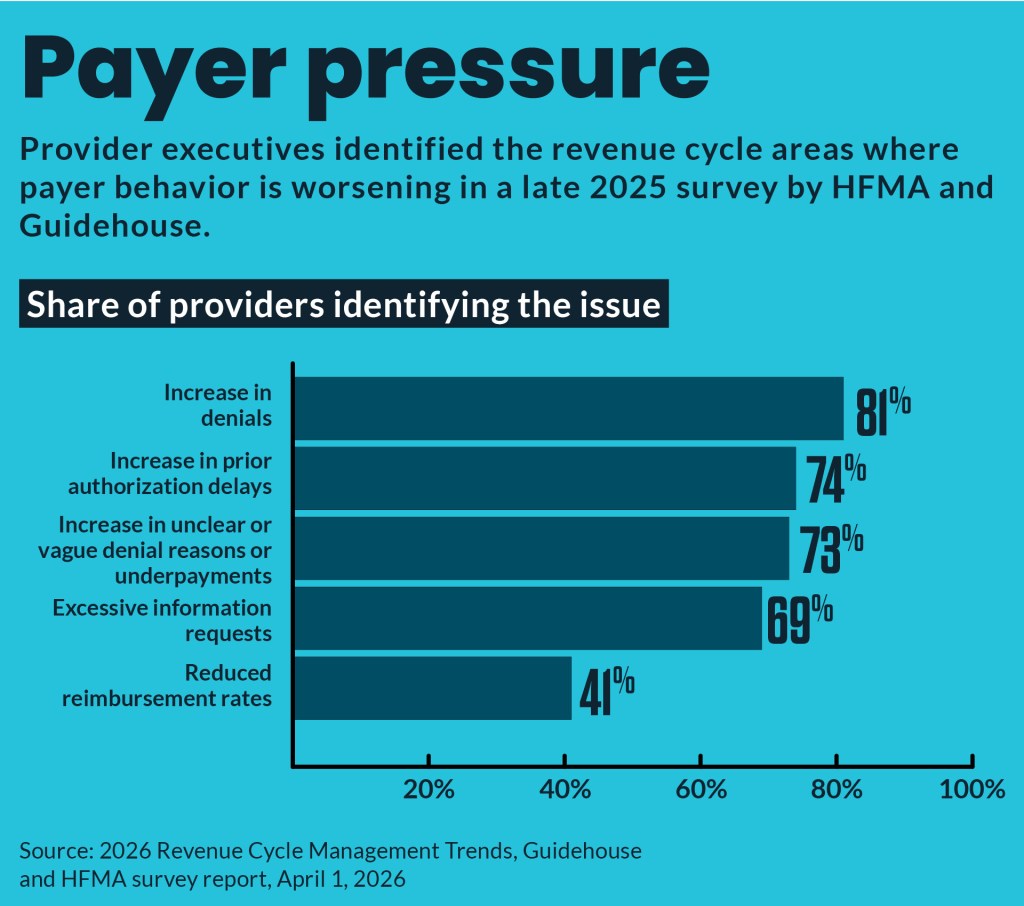
The continuing PA challenges were seen in an HFMA-Guidehouse survey of 191 provider executives in late 2025, which found that 74% of health systems have seen an increase in PA delays.
And the PA challenge is not limited to MA plans. Medicaid plans rejected prior authorization requests at similar or greater rates than their MA plans, according to a Modern Healthcare analysis [subscription required] of insurer prior authorization rates in publicly funded programs, which insurance companies were required to begin reporting March 31.
New rules
Kevin Isaacs, president and founder of Tribunus Health, which provides price transparency data and strategy to providers, also has not seen any PA improvement from clients.
Instead, he cited the proliferation over the last year of even more aggressive administrative restrictions, like threats from some insurers to automatically downcode Level 4 and 5 evaluation and management visits, which especially impact specialists.
“It was a smart plan, which is getting them so frustrated that [payers] were going to go even further, so that they will stop complaining about the prior authorization problem that they have right now,” Isaacs said. “We saw providers go out of network on that basis … because, if you’re a specialist who only gets referrals, the only reason someone comes to you is that they are Level 4 or 5; otherwise, they would be seeing primary care.”
David Merritt, senior vice president of external affairs at BCBSA, said in email that PA “reductions will vary by plan and market, but this is real progress.”
“BCBS companies are committed to addressing 80% of requests in real time, but to reach the goal, the requests need to be submitted in real time, electronically, not by fax or phone,” Merritt wrote. “Through partnership with providers and regulators, we know we can make a more streamlined experience for patients and providers.”
Regulatory approach
The voluntary PA reductions are part of an effort by the industry to address the issues of administrative burdens themselves. The Trump administration stated that failure to do so will result in aggressive regulations and statutory requirements to clamp down on PA use.
Previously issued regulations required MA plans, Medicaid managed care organizations and state Medicaid programs this year to institute decision windows of 72 hours for urgent PA requests and seven days for standard requests.
New regulations would apply the PA approval timeline to drugs under both medical and pharmacy benefits, according to a proposed rule published April 14.
Ruiz worried that coming CMS requirements that require PA review within specific timeframes will not help much. He expects that MA plans will simply provide faster PA rejections using AI to meet the new requirements.
“You’re just going to see denials shorten and instead of taking four days, they’ll now take the 72 hours that they have, or sometimes even less.”
Next steps
The AHIP-BCBSA-led voluntary effort stated that its participating plans aim, by 2027, to ensure that 80% of electronic PA requests are assessed while patients are still at their providers.
“Health plans’ multi-year series of voluntary commitments will streamline prior authorization while maintaining patient safeguards for safety, quality and affordability,” Chris Bond, an AHIP spokesman, said in an email. “As more providers do away with error-prone manual processes and adopt electronic prior authorization, health plans’ standardized approach will mean faster answers, a more consistent experience and less friction for everyone.”
In a separate initiative, UnitedHealthcare announced that it will eliminate most medical prior authorizations across all lines of business for 1,500 rural hospitals and their associated rural practitioners. The same group of hospitals can expect to receive accelerated payments for services, averaging fewer than 15 days. Both initiatives are set for implementation this fall.
Cigna said it aims to standardize electronic PA submission requirements for medical services that represent more than 70% of PA volume by the end of this year. Such standardized electronic PA accelerates access to care and simplifies providers’ administrative work, stated the company.
Aetna said it already has standardized 88% of its PA volume, which “continues to maintain the fewest medical services requiring prior authorization.”
Humana said it removed prior authorization requirements among more than 340 codes, accounting for approximately one-third of prior authorizations for 2025 outpatient diagnostic services.
