


Fast Finance
AI moves beyond revenue cycle
Eight in 10 health systems plan to increase their AI spending over the next 12 months.

Published
June 23, 2026
12:15 pm
|
Updated
September 1, 2026
9:58 am
An AI tool helped to cut emergency department (ED) lengths of stay (LOS), a recent study found. That improvement demonstrates the technology’s potential to drive operational efficiency, says one of its authors.
The prospective study, which was published last month in the journal Nature, used an AI model to predict hospital admission risk for ED patients over 11 months in 2023. In the 54,000 ED visits, the AI tool did not change the number of ED patients discharged per day but cut median ED LOS by 12 minutes without increasing 72-hour bounce back visits.
“It was a really promising and interesting application of artificial intelligence showing how this can actually make care better for patients and more efficient for the overall system,” Alexander Ryu, MD, vice chair of AI innovation for Mayo Clinic’s Department of Medicine and one of the study’s authors, said in an interview.
The approach used “a pretty straightforward AI model” that was not complex for physicians to use and did not require much data entry outside their usual workflows, he said.
The study characterized the LOS reduction as “modest” but implementing that kind of intervention at scale could provide a meaningful operational impact.
“In aggregate, that means getting a lot of patients the care that they need sooner,” Ryu said. “It means freeing up capacity to see additional patients.”
Operational potential
Ryu noted that ED patients are just one group that potentially could benefit from having AI tools provide such foresight.
“The next step could be things like informing more upstream hospital operational groups,” Ryu said.
That could include helping teams manage bed utilization, hospital room cleaning and even variation in staffing needs.
“We think that there’s more opportunity potentially there to make use of this information,” he said.
Ryu noted that multiple AI pilots and initiatives, such as ambient listening, were running in the ED at the time of the research, so the study included two separate time periods to cancel out effects from other AI interventions.
Governance
Like other hospital leaders, Ryu emphasized the importance of having a governance structure for AI use and meeting that before doing any enterprise-wide rollouts.
“That’s been a major undertaking that’s now coming to fruition and we’re able to benefit from that. Folks internally are developing AI solutions and having transparency and guidance on what kind of thresholds we need to meet, in terms of being able to deploy AI safely at scale and in a way that puts patients first,” Ryu said.
AI vendors that will stand out are those that will work with healthcare organizations to apply consistency to AI governance and ensure that an organization’s AI touchpoints as well as its data points are tightly integrated, Cheryl Cruver, president, U.S. markets, and chief commercial officer for AGS Health, said at the recent HFMA Annual Conference.
And while a lot of hospitals in today’s market hope to find one or two AI platforms that can solve many different needs, “It’s been shown that the multiples are there if you focus on deep, purpose-built AI and focus on a specific task as well,” said Nick Zafirson, vice president for Cedar.
AI push
The study’s findings come as more than eight in 10 health systems (84%) expect to increase their AI spending over the next 12 months, according to a survey presented at the HFMA Annual Conference.
In comparison, only 69% expect to increase their spending on cybersecurity, according to the early-2026 survey of 93 health system finance executives by HFMA and Fidelity Investments.
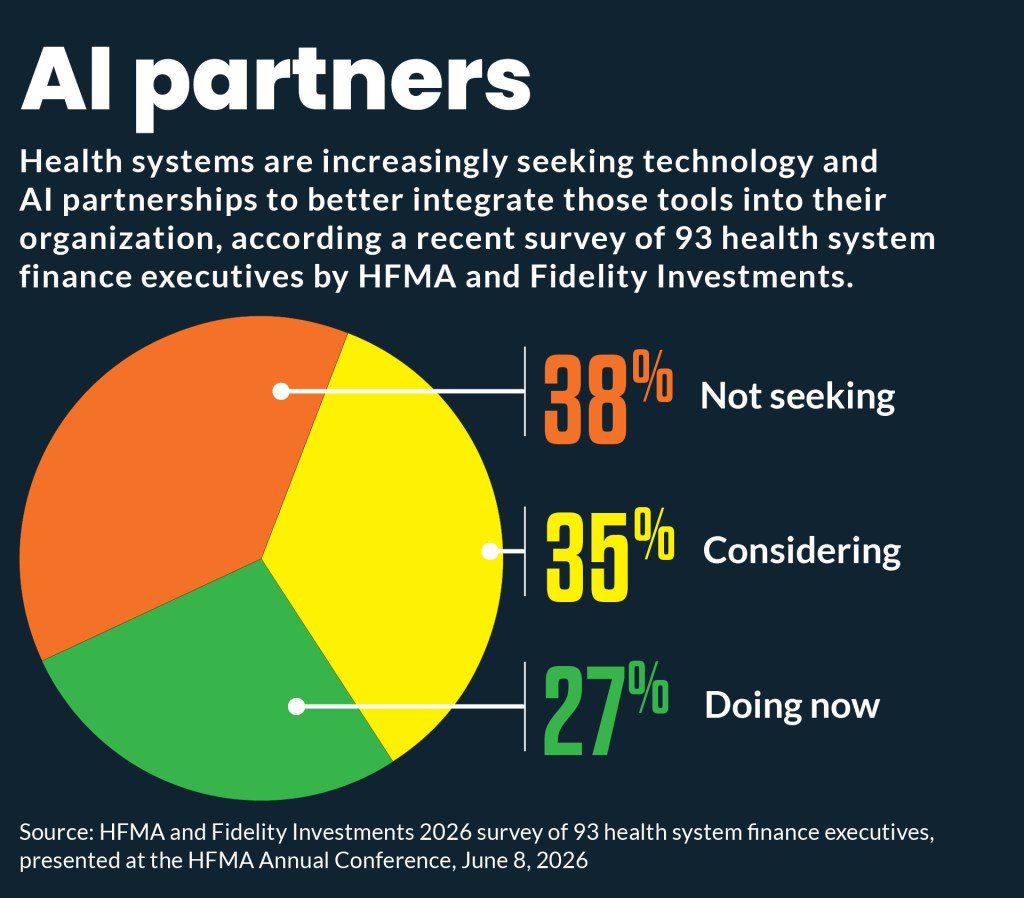
Technology and AI partnerships dominated the types of outside collaborations that health systems plan to undertake. In the survey, 27% of organizations already had such partnerships and another 35% were planning them.
Efficiency potential
The potential for AI tools to drive a range of operational improvements also were highlighted during the HFMA conference.
Economic futurist Andrew Busch said AI becomes even more important amid the shift from a volume-based model to a productivity- and outcome-focused model. The technology can help hospitals reduce administrative waste and maximize clinical efficiency.
A well-designed AI implementation is vital, Busch said.
“It’s super important to engage the multiple groups that are within healthcare to align everybody together,” he said. “That means the clinicians, that means the finance people, that means the data people, that means IT, that means legal and compliance.”
