



Fast Finance
Hospitals confront nursing opposition to AI
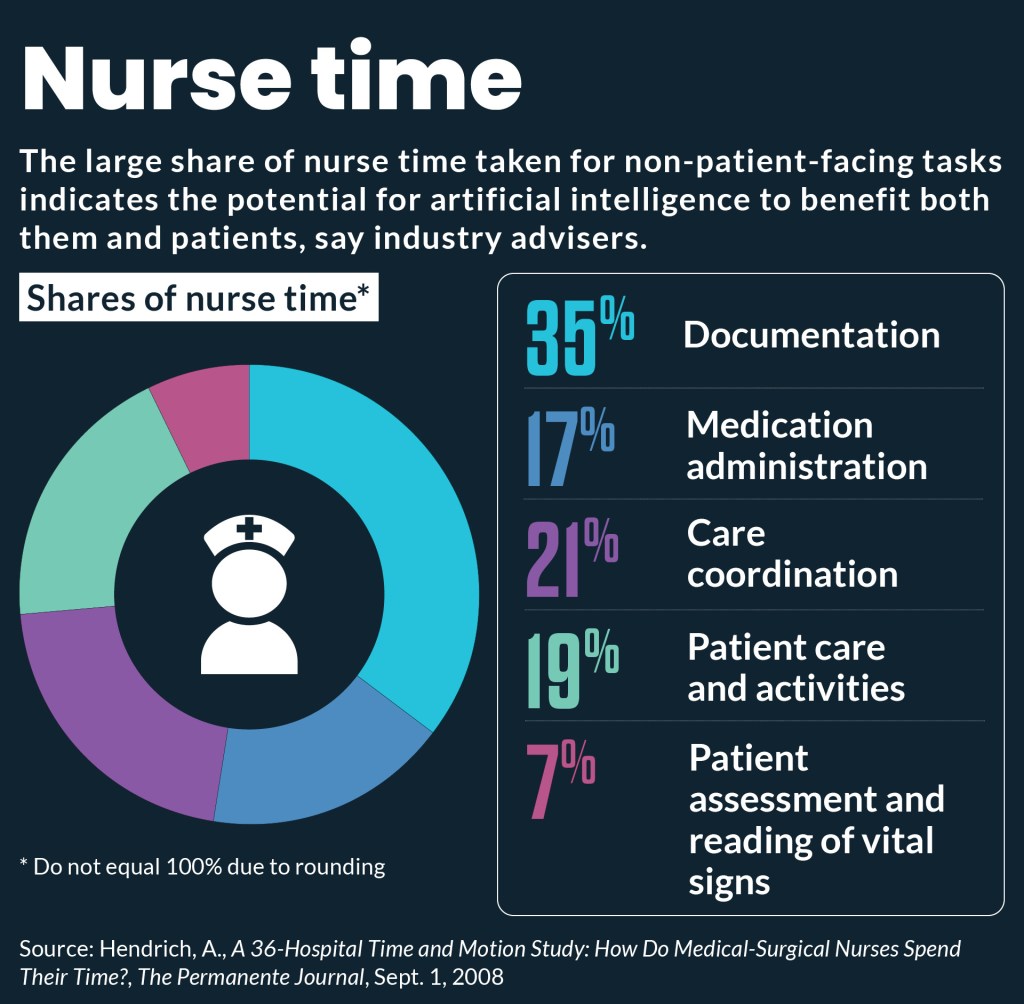
The potential for AI-driven improvements was seen in research showing that registered nurses spent only 20% to 38% of their work time on direct patient care.

Published
July 7, 2026
9:24 am
|
Updated
July 9, 2026
1:19 pm
Health systems’ adoption of artificial intelligence to improve productivity increasingly is meeting opposition from their nursing staff.
Nurse opposition to AI has become most visible in nurse strikes, where limits and guardrails on AI deployment for clinical and administrative uses have emerged.
Sixty-five percent of hospitals reported using AI or predictive models integrated with their electronic health records (EHRs) in 2023, according to a recent study. But nurse distrust of the technology was seen in a 2024 National Nurses United survey of 2,300 registered nurses, which found that 60% of respondents did not trust their employers to prioritize patient safety when implementing AI. Nurses were primarily concerned that AI tools were used for cost-cutting.
Industry advisers told FastFinance that AI concerns by nurses increasingly are showing up in union contract negotiations.
AI provisions that have surfaced in labor fights and nurses’ contracts include:
- Requiring hospital leaders to discuss with the nurse union if AI use results in the “diminishment” of union jobs
- Establishing a contractual definition of AI and a formal channel for nurses to flag concerns about new technology deployments
- Banning the use of specific AI vendors for political reasons
- Barring the replacement of therapists with AI
- Barring the replacement of nurses working in utilization review with AI tools
- Establishing AI guardrails that “preserves nurses’ exercise of clinical judgment and protects nurses’ skills and decision-making”
So far, healthcare AI adoption has been driven by pilots, experiments and efforts with little coordination, said James Cervantes, a partner at Jarrard, a strategic communications and change management firm.
“There’s a growing mistrust in AI and AI adoption and, also, I think there’s just a ton of hype around AI so that folks are just generally skeptical of it,” Cervantes said.
Why the AI focus on nurses?
Health systems initially focused AI on back-office functions like the revenue cycle. But more are looking for ways to improve administrative efficiency for clinicians.
The potential for AI-driven improvements was seen in research showing that registered nurses spent only 20% to 38% of their work time on direct patient care.
Much of that imbalance was driven by the extensive data entry required in EHRs.
Cervantes said that with AI, the pendulum can move toward the middle where AI can reduce the administrative burden of nurses, physicians and clinicians, to allow more face time with patients and their families. “I’m hopeful and optimistic that there is a happy medium here and that it’s not only good for clinicians, but it’s also better for patients.”
Start with trust
Cervantes said health system employees in general resist AI adoption because they don’t necessarily trust the reasons the organization is doing it or they don’t believe that they’ve been considered in its design.
“The first place to start, and where we often begin the conversation with our clients, is by asking, ‘What does trust look like today with your strategy, with your AI tools, with your leaders?’ How do we build from there?” he said.
Involvement needed
Also, key to AI adoption is involving nurses in the process.
“Nurse adoption of AI is driven by meaningful involvement throughout the process,” Ali Knight, RN, director of research at Advisory Board, said in emailed comments. “An effective path forward engages nurses from the onset, including selection, design and implementation.”
Knight said many AI solutions have not been developed specifically for nurses. That is why health systems need to ensure that adopted AI technologies reliably address the challenges that matter most to nurses as well as enhance patient care, while integrating into existing workflows to reduce burden “rather than create additional work.”
Jolene Ackerson, senior director of provider technology consulting and a health informaticist at Optum Insight, said it is important to recognize that the nursing response to AI is not simply a matter of adoption versus resistance.
For health systems, the most effective path forward is to shift from deploying AI to nurses to designing and implementing AI with nurses, Ackerson said in email.
“That means engaging front-line nurses early and consistently in strategy, workflow design, testing, governance, education and feedback loops,” Ackerson said.
Nurses need clarity and education about what the technology is intended to do, where it fits into their workflow, where it adds value, what its limitations are and where clinical judgment remains essential.
“Trust is the foundation of adoption, and nursing resistance often reflects valid concerns about safety, transparency, workflow impact and preserving clinical judgment,” Ackerson said.
Demonstrate value
Nurses are more likely to engage with AI, Ackerson said, when they see clear, practical value in their daily work. That includes:
- Reduced administrative burdens
- More efficient documentation
- Better access to information
- Improved workflow support
“AI should be positioned as a tool that supports nursing practice, not one that replaces clinical expertise, critical thinking or compassionate care,” Ackerson said.
Make it personal
Cervantes emphasizes listening to staff to understand their pain points and talking to them about how the tool can help to resolve those issues.
Secondly, health systems need to personalize how the tool will make meaningful differences in their daily work lives.
“From a nursing perspective, if we’re implementing a new AI tool, we would ask the question, ‘How does this make their shift better or how does it improve their day-to-day work?’ instead of saying, ‘AI will improve workflow efficiency,’” Cervantes said. “Imagine leaving your shift on time or even a few minutes early because your documentation, which took you an hour to do, now takes you 15 minutes to do with this new AI tool.”
