



Healthcare Revenue Cycle Management
TEAM could cost most participating hospitals millions, analysis finds

Published
5 hours ago
More than halfway through the first year of a mandatory CMS value-based payment model known as TEAM, it is likely to produce some big losers among the 721 participating hospitals.
The Transforming Episode Accountability Model requires the selected hospitals to take on coordination of care for original Medicare patients undergoing five types of surgical procedures starting with surgery through 30 days post-hospitalization.

The financial outcomes for those types of covered procedures are expected to range from a maximum loss per case of $15,142 for coronary artery bypass graft to a maximum gain of $7,970 for surgical hip and femur fracture treatment, according to a report by Rainfall Health. The other three types of included procedures — spinal fusion, major bowel and lower extremity joint replacement — are not far behind in potential maximum loss and gain in TEAM (see chart).
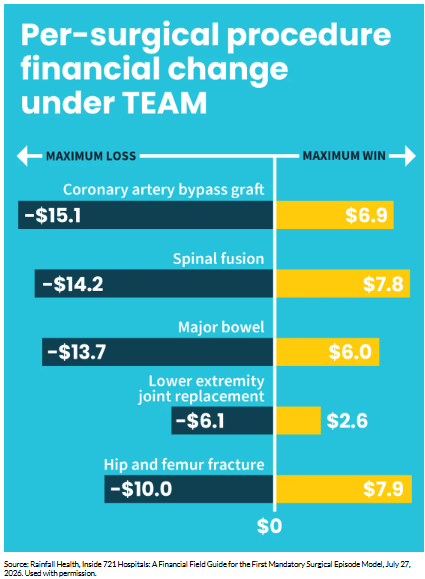
Rainfall Health also notes in the report that 56% of hospitals are expected to lose money in TEAM with an average loss of $1.2 million per facility, during the first performance year (PY1) of a five-year performance period.
“American hospitals are entering the most consequential decade of modern surgical care,” said Christina Keny, PhD, MHA, RN, vice president, clinical AI strategy for Rainfall Health and the author of the report. “We’re calling this the surgical reform decade. There are multiple forces colliding right now.” Keny said.
Those forces include the continued aging of the population, with the number of people who are 65 and over expected to climb to 73.1 million by 2030 and to 80.8 million by 2040.
Just the first wave
Also, Keny noted in the report that TEAM is just the first wave of CMS-mandated participation in new payment and clinical approaches. Future models carrying the same accountability discipline as TEAM are CMS’s Age-Friendly Hospital Measure, which has already begun inpatient quality reporting attestation for 2027 payment determination, and CJR, a mandatory, nationwide 90-day joint replacement episode model with two-sided risk on day one.
In addition, Rainfall Health officials, based on conversations with CMS, are expecting to see ambulatory surgery and possibly comprehensive joint replacement value-based care become mandatory in the same fashion as TEAM. That would bump up the number of hospitals mandated to participate to more than 2,500 hospitals, according to Rainfall.
The TEAM program offered the participants three tracks to get started. Track 1, which has no downside risk and lower levels of reward, is offered to hospitals for the first year, though safety-net hospitals can choose that path for up to three years.
Track 2 will carry lower levels of risk for specified types of participants, such as safety-net hospitals and rural hospitals.

The third track applies to the bulk of the hospitals and is associated with high levels of risk and reward.
A mid-volume hospital in Track 3 for all five PYs would see a worst-case scenario of losing $14.5 million, while a hospital that maintains the status quo would lose $6 million, based on Optum data in the report. The best-in-class hospital would gain $14.5 million.
A key to successfully negotiating TEAM is paying closer attention to post-discharge.
“Where the variability comes in is in that post-acute phase,” said Edward Burnetta, co-chair of the American Academy of Physical Medicine & Rehabilitation, adding that surgical post-acute care patients create 40% to 60% of the cost. “That’s really the area that you can make the biggest impact in this model,” Burnetta said.
“Proactive management would make a difference, particularly in the length of stay. And I think the length of stay is the key figure in this.”
