



Health system capital planning: Not for the faint of heart
Growing risk in capital planning is forcing hospitals to rethink how they prioritize capital investments and determine which projects offer the greatest long-term return.


The past decade has seen hospital finances whipsawed by a global pandemic, a record-setting multi-hundred-billion-dollar cyberattack, a more than 20-year record surge in labor costs and a trillion-dollar cut in federal Medicaid spending. Not surprisingly, hospital credit has deteriorated.
Hospital finances cumulative rating activity, quarterly trend
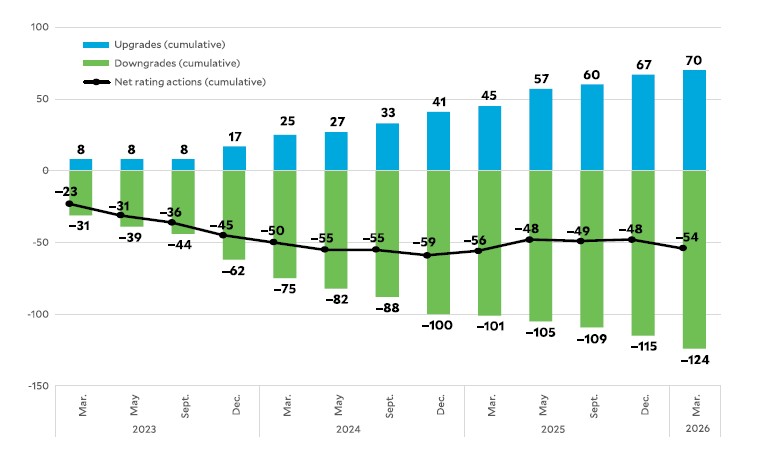
From March 2023 through March 2026, ratings agencies consistently issued significantly more downgrades than upgrades of U.S. hospitals, with steadily increasing numbers of both.
Yet hospital capital spending is soaring.a Capital spending for hospital and clinic projects exploded in 2024 to a 15-year record of $33.9 billion and is expected to rise to nearly $39 billion by 2030. The troubling disconnect between hospital financial uncertainties and soaring capital spending raises serious questions about the integrity of hospitals’ and health systems’ capital planning process.
Unexamined, this disconnect poses a direct threat to the sustainability of hospital credit and the ultimate survival of health enterprises. Capital planning in many hospitals and health systems has historically been a fraught and less-than-systematic process. Hospital plant age rose by 23%, to 12.7 years, from 2021 to 2024, with adverse consequences for operational efficiency.b Meanwhile, the queue of hospital capital projects has lengthened and often has been managed haphazardly compared with approaches of other large nonhealthcare businesses.
In many health enterprises, advocates of specific unmet capital needs that squeak loudest get the grease. And a variety of forces — all with legitimate concerns — lay claim to scarce capital resources.c These worthy claimants on scarce institutional capital jostle for positions in the capital queue, regardless of the downstream economic consequences for the health system’s cash flow and credit.
Rating agencies are acknowledging the connection between capital planning and credit worthiness. Moody’s has proposed updating its rating methodology to consider capital planning as a factor in its ratings, as well as measures of revenue quality and diversity, risk management, leverage and liquidity.d
Shifting times for health system capital investments
Capital projects that appeared unquestionably sound just a few years ago now pose increasing financial risk. For example, ROI from a proposed cancer center that would consolidate previously dispersed services such as surgery, chemotherapy/immunotherapy and radiation into a single location may once have seemed assured but now faces heightened risk. Cuts to 340B drug subsidies have eroded margins on chemotherapy and immunotherapy, while site-neutral payment reforms will reduce payment for outpatient procedures, including imaging and surgical services.
A decade ago, such a cancer center would have been a clear winner. Now it could be a potential operating risk. The possible return on capital to the enterprise may have turned negative. Depending on the construction budget and cost of staffing the new unit, borrowing money for the project could affect the health system’s bond rating.
The queue for capital planning is a stew
A major problem confronting hospital and health system leaders who seek a rational capital plan for their organizations is the sheer heterogeneity of capital needs and their financial impact on operations. The capital queue is a stew with a lot of ingredients.
Some capital expense is merely maintenance and repair — projects needed simply to keep the engine running safely. The older the physical plant, the more deferred maintenance and the larger the percentage of capital spending with no effect on operating financial performance (other than to enable continued operations).
Some capital spending is defensive, an example being expenditures associated with cybersecurity and patient safety, which are key elements of a risk management strategy.
Alternatively, some capital spending focuses on offense, with support for new programs and services. Installing AI, for example, is intended to enhance productivity, both clinical and managerial, and — depending crucially upon implementation — to generate a return on capital and labor.
And some capital expense is a requirement for growth, as capital commitments are negotiated during merger discussions with newly acquired hospitals or other businesses. These types of capital commitments should be made with an explicit and conscious view toward economic return.
Eventually, capital spending will press the limits of an organization’s capacity to borrow, possibly triggering ratings issues that raise the cost of capital. Cuts in federal funding for Medicaid, rising numbers of uninsured patients and the possibility of further reductions in 340B drug program subsidies and ambulatory care payments to hospitals will heighten operating risks and shrink a health system’s operating margins and access to affordable credit.
To govern is to choose
To effectively meet these challenges, a health system’s capital strategy must balance risk and return in a way that acknowledges the limits and constraints and recognizes that the targets are moving. To borrow heedlessly in this environment is to risk both higher borrowing costs and lower returns — and a death spiral that might culminate in program reductions, acquisition by others or even closure.
It is crucial that the portfolio of capital expenses be managed in a way that, net net, generates a positive return on the organization’s capital. All items in the queue must be evaluated, in part, on their capacity to generate a financial return for the organization. Moreover, the mix of projects must be balanced to generate a positive overall return on the organization’s capital, with an aligned plan on capital creation — generated through both financing and cash flow.
Advocates of capital spending must be prepared to expect challenges to their assumptions about benefits to the organization as a whole, which does not mean every capital expense must generate a positive return. However, because capital is necessarily limited, the organization must ensure that its invested capital generates sufficient return to pay back its debt and generate operating margin.
Making thoughtful capital choices will require both empirical analysis and hard choices by boards and management. For both, developing a structured and disciplined process to review and approve capital spending is a key requirement for responsible stewardship and governance.
Footnotes
a. Daly, R., “Despite pressures, healthcare construction spending to increase,” HFMA FastFinance, March 17, 2026.
b. Daly, R., “Capital expenditures surge amid aging facilities,” HFMA FastFinance, Feb. 10, 2026.
c. These forces include major donors, politically powerful medical staff, commitments to recently acquired franchises, pressure to adopt promising new technologies or invest in AI or cybersecurity infrastructure and the need to replace aging plant or equipment.
d. Steingart, D., et al., “Not for profit healthcare: Proposed methodology,” webinar, Moody’s Investors Service, Inc., Feb. 5, 2026.
Capital planning requires a strong, 5-part process
Depoliticizing the process of allocating an organization’s capital and husbanding that capital capacity for future years is not for the faint of heart. The governance processes used to allocate capital spending must be deliberate and disciplined.
Constructing a portfolio of capital investments that enhances profitability and efficient operations requires a more rigorous and less forgiving approach to managing capital spending. Following are five primary steps that make up this process, with the key questions that should be addressed with each step.
1 Establish a destination-based plan (e.g., true north). Where do we want to be 10 years from now? And what major investments will be required to reach the destination?
2 Determine the total capital need. How much capital will be needed to create enterprise value over that time period?
3 Determine the capital sources. What is our current capital and debt capacity? How much capital can be generated from our investments? And how much capital will need to be generated from our cash flow?
4 Create the governance and decision-making framework. How will capital priorities be decided? What hurdle rates can we expect for ROI on capital items and projected return for the whole portfolio? And how can we incorporate unplanned needs that inevitably will arise?
5 Map to destination. What are the levers to generate the necessary cash flow? Where does our credit rating need to be, and what can be done to achieve that rating?


