


Fast Finance
Capex surges to highest since 2008
Surging patient volumes, technology demands and consolidation targets are driving capex spend.

Published
August 11, 2026
8:44 am
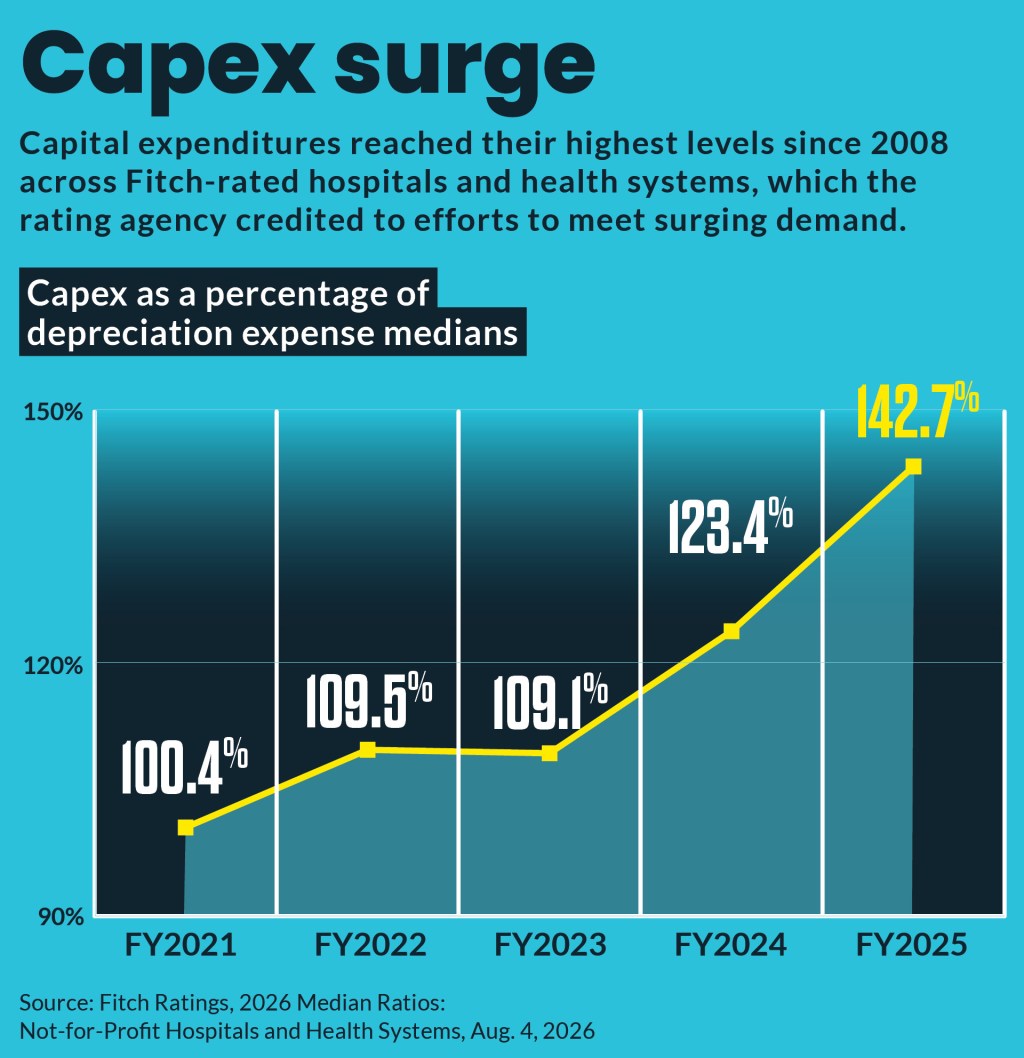
Hospital and health system capital expenditures in fiscal 2025 reached their highest since the start of the financial crisis in 2008, according to Fitch Ratings
Capital expenditure (capex) as a percentage of depreciation expense surged to 142.7% in fiscal 2025, the highest since it was 154.4% in fiscal 2008, among the hospitals and health systems rated by Fitch. Even the one-year increase was significant from the 123.4% level in fiscal 2024.
The capex acceleration occurred across hospital and health system investment-grade rating categories, although the size of the increase correlated with the strength of the organization’s credit rating.
James Kinn, managing director of healthcare strategy and finance at Forvis Mazars, said the capex increase he’s seeing among client health systems is organization-specific.
“Hospital capital spending for some organizations is surging; it’s becoming more selective, more strategic, harder to defer,” Kinn said in an interview. “When you think about capex, hospital systems are really being forced to decide which investments are truly indispensable.”
Routine capex focuses on aging physical plant and deferred maintenance, but other capex targets include:
- Adopting AI
- Migrating care to ambulatory
- Increasing tertiary, quaternary capacity
- Funding mergers and acquisitions
And the capex surge may continue. In a survey of health system executives earlier this year by the Advisory Board, 64% said their organization is growing their capital expenditures.
Capex trend
The ongoing surge in capex followed a big decrease during the COVID-19 pandemic as labor costs spiked and patient volumes fell, said Kinn.
But now that patient volumes have recovered — and exceeded pre-pandemic levels — Fitch reported that capacity shortages have emerged as a top driver of capex.
“Improving access has become a recurring administrative challenge — and a key strategic imperative, indicating pent-up demand for capacity expansion,” said the Fitch 2026 median ratios report.
The capex surge was enough to halt the increase in average age of plant. However, it remains the highest since it increased from 9.8 years in fiscal 2004 to 12.7 years in fiscal 2025. Unfortunately, lagging capex at the lowest-rated organizations “potentially creates patient experience and safety risks and competitive limitations, and it may limit volume recovery capacity,” stated Fitch.
Driving the spend
Several other industry trends also have juiced the capex surge, said Kinn.
Competitive position. As more hospitals and health systems undertake mergers, that fuels the need for their market competitors to also look at consolidation to maintain their competitive position. Similarly, when organizations see their competitors putting more resources into AI, that drives a need to respond with their own AI spending.
Inflation. Health system leaders have seen since the inflation surge started in 2022 that every year, they wait to build new infrastructure, it increases the cost of that project, Kinn said.
“If you want to build that tower now, it’s only going to be more expensive to delay that capital investment and make that investment five years from now,” he said.
Rate pressure. Although less of capex driver than consolidation, AI and aging infrastructure, lower reimbursement is putting financial pressure on organizations, Kinn said.
“If you continue to see top-line pressures on reimbursement related to regulatory changes, some organizations may not see a viable path forward financially,” he said. “And, therefore, that’s what is putting them into conversations around consolidation. Maybe in an indirect way, reimbursement or regulatory policy is indirectly pushing some elements of why capex is being driven a little bit higher.”
AI investment
Fitch’s highlighted spending on AI adoption as a response to existing and increasing labor cost pressure. As big of a cost driver as labor is now, Fitch sees it worsening with the ongoing retirement of baby boomer staff and increasing service demand from ballooning Medicare patients.
But Kinn sees AI as a labor cost driver in the short term since new labor is needed to implement AI in health systems.
“On the flip side, there’s still the question of ‘OK, is AI going to replace jobs?’ And I think that’s still slow moving,” he said.
More than eight in 10 health systems (84%) expect to increase their AI spending over the next 12 months, according to a recent survey of health system finance executives by HFMA and Fidelity Investments. In comparison, only 69% expect to increase their spending on cybersecurity.
Funding sources
The funding sources for the capex surge remain the traditional buckets of debt, cash and investments and philanthropy, Kinn said.
A banking executive, who was not authorized to speak publicly and who focuses on health systems, said that many hospitals and health systems prefer lower-cost borrowing options, such as variable rate debt. However, due to concerns that hospital growth may have peaked due to industry trends and payment policy, he sees a case for higher-cost fixed rate debt.
“If I were a hospital, I’d issue a long fixed rate because if we’ve reached peak hospital, with demographics going against us, with reimbursements going against us, with an economic recession maybe coming around the corner, you want to lock in a credit profile,” the banking executive said in an interview. “But that’s a more expensive proposition these days.”
Fitch raised concerns about some health systems’ use of cash to fund their capex surges. Specifically, the ratings agency noted organizations rated “BBB” increased capex to 129.3% of depreciation but at the same time their days cash on hand decreased from 135.8 days to 116.0 days. Fitch stated that was the largest single-year BBB liquidity drawdown in their dataset.
Balancing which source of funding to use in capex, said Kinn, requires creating a detailed business case for investments that detail their ROI.
“At a high level, though, if you look across the industry, organizations have a tighter balance sheet today than what they’ve ever had in the past,” Kinn said. “So it may be that organizations think about debt as just one lever to pull, but not necessarily the most important lever to pull, as they think about all their capital projects and how to fund those going forward.”
