



Fast Finance
Businesses increase support for hospital price caps
Watch red states, like Texas and Ohio, for future price caps, says one employer advocate.

Published
August 18, 2026
11:25 am
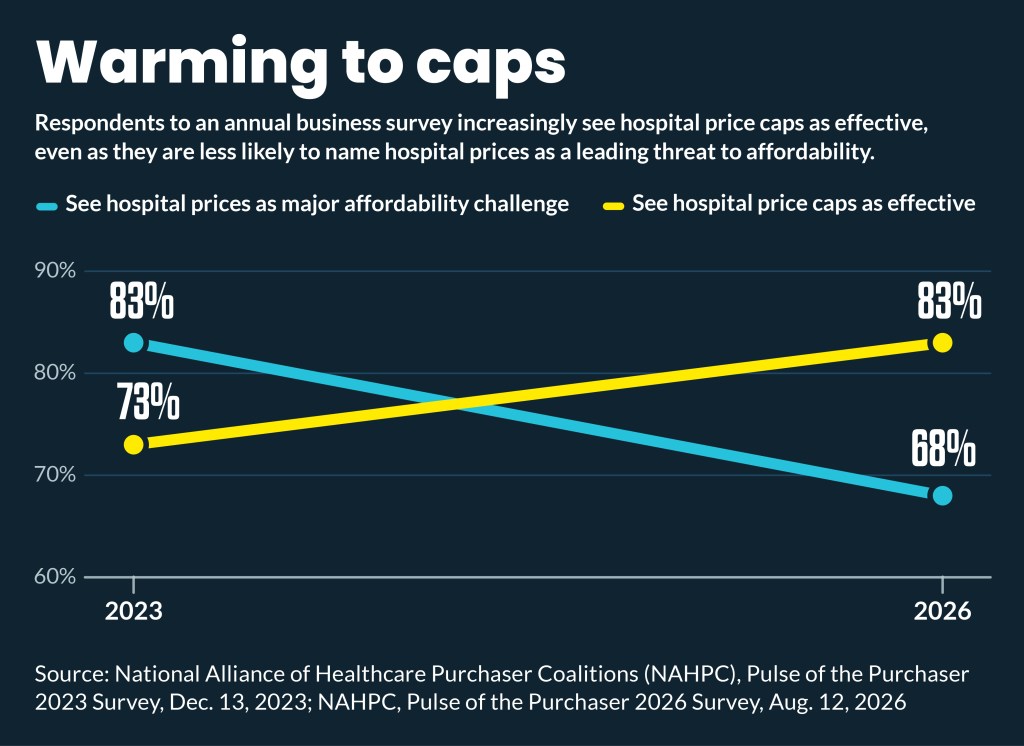
Business groups increasingly support various approaches to cap hospital prices.
Although many business groups continue their traditional opposition to any government price controls, an increasing number of business professionals see ones focused on hospitals and health systems as an effective option.
That support was shown in a new National Alliance for Healthcare Purchaser Coalitions (NAHPC) employer survey that found 83% of employers identifying hospital rate regulation as a “very” or “somewhat helpful” reform. That was an increase from 76% of respondents who said that rate regulation would be helpful in last year’s survey.
“I think people are coming around to this idea that there is something fundamentally broken about hospital markets and that, unless that is fixed, price caps may be the only answer,” Shawn Gremminger, president and CEO of NAHPC, said in an interview.
It marks a change in business executives’ views from just a few years ago, he said.
He credited the change to three factors:
- Prices continue to increase, despite many other initiatives to arrest them.
- More policymakers view it as a viable option.
- More view hospital markets as dysfunctional.
These three developments have led more business organizations, and politicians who align with them, to view hospital price caps as an option.
Why it matters
Receptivity to hospital price caps by business leaders and conservative politicians led conservative-leaning Indiana to enact a law (HEA 1004) to limit hospital prices in commercial markets. Starting in 2029, not-for-profit health systems in the state are required to align their prices at or below the statewide average or risk losing their state tax-exempt tax status, among other provisions in the law.
“Business leaders, conservative members of the state legislature, the governor himself have all come around to the idea that ‘We’re a super-free market but hospitals don’t exist in a free market, so that’s a problem,’” Gremminger said.
He said the backing of business leaders was critical to pushing those caps into law.
One of those backers was the Indiana Manufacturers Association (IMA), which threw its support behind the legislation after seeing the results of hospital price reports from RAND Corp. and others. Also influential was “the huge reserve balances as reported on the five largest hospital corporations’ Form 990s,” said Andrew Berger, president and CEO of IMA.
“The rising cost of healthcare benefits for employees is a significant concern for employers and Indiana manufacturers, as manufacturing is the largest employment sector in the state and provides the highest percentage of benefits to employees,” Berger said in emailed comments. “The price controls passed in HEA1004 impact the nonprofit status of these entities and will be incentive to lower prices helping Indiana businesses, employees and their families.”
Randa Deaton, president and CEO of the Employers’ Forum of Indiana, said her group began advocating the approach in 2020 after members asked hospitals to come up with a plan to address high and increasing prices, but none was offered. Their push also followed about 10 years of price transparency efforts in the state.
“The idea that transparency alone will fix healthcare prices has not proven to be true,” she said in an interview.
Other states
Business groups have taken a mixed stance on various types of hospital price caps considered by legislatures in other states.
The Healthcare Purchaser Alliance of Maine (HPAM), whose members provide health coverage for nearly 25% of the commercially insured in the state, backed legislation (LD 2196) that would require hospitals to cap prices for hospital services at 200% of Medicare rates.
“We understand that with changes to federal funding and other headwinds, many hospitals are in difficult financial positions, but the answer to hospital troubles cannot be pouring more money into an inefficient system,” Trevor Putnoky, president and CEO of HPAM, said in testimony on the bill. “Instead, the legislature should create the conditions that push hospitals to improve efficiency, and the state can play a key role in helping hospitals improve.”
That view was countered by the Maine State Chamber of Commerce.
“While we appreciate the motivation behind the legislation to reduce the costs of healthcare in the state of Maine, we are concerned that the scale of this proposal would be disruptive to healthcare services when the system is already economically fragile,” Amanda Johnson, a government relations representative for the chamber, said in testimony. “Furthermore, the concept of a price cap may be appealing, but it fundamentally interferes with the natural negotiation between hospitals, providers, insurers and communities.”
Ultimately, the bill was amended to replace the price caps with more limited provisions to cap price increases for individual insurance plans, small group plans and the state employee health plan.
The Vermont legislature passed Act 68 in 2025, which will begin implementing reference-based pricing in hospital fiscal year 2027 and global hospital budgets across all institutions by 2030. The Vermont Chamber of Commerce backed that bill.
National business groups also remain split on hospital price caps. For example, the Purchaser Business Group on Health (PBGH) favors controlling hospital price increases by enforcing full-price transparency and strengthening antitrust enforcement and oversight of mergers and acquisitions.
However, PBGH’s 2021 survey of executive decision-makers at more than 300 large private employers found that 45% “somewhat” or “strongly” agreed with government policies that would cap prices for hospitals in markets with limited or no competition.
Next states
Although Democrat-led states have long focused on hospital prices, Gremminger said he sees future action on hospital price caps as more likely in GOP-led states.
“Blue states have created a whole bunch of cost-growth containment committees and things like that,” he said. “And they are, in general, really ineffective; they don’t have enough teeth.”
Instead, Gremminger expects that the next legislative push on hospital price caps could come in Texas or Ohio. Republican states “are just taking it on in a much more direct way, which is just saying, ‘We’re going to cap prices,’” he said.
