



$3 billion annual hospital VBP cost: study
Administrative costs also increased more with Medicare Advantage local market penetration and Medicaid expansion.

Just four mandatory value-based payment (VBP) programs cost hospitals $3 billion in higher administrative costs every year, according to new research.
The administrative cost findings of research published in August in JAMA Health Forum could help project hospital costs as mandatory VBP programs continue to propagate.
The researchers identified changes in administrative costs when Inpatient Prospective Payment System (IPPS) hospitals fell under four older mandatory Medicare VBP models:
- The Hospital Value-Based Purchasing (HVBP) program and the Hospital Readmissions Reduction Program (HRRP), established in 2012
- The Hospital-Acquired Condition Reduction Program (HACRP) established in 2014
- The Comprehensive Care for Joint Replacement (CJR) model, launched in 2016
The study compared changes in administrative costs between 2,820 participating IPPS hospitals with those of 1,512 nonparticipating hospitals. Annual administrative cost increases per hospital were:
- $2.78 million compared with general acute care hospitals in Maryland
- $2.62 million compared with critical access hospitals (CAHs)
- $2.06 million per hospital compared with long-term care hospitals (LTCHs)
Aggregated nationally, these increases corresponded to more than $3 billion in additional annual administrative costs.
“Recognizing the implications of alternative payment models for administrative burden, policymakers should ensure that anticipated improvements in cost, quality or access outweigh increases in resource-intensive complexity,” wrote the authors.
More VBP models
The findings come as mandatory models continue to proliferate. The Transforming Episode Accountability Model (TEAM), which launched in January, is a mandatory five-year Medicare bundled payment initiative for hospitals in selected regions. The Comprehensive Care for Joint Replacement Expansion (CJR-X) model, to launch Jan. 1, 2028, will extend mandatory Medicare joint-replacement episode accountability to nearly all IPPS hospitals.
The researchers warned that their data indicated phantom cost savings from various VBP programs.
“If hospitals reduce clinical expenditures while expanding administrative capacity to achieve better program outcomes, measured efficiency may appear to improve even as total costs rise, particularly when the administrative expansion is short term and yields minimal durable benefits,” they wrote.
Since budget-neutral models don’t account for hospitals’ administrative costs, the researchers warned post-model assessments can overstate the healthcare savings they provide. Also, that oversight creates a cost challenge that only larger organizations can absorb.
Ongoing concern
Previous research found that proliferating government reporting requirements drove increased hospital administrative costs due to the time and labor needed to respond to them. The cost for one hospital reporting healthcare quality metrics in just one year was $5 million in personnel costs and $600,000 in vendor fees, according to one study.
The study’s findings followed a recent trends report that found hospitals’ administrative costs increased from 186% of direct patient care costs in 2011 to 199% by 2023.
The American Hospital Association (AHA) stated that the staff and technology needed to meet the compliance, reporting and documentation requirements introduced in recent decades consume an estimated 25% to 35% of all healthcare spending.
The AHA recently issued a health affordability blueprint that, in part, urged “minimizing unnecessary, outdated and redundant regulations, such as duplicative surveys and documentation requirements.” In May, in response to a Trump administration deregulatory initiative, AHA provided a list of proposed changes to lower health system costs, including scrapping mandatory models.
Cost drivers
The increased administrative costs found in the new research stemmed from requirements for VBP that expanded beyond traditional care delivery and payment systems. Such program requirements include performance tracking and reporting, financial risk management, investment in care coordination and quality improvement infrastructure and risk adjustment.
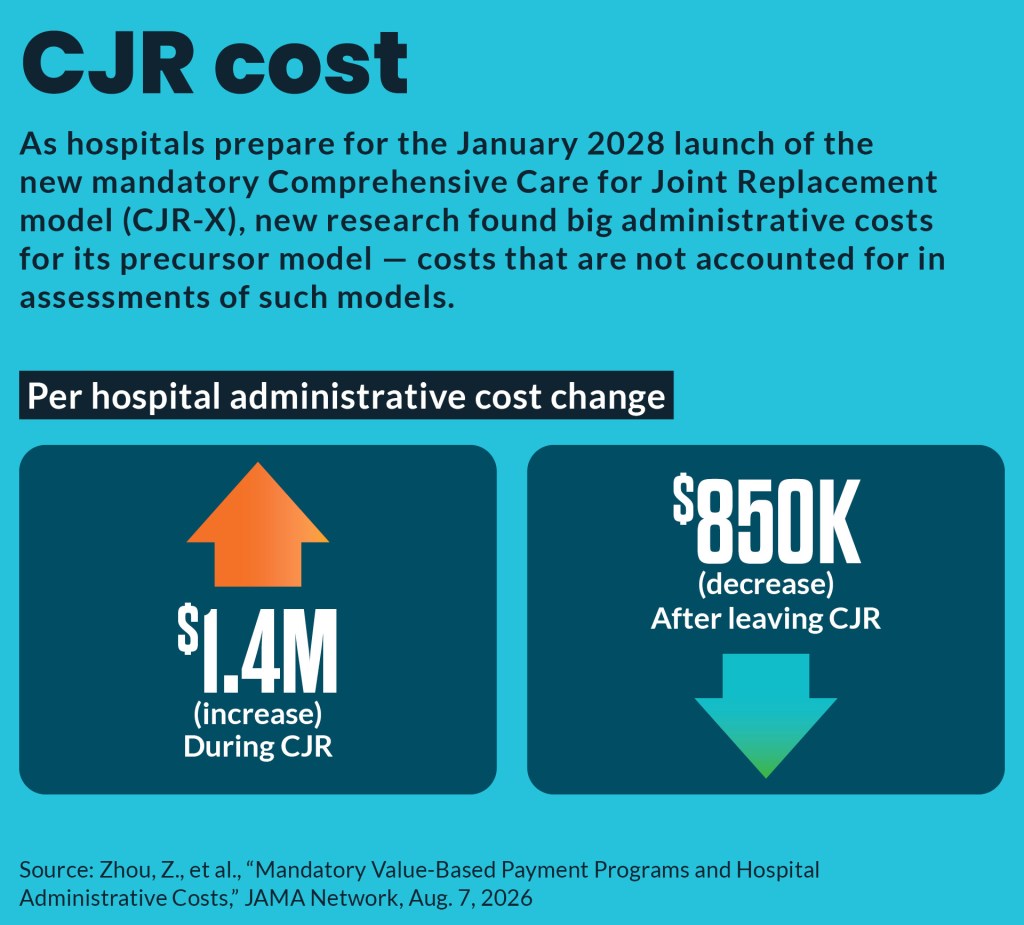
The study also examined administrative cost increases in each of the mandatory programs and found that the biggest annual cost increase per hospital ($1.4 million) occurred with participation in the CJR model.
After hospitals left the CJR program, their annual administrative costs decreased by $850,000, according to the study.
MA effect
The study also identified administrative cost increases at hospitals in markets with heavy penetration by Medicare Advantage (MA) plans.
MA plans have aggressively pushed VBP arrangements — beyond those used by traditional Medicare. For example, 43% to 45% of MA payments came through downside-risk alternative payment model (APM) contracts in 2024. That compared to 34% to 36% in traditional Medicare.
The study found a $2.29 million administrative cost increase in each of the 258 hospitals both participating in the four mandatory Medicare VBP programs and located in markets with the highest MA penetration.
In contrast, annual administrative costs each year at participating hospitals with the lowest MA market penetration increased by $950,000.
Medicaid expansion
Medicaid coverage expansion appeared to bring increased administrative costs, as well.
Participating hospitals in states that expanded Medicaid eligibility under the ACA saw administrative costs increase each year by $3.46 million, while those in nonexpansion states saw $2.46 million in administrative cost increases.
“Estimates that were larger in magnitude among hospitals in expansion states may reflect greater administrative responses to value-based payment programs in more complex policy environments,” said the authors.
