


Healthcare Operations Management
A new way to measure nursing productivity: Total labor cost per admission
An innovative model for measuring nurse productivity better accounts for patients’ care needs and the team-based nature of nursing care.


Published
September 25, 2026
4:39 pm
Since the early 1980s, U.S. hospitals have used a standard method to measure nursing productivity. In recent years, however, the industry has witnessed significant changes in the workplace and the way hospitals are reimbursed, including a shift toward pay-for-performance and value-based care. And at the same time, patient and caregiver expectations have increased substantially amid mounting pressure from industrywide labor shortages. Together, these trends have caused the traditional approach to measuring nursing productivity to be called into question. (See the sidebar below “How nursing productivity has traditionally been measured” for a further discussion of the traditional approach).
Given this ongoing industry transformation, it has become incumbent on hospital leaders to redefine care delivery and explore innovative approaches to team-based care. In short, they need to measure the value of nursing services from a contemporary perspective.
Providence, a large regional health system based in Renton, Washington, has been studying this approach since 2024. The health system’s aim is to transform the care model by redefining the traditional unit of service from hours per patient day to the total cost of labor per patient admission to capture broader, more holistic impacts, including financial implications, quality of care and caregiver experience. Providence’s new approach, called co-caring, represents a significant departure from how nursing productivity has traditionally been measured.
Innovative success story: Providence’s co-caring model
Leaders at Providence decided it was important to create space for nurses to define for themselves how to deliver care most effectively in the acute care setting. Nurses were invited to deconstruct their current role and create a new model of care based on the needs of their patients, with an appropriate distribution of patient care across a collaborative team.
Once patient care needs were delineated, team members identified the full complement of tasks, responsibilities and activities required to meet these needs and determined which role or skill mix was best suited for each activity, as the following exhibit illustrates.
Redistribution of nursing work in the Providence co-caring model
| Domain of nursing practice | Bedside registered nurse | Virtual registered nurse |
|---|---|---|
| Clinical assessment and decision-making | Performs comprehensive assessments, clinical interventions and real-time clinical judgment | Reviews assessment findings, supports surveillance, identifies trends and escalates concerns |
| Care coordination | Coordinates immediate bedside care and interdisciplinary interventions | Coordinates longitudinal care, facilitates communication among disciplines and supports transitions |
| Patient and family education | Reinforces teaching during direct care encounters | Leads admission education, discharge education, medication review and family discussions |
| Documentation | Documents assessments, interventions and clinically significant events | Completes or supports standardized documentation, admission history, discharge documentation and care coordination documentation |
| Communication | Communicates with providers and responds to changing patient conditions | Facilitates communication among patients, families, bedside caregivers and interdisciplinary teams |
| Direct patient care | Administers medication and performs procedures, complex interventions and clinical surveillance | Provides virtual assessment, education, coaching and care coordination |
| Professional contribution | Leads clinical decision-making and bedside care | Extends nursing expertise across multiple units, mentors bedside nurses and supports workflow efficiency |
This new method of care delivery, focused on patient needs and top-of-scope practice, became known as the co-caring model. In the model, a nurse and a technician form a dyad at the bedside to assist and care for patients, while another nurse assumes responsibility for caring for patients virtually.a
This model has two significant differentiators:
- Virtual nurses were not simply added into existing workflows.
- The team’s composition at the bedside was changed, increasing the need for teamwork.
Staffing ratios by role: Total patient care model versus co-caring model
| Role | Total patient care model | Co-caring model |
|---|---|---|
| Bedside nurse | 1:4 | 1:6 |
| Technician | 1:15 | 1:6 |
| Virtual nurse | 0 | 1:15 |
The initial pilot yielded positive outcomes, including improved retention, operational efficiencies and a reduced total cost of care. When hospital leaders were asked to monitor this model of care, they initially considered using the traditional nursing hours per patient day (NHpPD) approach to monitor productivity. However, they quickly were convinced of the limitations of this approach, given its inability to account for outcomes such as:
- Reduction of premium pay
- Change in skill mix
- Increase in employee retention, leading to lower recruitment costs and reduced orientation and onboarding time
- Higher bed utilization due to shorter length of stay (LOS)
- Higher clinician engagement
- Reduced readmissions
- Greater patient engagement and loyalty, leading to enhanced brand reputation
- Improved quality outcomes, leading to higher payer reimbursement rates
Instead, they recognized the need for a unit of service that would quantify both the value of the team and the cost of labor — i.e., the total cost of labor per patient admission.
Total cost of labor per patient admission (per unit)
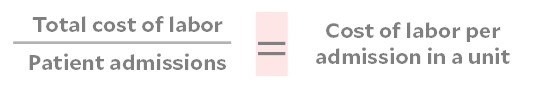
The premise for this measure was that assessing the total cost of labor required to care for a group of patients offers a more comprehensive insight into nursing productivity than can be obtained through traditional measures. The fundamental conclusion: When evaluating the cost of providing care, it’s more important to account for the total cost of labor as opposed to hours or FTEs, because not all FTEs bring the same value, given that every caregiver offers something different to patients. Thus, considerations that matter more than the FTE count are the composition of the team, the outcomes they generate and at what cost.
By capturing tangible and intangible performance improvements (such as operational efficiencies) at the unit level, the total cost of labor per patient admission metric (shown at right) enabled Providence’s leaders to assess the co-caring model’s value and potential.
This outcome was possible because the holistic unit-of-service metric includes all three traditional targets for assessment:
- Productivity
- Non-productive time
- Premium pay
It therefore allows for measurement of cost improvements resulting from reduced turnover, optimized skill mix, utilization of virtual nursing and reduced overtime or use of agency nurses.
The inclusion of patient admissions also captures improvements in quality of care and throughput efficiencies, as reflected in bed utilization and decreased LOS. Moreover, it does so holistically, as opposed to measuring the impact of each outcome individually, which unnecessarily complicates the analysis.
Assessment of initiative results
Based on these premises, the authors assessed results of the approach in seven units where co-caring is practiced daily. For comparison, we then calculated the total labor cost per patient admission for similar units over six months, from January through June 2024, using the total cost of labor per patient admission metric.
Findings for two departments — medical-surgical units and progressive care step-down units — demonstrated how Providence’s co-caring model out-performed models used by other healthcare organizations in the health system’s service area.
Looking at all of Providence’s states, the assessment found that:
- The average total cost of labor per patient admission for Providence’s medical-surgical units was 28% lower than for all other organizations.
- The same measure for Providence’s progressive care step down units was 53% lower than units for all other organizations.
Regarding the finding for just the medical-surgery units, for a typical 30-bed unit, the reduced labor cost finding can be extrapolated to as much as $2.8 million annually in cost avoidance (including the initial capital and other technical-related annual costs to support the new model of care).
Meanwhile, when controlled for geography on a state-by-state basis, the following results stand out:
- In Washington, the average total cost of labor per patient admission for medical- surgical units was 36% lower than for all other organizations.
- In Texas, this measure for medical- surgical units was 18% lower than for all other organization
- In Texas, the measure for progressive care step-down units was 30% lower than for all other organizations.
It should be emphasized that in focusing on the total cost of labor, this assessment was not intended to be a comprehensive ROI analysis for the program.
That said, however, another positive result of the effort was to help bring joy back to the practice of nursing (by removing the barriers to practice). This result was evidenced by the clear improvements that Providence experienced in nurse retention, the vacancy rate, the cost of premium labor and operational efficiencies that eventually impact the total cost of labor.
Even so, changing how productivity is measured creates challenges, and we also identified two limitations:
- The current national productivity benchmarking used by many health systems and individual hospitals only accounts for hours per patient day, so Providence was limited in its ability to compare its performance with that of others.
- The model was not applied in all clinical areas. So more studies are needed to assess its applicability in other healthcare settings (critical care units, for example).
In the end, however, Providence’s leaders were determined not to let the lack of comparison present a barrier to innovating.
Reconsider how to measure nursing productivity
Industry changes are occurring today that are increasing the challenges U.S. health systems face in making sure they remain competitive and sustainable. To meet these growing challenges, health system leaders should evaluate and implement innovative workforce strategies, of which Providence’s co-caring model is an example that has proven viable.
The evaluation process can best begin with two preliminary steps:
- Assessing how the strategies align with the organization’s goals and capabilities
- Performing a comprehensive feasibility study focusing on cost, implementation resources and change management to further guide successful adoption
As the healthcare landscape evolves, it will be incumbent on hospitals and health systems to reconsider how they assess nursing productivity. By prioritizing new care models, integrating advanced technologies and reimagining workforce models, hospital leaders can address burnout, enhance patient outcomes and ensure long-term sustainability. Those that adopt these next-generation approaches will create a workforce that meets today’s demands and thrives in tomorrow’s challenges. In this way, we can build a healthier, more resilient future for providers and patients.
Footnote
a. Trepanier, S., Schlegel, S., Salisbury, C., and Moore, A., “Implementing a virtual team model in the acute care setting,” Nursing Administration Quarterly, July/September 2023.
How nursing productivity has traditionally been measured
Hospital leaders have historically focused on improving nursing productivity by increasing workforce efficiency, with a focus on ensuring that healthcare professionals work harder and faster. They have done so in part by deploying the following programs:
- Lean methodologies. Implement-ing lean management techniques to reduce waste and streamline processes
- Extended shifts. Increasing shift lengths to cover more hours without increasing headcount, resulting in premium pay such as overtime and double time
- Supplemental staffing. Using high-cost agencies, per diem and other temporary staffing to meet the demands of patient care
- Cross-training. Training staff to handle multiple roles to ensure flexibility in staffing
Recent trends identified in a 2024 nursing workforce study, however, suggest the need to reconsider this approach has become imperative for hospitals:a
- More than 138,000 nurses left the workforce from 2022 through 2024, citing stress, burnout and retirement as key reasons.
- Among registered nurses and license practical nurses/virtual nurses, 39.9% and 41.3%, respectively, reported an intent to resign or retire by 2029.
Nursing productivity has been defined as “a measure of the efficiency with which labor, materials and equipment are converted into goods and services, usually expressed as a ratio of output per input.”b Since the 1980s, it has been operationalized as nursing hours per patient days (NHpPD) in bedded nursing units, where patient days are determined by the number of patients found in hospital beds at midnight. This method does not account for the actual care needs of the patients, the constant movement of patients (in and out of any given unit), any related outcomes (operational, clinical or financial) or the skill mix and team-based nature of nursing care.
Findings of a 2022 study strongly reinforce this perspective. The researchers interviewed 22 nationally known healthcare leaders representing diverse backgrounds of C-suite members involved in the budget process, and the consensus among them was that the current method for measuring productivity in nursing is outdated and must be redesigned to reflect today’s healthcare delivery model.c
Footnotes
a. NCSBN, “NCSBN research highlights small steps toward nursing workforce recovery; burnout and staffing challenges persist,” news release, April 17, 2025.
b. Edwardson, S.R., “Measuring nursing productivity,” Nursing Economics, January-February 1985.
c. Disch, J., and Finis, N., “Rethinking nursing productivity: A review of the literature and interview with thought leaders,” Nursing Economics, March-April 2022.
Standard formulas for nurse productivity measurement
Labor performance in traditional nursing units is typically assessed using a standard operating model. Nursing labor performance emphasizes efficiency, cost control and quality of care. This traditional model considers three primary target types:
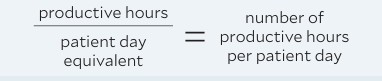
Productivity. The relationship between the number of hours worked (productive hours) and the volume of a given unit of service (patient day equivalent)
Non-productive time. Paid time that does not directly contribute to patient care (e.g., education, meetings, orientation and onboarding)

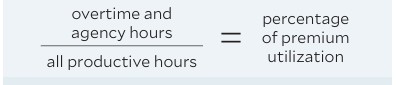
Premium pay. Assessment of premium hours (overtime and agency) relative to total productive hours