



Healthcare Finance Technology
Agentic AI in healthcare: The devil is in the workflow


Published
1 hour ago
As a wave of agentic AI solutions sweeps into healthcare enterprises, healthcare leadership is determined to harness its full power. AI promises to transform health enterprises. But whether the results meet expectations depends crucially upon how it is implemented. As Stuart Winter-Tear recently warned, we are not installing agents, we are redesigning work.a
If we are not deliberate and thoughtful about how we manage this redesign, AI agents could actually increase headcounts, not reduce them. This outcome would not only disappoint senior management and boards but also trigger backlash from frontline and administrative staff alike.
As we learned from implementing electronic health records (EHRs), introducing new technology into heavily siloed healthcare operations exposes broken processes and shaky handoffs, forcing organizations to absorb the cost of managing technology.
This same dynamic is happening with the wave of agentic AI pilots, but at a much faster rate and across more organizational seams.
The hidden challenge of AI adoption in healthcare
Winter-Tear introduced the idea of AI translation debt as a way of conceptualizing this effect. Translation debt is the hidden operational work created when organizations layer AI into existing workflows without redesigning them. What appears to be automation is actually a redistribution of work into managing the processes, now complicated with AI as an added layer
The shifting boundary between humans and machines must be managed, or the implementation adds unnecessary costs of translation debt, including the need for more coordination and reconciliation, exception handling and supervision by people — which disappoints literally everyone.
As soon as a healthcare organization introduces an AI agent, all the implicit coordination, exception handling and context previously performed by people must be made explicit, structured and governed. If the workflows are not deliberately redesigned, the organization’s staff will have more work to do, not less.
We have seen this scenario before. Lessons learned from earlier EHR deployments underscore this need for workflow redesign when adopting a transformative new technology. Today’s healthcare leaders should take those lessons to heart when implementing agentic AI.
The lessons of past EHR implementations
When EHRs were deployed at scale, they were accompanied by sweeping promises of streamlined workflows, reduced administrative burden and improved clinical productivity. Although EHRs did deliver important gains in data availability and standardization, many organizations failed to fundamentally redesign the underlying work. Instead, they digitized existing processes, effectively “paving the goat paths.”
One of the most visible consequences was the proliferation of shadow systems, where work processes that were supposed to be supplanted persisted in the shadows. Even today, despite the presence of a comprehensive enterprise platform, clinicians and administrators continue to rely on spreadsheets, manual trackers, external visualization tools and informal communication channels to manage handoffs, exceptions and workflow gaps. The work did not disappear, it was displaced, fragmented and often multiplied.
These shadow systems are not anomalies. They were the operational manifestation of translation debt. The EHR did not eliminate coordination of work; it displaced it into spreadsheets, inboxes and informal workflows outside of the system.
When EHR implementations proliferated, the documentation burden expanded dramatically. Physicians and nurses found themselves spending as much time interacting with the EHR as they did caring for patients, with much of this working spilling into evenings and weekends — what became known as “pajama time.” What was positioned as efficiency-enhancing automation instead introduced new layers of structure, data entry, reconciliation and compliance work.
These outcomes are not failures of the technology itself, but implementation failures. The underlying workflows were not rethought to align with the capabilities and constraints of the system. As a result, the introduction of EHRs created significant translation debt: new coordination, supervision and exception handling work that had to be absorbed by the organization in real time.
Applying the lessons of the past to today’s agentic AI implementations
An explicit assumption from C-suites is that AI will reduce headcount. In practice, unmanaged translation debt often drives the opposite outcomes. Moreover, administrative friction and role confusion are not the only consequences. Patients and their families will notice these coordination gaps in the form of delays in care processes, dropped batons, cancelled appointments and billing errors that cost them money.
With these lessons in mind, work redesign will be critical to ensuring that the AI implementation will not inadvertently create more work. That redesign should start with a focus on the following questions:
- What work will AI perform that people perform today?
- What new work will the implementation create for people, and where might work end up being duplicated?
- Where are human-AI handoffs, exceptions and other forms of translation debt likely to arise?
- Who will be responsible for coordinating the work of AI and people, resolving exceptions when they occur?
Particularly given the rising fear of layoffs and losses of clinical autonomy, work redesign is going to matter a great deal. And workers will need to play a leading role in it. You cannot redesign work without the workers’ knowledge and input. They are the ones presently doing the work and know more about the risks and uncertainties of that work than any “machine.”
Front-line staff are not just users of these systems; they are the ones who absorb the translation debt when implementations fall short. Having workforce buy-in to care and administrative process redesign will be the key intervening variable in determining whether specific AI applications generate measurable benefit.
There is a big upside in getting this work redesigned right. For a burnt out and frustrated clinical workforce, handling this process thoughtfully could help remove a lot of the pointless busy work and time-wasting administrative processes that have damaged patient care. Studies have shown nurses spend only about a quarter of their time in direct patient care activities.b An important goal for an agentic AI implementation should be to substantially improve upon that statistic.
A mindset for positively reshaping the future
Health enterprises are confronting growing shortages of clinical workers that will accelerate as the rest of the workaholic boomers on which our care system depends reach retirement. Humility should compel us to acknowledge that we created many of these shortages by poorly managed technology implementations.
Appropriately and deliberately managed, agentic AI implementations could both alleviate workforce shortages and improve workforce job satisfaction — a much-needed double win.
Authors’ note: In this commentary, we discuss implementation considerations for health systems that are seeking to adopt agentic AI solutions that are available today for practical purposes. There remain larger questions about AI as an evolving technology that must be considered to ensure that AI solutions are used safely and effectively, and we encourage healthcare leaders to give due consideration to such questions. The largest question, which is beyond the scope of our discussion but is very present in today’s discourse about AI, involves understanding how to place guardrails on AI to ensure its absolute responsiveness to human control. We can be assured that this topic will only gain attention on the global stage as we advance further into the new age of AI.
Footnotes
a. Winter-Tear, S., “You are not deploying agents. You are redesigning work,” Unhyped AI, March 16, 2026.
b. See, for example, Bakhoum, N., et al., “A time and motion analysis of nursing workload and electronic health record use in the emergency department,” Journal of Emergency Nursing, April 20, 2021.
A case example of what drives translation debt
To fully understand how translation debt emerges, it is helpful to look at how the electronic health record (EHR) company Epic processes work across its core components.
At the front end are the input dependencies, most notably physician documentation. While digitized in the EHR, this documentation remains highly variable in quality and often lacks the specificity required for downstream processes. The system captures the information, but it does not resolve those underlying inconsistencies.
Assume that AI is then introduced at a discrete point in the workflow, most commonly in coding. AI-assisted coding tools can materially improve speed and increase coding specificity. At this step, the automated tools are working as intended. The output is faster and, in many cases, more complete than manual processes.
However, this phase is not where value is determined. The coded output must move through the rest of the Epic revenue cycle architecture, including the charge router, claim edit rules and work queues. It is at this layer that translation debt begins to emerge.
How EPIC processes exemplify the emergence of translation debt
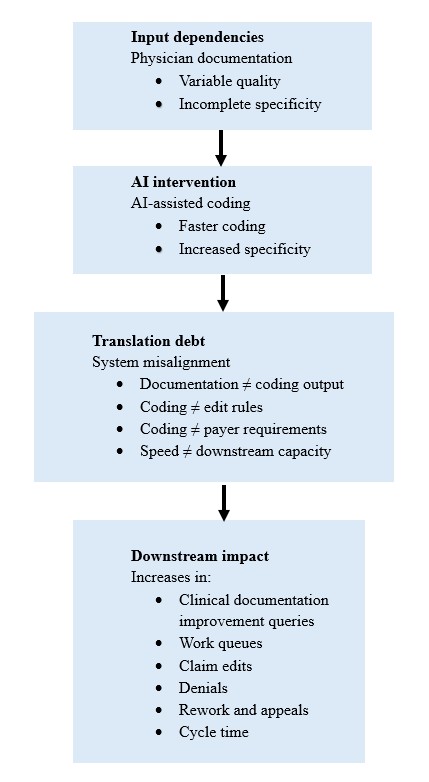
The AI outputs do not operate in isolation. They must align with physician documentation, conform to internal edit logic and meet highly specific payer requirements. In practice, they often do not. Documentation may not fully support the level of coding detail generated. Edit rules may reject otherwise valid codes due to configuration requirements such as modifiers or sequencing. Payer-specific policies introduce further variation that the system must reconcile.
At the same time, AI accelerates the production of coded output, while downstream processes —including review, work queue resolution and billing operations — do not accelerate at the same rate.
These misalignments create translation debt. It does not appear at the point where AI is applied. It appears in the system that sits downstream of it, where outputs must be interpreted, validated and reconciled with the operational and financial reality of the organization.
In Epic, this process is not theoretical. It is visible in the form of increased CDI queries, expanding work queues, more claim edits, rising denial rates and additional rework and appeals activity. Cycle times lengthen even as individual steps appear to become more efficient.
The lesson is not that technology has failed. The AI-assisted coding has done exactly what it was designed to do. The challenge is that the surrounding workflows, rules and operating model were not redesigned to absorb that output.
That gap between improved task performance and unchanged system constraints is where translation debt accumulates.

