



Fast Finance
Complex relationship between maternal unit closures and SDP funds
Some of the largest numbers of recent closures of L&D units occurred in states receiving the most SDPs.

Published
4 hours ago
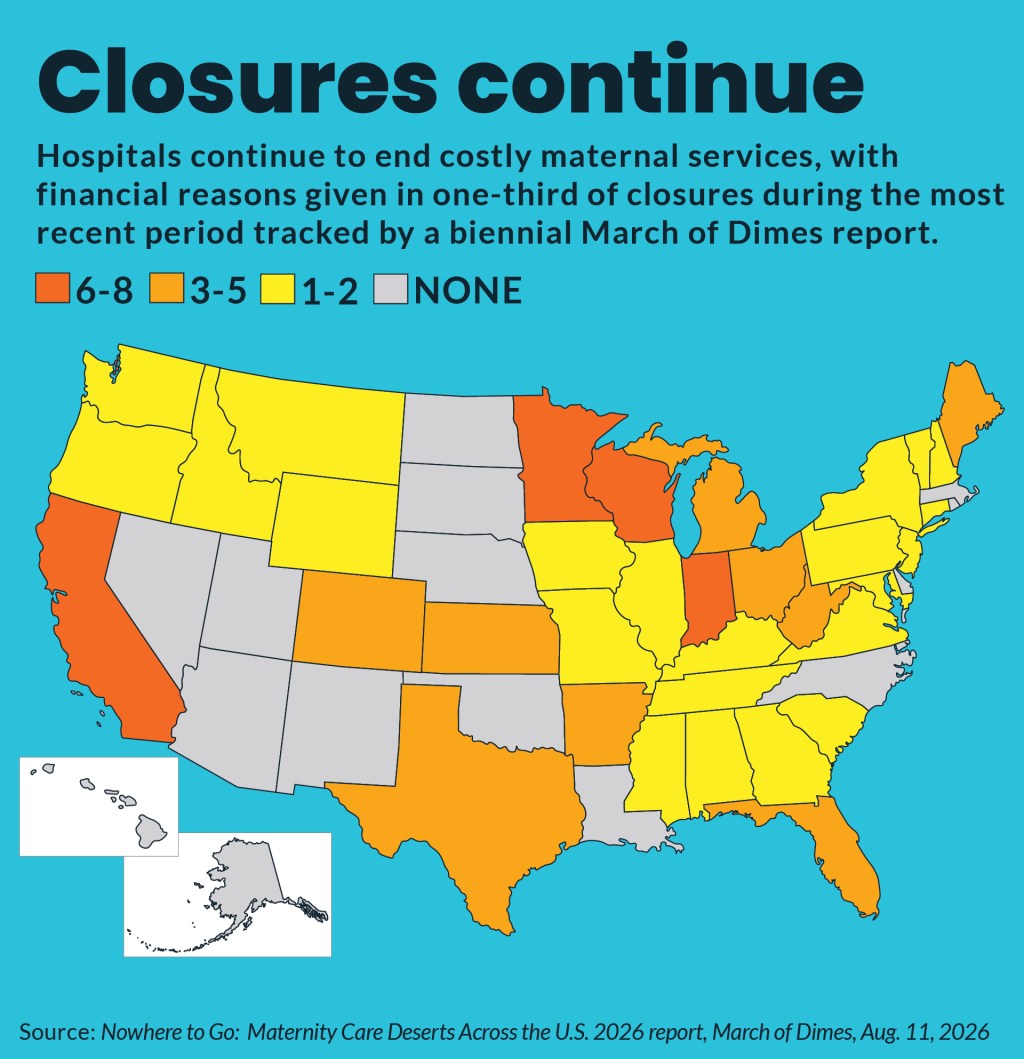
State-directed payments (SDPs) are credited with maintaining maternal healthcare access. However maternal care units continue to close, despite record SDP funding.
Looming cuts to SDPs are widely expected by providers and advisors to result in more maternal care unit closures. But some emerging alternatives aim to improve some access.
Maternal care for Medicaid enrollees is the focus of both advocates and state Medicaid programs, themselves, including the high-profile recent push by 49 states to extend postpartum Medicaid coverage through 12 months. Maternal patients are also unique in the data transparency on their health outcomes. States have reported that Medicaid maternal patients have up to three times higher death rates and higher morbidity than their commercially insured counterparts.
Those concerns led the March of Dimes to track maternal care access. Findings from its latest report for 2024 to early 2026 compared with the previous report from 2021 to 2022 include:
- 96 labor and delivery units closed in hospitals (2024 to early 2026)
- 107 obstetric units closed (2021 to 2022)
- 70.3% of rural counties lack a hospital with labor and delivery (L&D) services (2024 to early 2026)
- 67.4% of counties lack a single obstetric hospital (2021 to 2022)
“Essentially we’re tracking the same thing,” said Michael Warren, MD, chief medical and health officer for the March of Dimes, about the reports’ alternating tracking between labor and delivery [L&D] and obstetrics closures. “It’s just a change in the nomenclature.”
Financial driver
Financial pressures were reported in about one-third of L&D unit closures identified in the latest March of Dimes report. Those pressures included rising operating costs, low Medicaid reimbursement and persistent financial losses associated with maintaining L&D services.
However, the continuing closures came as SDP funds, which often are targeted at maternal care and boost Medicaid rates as high as commercial rates in many states, reached $104 billion in 2025, according to one study. Thirty-seven states spent between $21 million and $9.1 billion in 2025 SDP funds directly on boosting Medicaid rates to at least 90% of average commercial rates, according to the study.
SDP funds are expected to continue to increase in some states ahead of SDP cuts slated to begin Jan. 1, 2028, under provisions of the One Big Beautiful Bill Act (OBBBA).
Multiple states this year have received SDP renewals with large increases over the 2025 SDP funding. For instance, the Texas Comprehensive Hospital Increase Reimbursement Program, a component of its SDP, increased from $6.5 billion in 2025 to $9.15 billion in the 2026 approval.
But when SDP cuts in OBBBA begin, they are estimated by CMS to cut $510 billion over 10 years.
The American College of Obstetricians and Gynecologists recently wrote to CMS that “further limits placed on SDPs could impact practice sustainability and shutter doors of obstetric units and rural hospitals.”
Mixed results
Some of the largest numbers of recent closures in L&D units identified by the March of Dimes occurred in states receiving the most SDPs. For instance, California receives the most SDP funding — $10.6 billion, according to a KFF report — while it tied for the most closures (eight).
But the other leading state for L&D closures, Wisconsin, receives less in SDP funding ($1.8 billion) than 25 other states. And the third leading state for closures, Minnesota, receives relatively little SDP funding ($162 million).
Some states with high SDP funding had no closures, such as North Carolina, which receives the third-most SDPs ($5.2 billion).
No closures occurred in 14 of the 40 states with SDPs (35%), while two of the 10 states without SDPs had no closures (20%).
Where SDPs helped
Oklahoma received $1.3 billion in SDPs and had no L&D closures in the report. No hospitals in the state have closed their L&D offerings since SDP started in 2024, said Rich Rasmussen, president and CEO of the the Oklahoma Hospital Association.
However, some hospitals have started to evaluate whether to continue maternity services due to the coming SDP cuts, Rasmussen said in an interview.
“It’s safe to say that hospitals have remained committed to maternity care, knowing that they have the direct payments to ensure that they can offset the tremendous losses from delivering babies,” Rasmussen said. “But with the pressure mounting, with these cuts coming, there are hospitals that are really watching whether or not they can continue to do that.”
SDP funding raised recent concerns when the state’s newly approved version was reduced by $200 million. Rasmussen said state miscalculations were partly to blame and OHA was working with the state to address those.
Even bigger financial risk for hospital maternal care comes from proposals under consideration in Congress to cut the 340B program or implement site-neutral payments.
“I’ve heard many CEOs say, ‘You know, if I take the cuts of the [SDP], and then you go ahead and you pile on the 340B drug cut or a site-neutral drug cut, I can’t do it anymore,’” Rasmussen said.
New approaches
Warren noted that hospitals report that nonfinancial factors have an even larger impact on maternal care unit closures. These factors include declining birth volumes and workforce shortages.
Still, the loss of SDP funds was expected to exacerbate the closure trend, especially at facilities with low maternal volumes dependent on fee-for-service, volume-based payment.
“It’s like we’re paying for widgets,” Warren said in an interview. “You can’t churn out enough of those services to be able to recoup all those costs. And this situation of delivering care is particularly challenging because you’ve got to be ready 24/7 to provide that care.”
One effort to address the low-volume, high-cost paradox is a California pilot program, approved in 2025, to support standby perinatal services at five critical access hospitals in the state.
Poor clinical outcomes and declining birth rates require new delivery approaches to maternal care, David Johnson, CEO of 4sight Health, a healthcare advisory company, said in an interview.
“Do we really need a bunch of rural hospitals that have a census of one or two patients and really lack expertise?” he said. “Why don’t we figure out how to provide the basic services locally? Childbirth would fall into that. And it probably means fewer hospital births and more at-home births supported by midwives and doulas.”
Maternal care support has been proposed by multiple states as part of their applications for OBBBA’s Rural Health Transformation Program (RHTP).
Recently obtained Oklahoma funding under RHTP led one hospital state, Newman Memorial Hospital, to move forward with plans to reestablish maternal services next year, despite the SDP cuts, Rasmussen said.
Many RHTP proposals, to which federal funds have started to flow in recent weeks, have focused on expanding telehealth and clinical recruitment focused on maternal care, said Rob Ross, a managing director at Health Management Associates.
“The issue, to state the obvious for rural health transformation, is it goes away eventually in five years,” Ross said in an interview about the $50 billion in RHTP funds. The challenge, “to establish a program but not have ongoing funding, is it [creates] a risk for a hospital to go forward with [it].”
