



Fast Finance
Fast outpatient shift expected from end of IPO list
The speed with which procedures will shift will vary but the musculoskeletal procedures removed this year likely will shift as quickly as TKA.

Published
4 hours ago
The ongoing phaseout of Medicare’s inpatient-only list (IPO) likely will move many of those surgical procedures to outpatient settings with lower reimbursement.
That expectation is based on site-of-care shifts that happened when CMS previously removed other surgeries from the IPO list, said Allison Oakes, PhD, chief research officer at Trilliant Health.
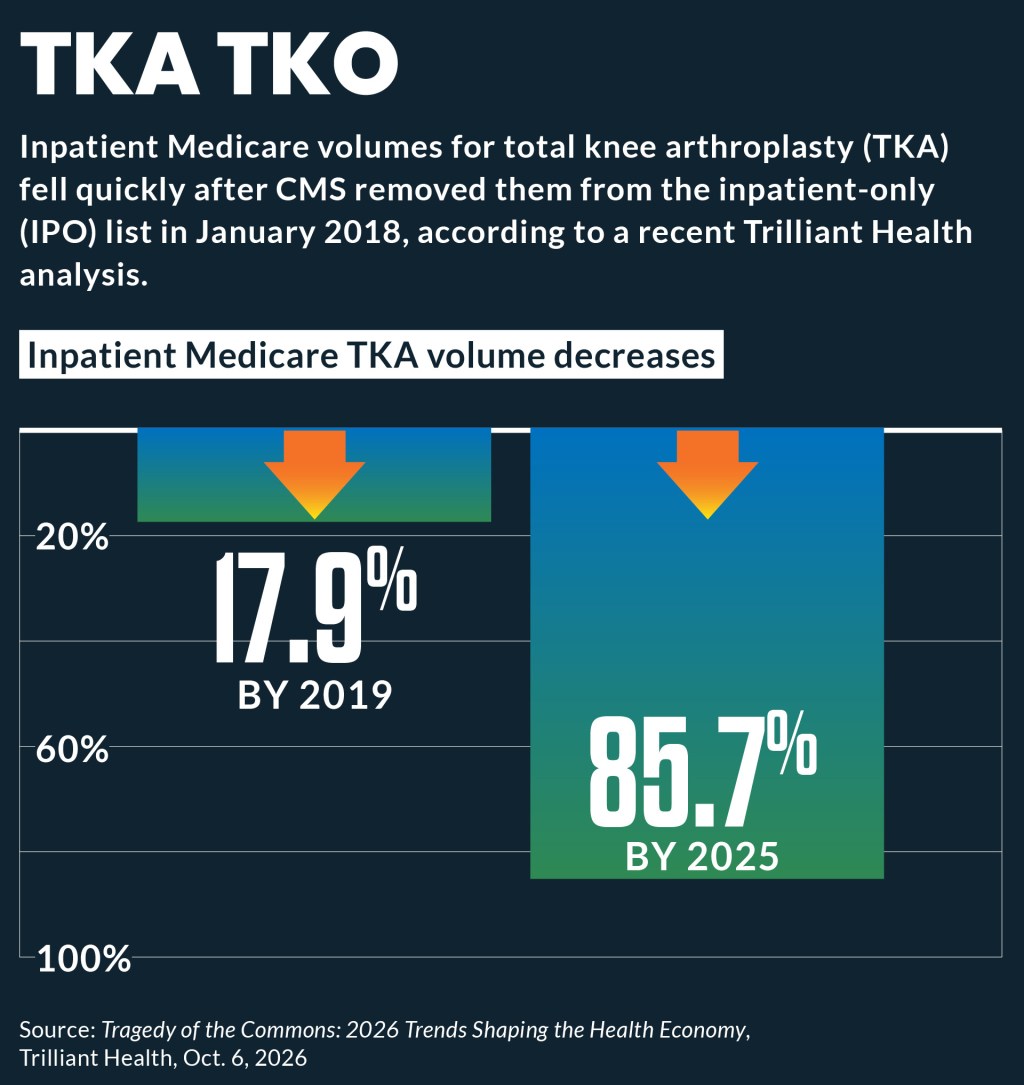
Medicare removed total knee arthroplasty (TKA) from the IPO list in January 2018. Inpatient traditional Medicare TKA inpatient volume decreased 17.9% in the first year and reached a cumulative decline of 85.7% by 2025, according to an all-payer claims database analysis in a new Trilliant report.
“They should be prepared for it to happen quickly,” Oakes said about hospitals in emailed comments on the finding. “The pattern is a steep first-year drop followed by years of continued erosion.”
CMS last year announced a three-year phaseout of the entire IPO list, beginning with the removal of 285 mostly musculoskeletal procedures this year. That phaseout would continue under the 2027 Outpatient Prospective Payment System proposed rule issued in July.
Oakes said the speed with which previously IPO list procedures will vary across procedures, but the musculoskeletal procedures removed this year likely will shift as quickly as TKA. That’s because those procedures are high-volume, standardized, match existing ambulatory surgery center capacity and have big differences in reimbursement based on their setting.
Policy impacts on surgical volumes, like Medicare’s elimination of the IPO list, have an outsized financial impact on hospitals because surgeries account for more than 50% of revenue for most hospitals, according to a post from America’s Essential Hospitals.
TEAM warning
The Trilliant report also looked at data across hospitals in the Transforming Episode Accountability Model (TEAM), a mandatory bundled payment model that includes five types of procedures at 741 hospitals that launched in January.
Trilliant found the average 30-day episode costs for those hospitals were highest for coronary artery bypass graft (CABG), which is included in the TEAM model. Those averaged $36,453 and there was a 15-fold difference in episode cost.
That 15-fold difference in episode costs shows how much hospitals stand to lose under the model’s price caps and can’t be explained by case mix alone, said Oakes.
“It’s a signal of enormous, unmanaged variation in care after the operating room, and that’s exactly the variation that a mandatory 30-day bundle is designed to expose,” Oakes said. “Importantly, many hospitals don’t fully understand the extent of this variation or have a way to measure or manage the care that goes on post-discharge.”
Bundle expansion
The Trilliant report also looked at hospital costs in the Comprehensive Care for Joint Replacement Expanded (CJR-X) model. CJR-X is a mandatory nationwide Medicare bundled payment program for lower extremity joint replacements (LEJR) that begins Jan. 1, 2028.
Trilliant found that in 2024, 90-day LEJR episode costs at prospective CJR-X hospitals averaged $19,179.
Oakes said CJR-X makes the hospital responsible for care that they may not be able to directly manage.
“Hospitals will need data, not just on their own patients and performance, but also on their competitors, to understand their financial exposure.”
The report found that cost and quality for those procedures are “essentially uncorrelated” at those hospitals.
That finding “undercuts the assumption that spending more buys better outcomes,” she said.
Surgical replacement
Another surgical trend examined by Trilliant was the replacement of procedures by emerging medical therapies.
It found GLP-1 patient volume increased 719.7% since 2019, while bariatric surgery volume has declined 32.4%. Similarly, patients receiving SGLT2 inhibitors, which treat heart failure, increased 247.7%, while cardiac catheterization decreased 7.1%.
“For a hospital, a procedure replaced by a prescription is lost revenue,” Oakes said.
She added that a coming wave of pharmaceuticals could have similar effects if they “are priced based on their actual value, and if they function as a substitute for more expensive care.”
“In other words, the scenario providers should worry about most, drugs that replace procedures, is also the one that has the potential to lower total spending,” Oakes said. “Right now, it’s too early to tell which way it will go.”
