


Fast Finance
Market worries overtake policy concerns
Equity market valuations continue to be high and increasingly are concentrated in the technology sector.

Published
14 seconds ago
For some hospital and health systems, the potential of a coming stock market crash is more worrying than looming policy changes.
The market concerns stem from the increasing reliance on investments to make up for uneven operating margins, according to the Marsh (formerly Mercer) “2026 healthcare asset owner survey results.”
Many institutions with negative operating margins have used nonoperating income from investments to offset their negative operating margins, said Chris Cozzoni, healthcare segment co-lead and partner for Marsh.
“But now they’re looking at things such as, ‘Hey, there’s a whole lot more volatility in the equity market,’” he said.
Equity market valuations continue to be high and increasingly are concentrated in the technology sector, he noted.
Investment market dynamics were the leading concern for 37% of the 77 hospitals surveyed and health systems with investment pools. The next largest concerns for this year were government policy (24%) and liquidity (16%).
The potential for a major market pullback was seen as a real risk, even as the higher-performing organizations continue to expand their types of investments into private equity and illiquid investments.
“But there are many institutions that are struggling now where we’ve been stepping back with them and evaluating ‘how much we should have in a short-term investment pool,’” Cozzoni said.
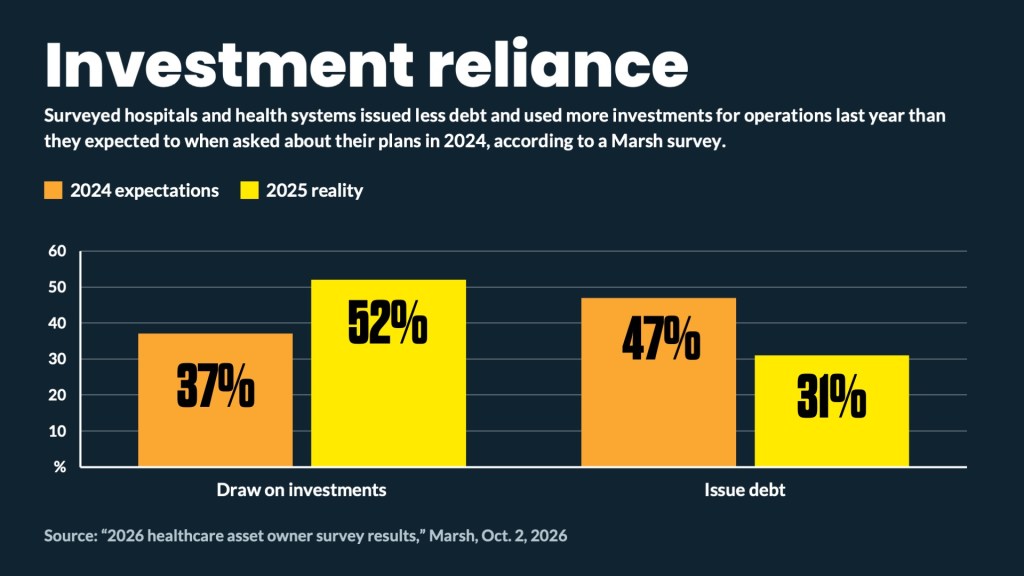
Investment reliance
A majority (52%) of surveyed organizations drew on investment reserves in 2025, up from 43% that did so in 2024. Use of investment reserves in 2025 was much higher than the 37% of respondents who said in 2024 that they planned to do so.
That increasing investment reliance stemmed from the uneven operating margin improvement since the lows of 2022. Operating margins in 2025 ranged from -11.4% to 16.5%, among organizations tracked by Marsh.
“There is a much bigger dispersion of what we’re seeing in the marketplace now than what we used to [when], overall, everybody was making a decent operating margin,” Cozzoni said. “And now we’re seeing some do really well and others really struggle.”
This year, the surveyed organizations expect to have a more balanced approach to funding liquidity, with similar shares seeking liquidity from reserves, lines of credit and debt issuance.
Operational stress
To address the underlying operational stress that is driving the increased use of investment reserves, nearly all organizations (94%) were pursuing operational process improvements.
Operational improvements include across-the-board cuts and creating rainy day funds. The latter initiative stems from “knowing they have the cash now, but this is going to be an issue starting next year, especially,” Cozzoni said.
Federal Medicaid cuts are expected to begin to bite next year when work requirements and biannual recertifications go into effect.
Other ways those organizations address operational stress include:
- Reducing capital expenditures, 15%
- Implementing workforce or benefit reductions, 20%
- Planning to draw on investment portfolios to support operations, 20%
Capital expenditure push
Despite the continuing policy concerns, many hospitals and health systems continue to expand their capital expenditures.
After 46% increased capital expenditures over the past year and only 15% reduced it, capital expenditures were expected to continue to increase from COVID-era lows.
“Whether that’s just capital maintenance, improvements or even new buildings, more and more are saying we need to go back and [fund] these capital expenditures,” Cozzoni said.
The outlook for the next one to three years has moved from major growth initiatives to smaller projects with select focus on major projects.
“Rather than implementing widespread spending cuts, organizations appear to be concentrating resources on their highest-priority initiatives and favoring projects with the clearest strategic and financial returns,” the report stated.
Cozzoni said he is hearing from clients that they are responding to the policy pressure with either growth plans or cuts, depending on their situations.
“If they’re in an area where they still have a strong balance sheet and can continue to grow, they are trying to grow,” Cozzoni said. “And there are ones that are struggling right now just to keep a low negative operating margin, [where] you’re seeing them more and more focused on the cuts right now.”
Fed risk
Debt issuance is set to increase, with 40% of respondents planning to issue new debt in 2026, compared with 31% that issued debt during 2025.
A complicating factor for such hospital borrowing is increasing Federal Reserve rates. In September, the Federal Reserve raised its benchmark interest rate by 25 basis points to a target range of 3.75% to 4.00% and the benchmark 10-year Treasury yield moved above 5%.
The issue arose after the survey was conducted, but Cozzoni said hospital clients recently began raising concerns about its impact on their own debt issuance and whether they should move forward.
“I haven’t [heard] any clients say, ‘We’re not doing it because of the higher interest rate,’ but it’s definitely becoming a concern and more of a factor. You could see that start to happen at some point,” he said.
Pension option
The outsized performance of the stock market also has provided new options for hospitals and health systems, the survey found.
Healthcare pension plans have strengthened considerably over the past five years. Average projected benefit obligation (PBO) funded status increased from 88.7% in 2020 to 106.7% in 2025. Meanwhile, the median PBO funded status reached a new high of 104.4% last year.
As overfunding becomes more common, organizations are beginning to consider risk transfer strategies as a means of reducing pension plan liabilities, according to the survey.
“I talked with one client who just froze their plan, and another one who is going to transfer 100% of the risk off,” Cozzoni said. “It really comes down to why they want that risk on the balance sheet if it is overfunded right now.”
