



Fast Finance
Why the Democratic health reform fight matters
One senior Democratic senator recently switched to backing Medicare for All and plans to push it in his committee if his party takes the chamber in the midterms.

Published
7 hours ago
Ahead of the midterm election, Democrats increasingly are split over whether to push for a federal public option or a “Medicare for All”-type single-payer model.
The outcome of the election could determine which side the party comes down on in the next presidential election and drive any subsequent healthcare reform push. The national fight also has implications for either Democrat-favored approach at the state level.
This year, the Democratic health policy divide is playing out among Senate candidates, Democrat-aligned groups, polling results and side-switching among elected Democrats.
Switching horses
One longtime backer of a public option, Sen. Ron Wyden (D-Oregon) last month signed onto the Medicare for All bill sponsored by Sen. Bernie Sanders (D-Vermont).
“America’s health care system needs a foundation that provides high-quality, easy-to-use and affordable health care to every American that can’t be clawed back every time Republicans win an election. That foundation is Medicare for All,” Wyden said in an emailed response to questions on why he switched from supporting a public option.
If Democrats win the Senate majority in the midterm election, Wyden would lead the Senate Finance Committee, which oversees most federal health policy. In that role, Wyden said his “top priority will be building a path toward Medicare for All and creating a healthcare guarantee for every single American.”
Wyden’s move to Medicare for All was interesting because of his longtime support for reforms focused on private insurance, said Jonathan Oberlander, PhD, a political science professor at the University of North Carolina at Chapel Hill.
“It may be a signal that Medicare for All has growing momentum,” Oberlander said in an interview.
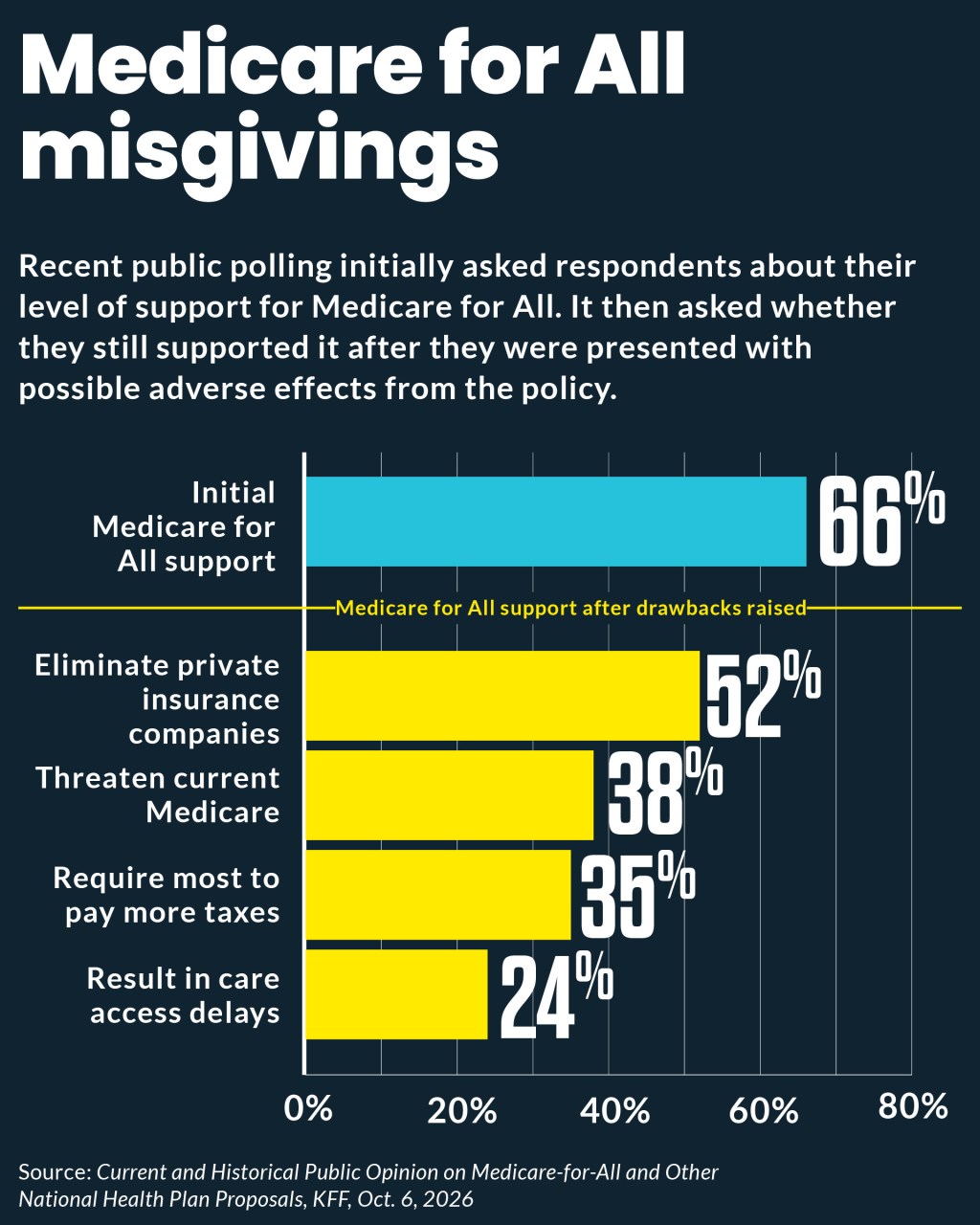
Wyden’s switch comes as Medicare for All recently gained its highest level of public support found in ongoing polling by KFF. Two-thirds (66%) favored a national Medicare for All health plan, according to the poll, up from 53% in October 2020.
That support and the Democrats’ push for a single-payer system are both fueled by growing affordability concerns and looming Medicaid cuts under the One Big Beautiful Bill Act (OBBBA), said Oberlander.
Candidate push
Various types of single-payer proposals also were backed this year by several high-profile Senate candidates. What is unusual is that swing-state candidates (Michigan, Maine and Minnesota) would back what has long been seen as a far-left position, said Oberlander.
The party split on health reforms also played out in Senate races, with other Democratic candidates instead backing either public options (Texas and Georgia) or increasing funding for existing federally funded health insurance programs (North Carolina).
The Democratic candidate split “has just gotten less attention, but it does reflect this long-standing division in the Democratic Party about which way you go for everybody,” Oberlander said.
Differing performance of those Democratic candidates in the midterm election could inform the party’s health reform push in the 2028 presidential election.
“If progressive candidates do well, the push for Medicare for All presumably will continue,” Jared Rhoads, executive director of the Center for Modern Health, said in emailed comments. “If the centrists outperform the progressives, perhaps the party coalesces around the public option going into the next presidential election.”
Advocates split
That split has been playing out among Democratic-aligned advocacy groups.
The moderate Democratic political group Majority Democrats recently launched a campaign to push back against support for Medicare for All. Instead, it promoted an alternative public option proposal called “Medicare for Americans.”
Such advocacy drew pushback from longtime supporters of a single payer system, including the union group National Nurses United (NNU).
“The public option would make our health care crisis worse,” Jamie Brown, RN, president of NNU, said in emailed comments. “As nurses, we know you don’t save a patient by compromising their care, you save them by providing it. That’s the difference between a compromised plan like the public option and a guaranteed plan like Medicare for All.”
Hospital pushback
Both types of left-wing health reforms this year drew strong opposition from hospital-backed groups, like the Partnership for America’s Health Care Future (PAHCF). That advocacy group includes the American Hospital Association, Ascension health system and Ardent Health.
PAHCF recently highlighted KFF polling that found favorability toward Medicare for All falls to only one-quarter of the public when respondents learn it could lead to delays in medical tests or treatment.
Single-payer advocates reject that concern.
“Medicare for All gives people greater choices with their care because there would be no insurance company telling them who is in network,” said Brown when asked about access concerns under Medicare for All.
Similarly, PAHCF said public options do not resolve the public’s cost and access concerns.
“Research shows [public options] could destabilize private coverage, limit access to high-quality care and leave taxpayers with higher costs,” Lauren Crawford Shaver, executive director of PAHCF, wrote in a recent blog post.
Hybrid approach
The latest fight between liberal health reform proposals alternatively could fuel moderate hybrid approaches, said Rhoads.
“There’s a version of the public option that even market-oriented, limited-government thinkers should be willing to examine,” Rhoads said. His think tank is exploring whether a universal, basic, limited public coverage option, coupled with substantial deregulation of the private sector “could offer a politically viable escape out of the status quo, which almost nobody is happy with.”
State effects
The battling Democratic health reforms are playing out at the state level.
After several failed efforts to implement a single-payer option in states like California, Oregon is developing a single-payer plan with lawmakers expected to vote on it next year, according to local reports.
Meanwhile, three states (Colorado, Washington and Nevada) have implemented versions of public options in their ACA marketplaces, and other states have legislation to do likewise. Enrollment in the long-standing Colorado and Washington public options has grown rapidly and drawn concerns from hospitals.
“Coverage without access is meaningless to patients,” Cara Welch, MBA, a spokeswoman for the Colorado Hospital Association, said in an emailed response to questions about the state’s public option. “And with the looming [OBBBA] cuts to Medicaid providers and patients, public option plans that would further weaken the healthcare system and shut doors to care are the wrong solution.”
