



Fast Finance
Workforce leads rural grants
Some rural hospitals have said they found the compliance requirements under RHTP grants too onerous and didn’t apply.

Published
4 hours ago
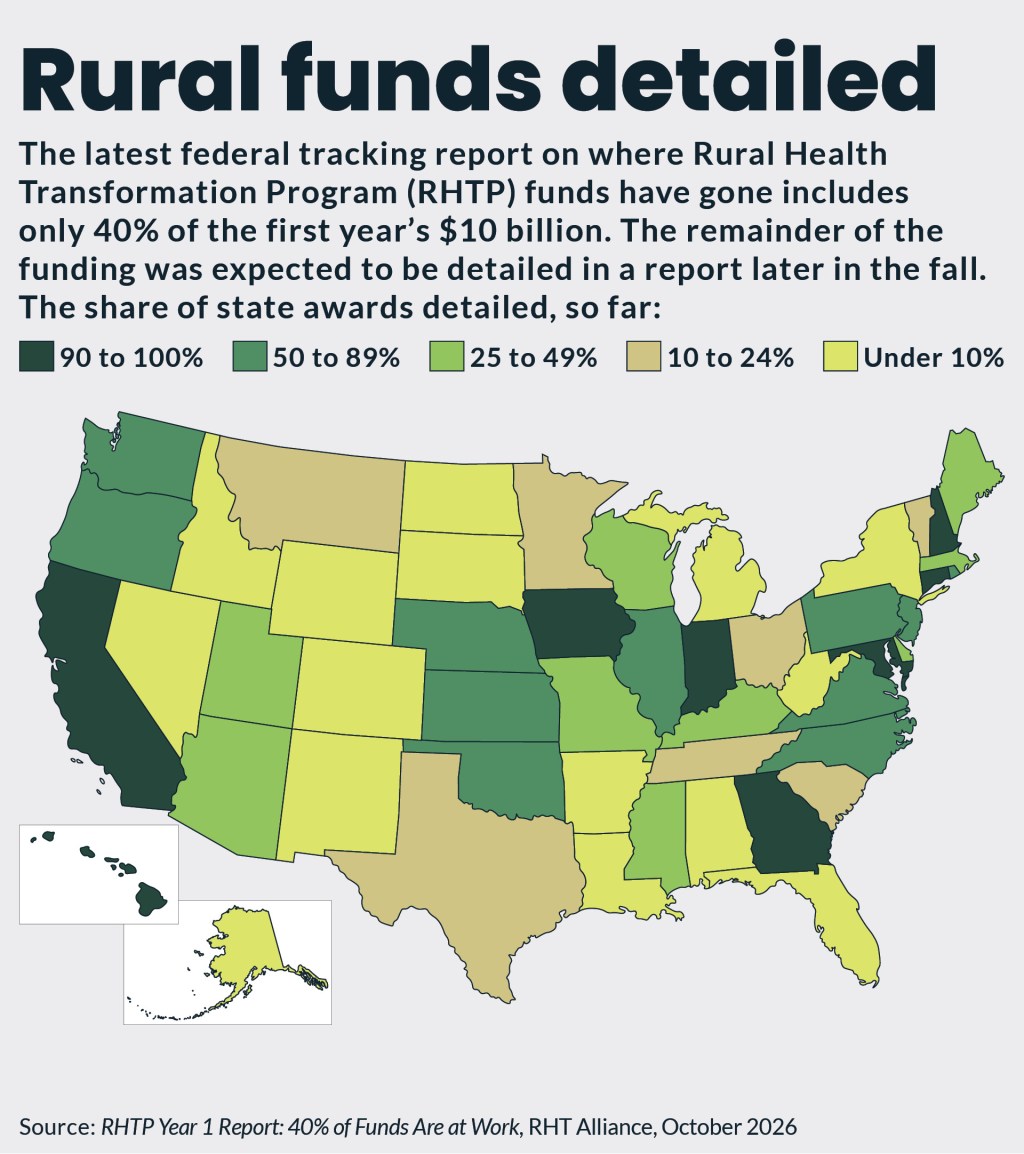
Workforce initiatives garnered the biggest share of $4 billion in federal rural healthcare grants provided by midsummer, according to an analysis.
The grants were detailed in a recently released federal report on funding obligated so far through the Rural Health Transformation Program (RHTP). The report detailed $4 billion out of $10 billion in spending planned for the first year of the five-year program. A follow-up report later in the fall is expected to detail the remaining first-year spending.
Among the grants announced so far, workforce initiatives from 34 states garnered the most funding, $651 million, according to an analysis by RHT Alliance, comprising consulting firms, IT vendors, law firms and others.
Workforce initiatives included $65.7 million that California received for workforce capacity, retention and relocation grants.
Brock Slabach, MPH, FACHE, chief operations officer for the National Rural Health Association, said the report shows the breadth of initiatives targeted by RHTP, but it does not always detail specifics of which organizations ultimately will receive the funds.
“A single obligation rate cannot show whether the funds have reached front-line providers, which, of course, we’re most concerned about,” he said in an interview.
The obligated funds were expected to continue to go out to providers and other recipients in the coming weeks and months. They need to spend those funds by the end of next year.
Other major categories of funding, according to the RHT Alliance report, include:
- $566 million for appropriate care availability
- $481 million for prevention and chronic disease initiatives
- $476 million for IT advances
Provider share
Categories that may benefit providers the most include:
- $330 million for capital and infrastructure
- $318 million for innovative care
- $133 million for provider payments
Slabach highlighted the $85 million garnered by Georgia to implement the Achieving Healthcare Efficiency through Accountable Design (AHEAD) model. AHEAD is a voluntary, state-based total cost of care (TCOC) and multi-payer payment framework created by the CMS Innovation Center.
“That’s one of the commitments that I’m excited about because if you look at this as a transformational program, we can tinker around the edges on a lot of issues, but if we don’t fundamentally change the incentive structures under how rural hospitals and clinics are paid, there won’t be any change to behavior in the long term,” Slabach said.
Major initiatives
The single largest state commitment was the $121 million Indiana received to implement a five-year initiative focused on prevention and chronic disease.
The second-largest single state award was for the North Carolina Rural Health Transformation (NCRHT) Program Hub Leads. The state designated regional leads, such as UNC Health, to coordinate rural care transformation, especially for primary care, maternal health and behavioral health.
Funding to regional hubs and grant programs will be redistributed through coming provider-level subawards with structured application windows, stated the RHT Alliance.
Capex boost
Although the federal report does not usually detail specific provider recipients, it notes significant funds for hospital capital purchases. For example, robotic surgery funding provided included $39.1 million for Iowa providers and $22 million for those in Georgia.
Specific infrastructure grants included:
- $190,000 for St. Luke’s Hospital Carbon Campus in Pennsylvania to purchase new operating room equipment and build a sterile storage space
- $20 million for Connecticut for rural hospital infrastructure improvements, right-sizing initiatives, facility upgrades and minor renovations
- $5.8 million for Iowa to fund new on-site CT scanners
Hospital concerns
Slabach said he has heard hospital concerns about the RHTP process that include failure to win any grants because their grant application “wasn’t up to par.”
Some independent rural hospitals have stated that the lack of administrative staff created paperwork obstacles to those funds. In response, some state hospital associations plan to beef up their administrative help for those hospitals.
“State offices of rural health and some of the flex programs around the country are trying to gear up to see if there’s any assistance that they can provide to providers to be able to seek additional funding opportunities,” Slabach said. “But, again, those are just starting or becoming more developed, so it’s hard to know or tell yet what the outcome will be.”
Other rural hospitals have told Slabach that they found the compliance requirements under RHTP grants too onerous and didn’t apply.
“They just don’t feel like the juice is worth the squeeze,” he said.
Others are worried about the potential for federal clawbacks of the funds. CMS stated that it will review annual performance metrics, progress reports and state policy actions to potentially change allocations of RHTP funds and potentially claw back funding in certain circumstances.
