



Fast Finance
Middle class avoiding care over cost
The increasing commercial patient affordability challenges are showing up in hospital and health system data this year on reduced demand for elective surgery and soaring bad debt.

Published
October 27, 2026
9:22 am
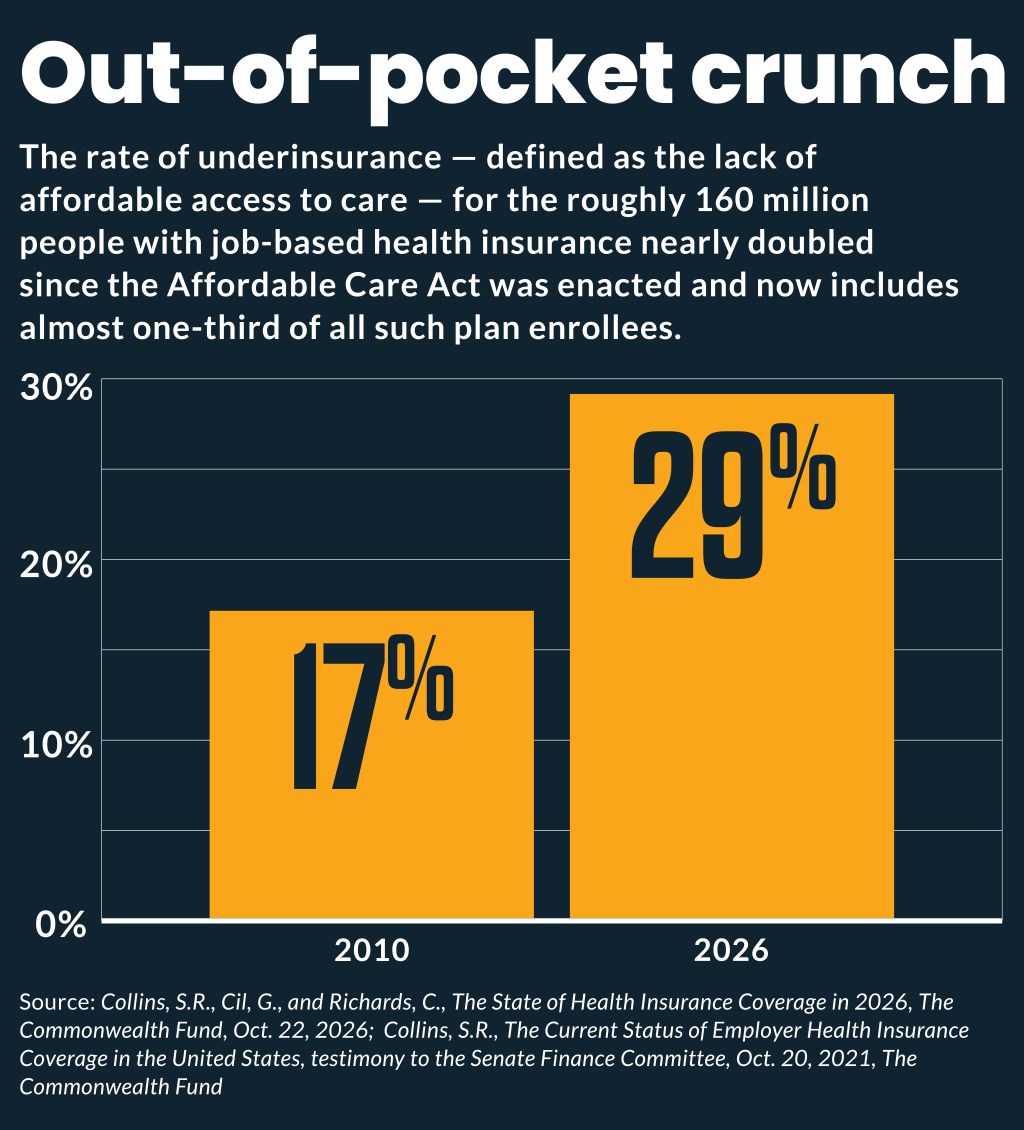
Commercially insured individuals with average incomes are avoiding care at the highest rates because of cost concerns, a recent survey found.
Households with income between $75K and $90K reported the highest rate of cost-driven care avoidance, with 38% of those patients skipping or postponing medical care because of cost, according to a public survey by PayZen. They also were the most likely to cite cost as their biggest concern before care (35.7%).
The next highest rates of skipping care due to cost included:
- 34% of households earning $15,000 –$30,000
- 29% of households earning $60,000 – $75,000
- 26% of households earning $30,000 – $45,000
The real median household income was $87,460 in 2025, according to data from the U.S. Census Bureau.
Additionally, 69% of patients with employer-sponsored insurance (ESI) described their most recent hospital bills as stressful or unresolved. The only other type of insurance with a higher rate of hospital bill fear was among those with ACA marketplace plans and other individual plan holders.
“So it’s not only the poorest patients for a health system or people [who] qualify for financial assistance [struggling with healthcare affordability], it’s really people [who] work, [who] have median household incomes and [who] have insurance,” said Tobias Mezger, a co-founder and chief revenue officer of PayZen. “Their deductibles, their coinsurance is something that causes a lot of stress and causes them to postpone care.”
Average deductibles among people with ESI coverage in 2026 reached $1,955 for single coverage and $5,380 for family coverage, according to the latest annual KFF employer survey. In addition to deductibles, 60% of ESI enrollees are charged coinsurance (average 20% of total charges) for hospital admissions and 64% are charged coinsurance for outpatient surgery (also average of 20% of total charges).
Most voters (51%) named healthcare costs as the most important healthcare issue of midterm elections, according to a KFF survey.
Mezger said health systems he talks to realize that the healthcare cost concern is a leading issue for the public this year, although addressing that may not always rise to the top of the priority list for those organizations.
In a PayZen-HFMA health system survey of revenue cycle leaders earlier this year, the leading priority for most respondents (62%) was commercial plan revenue, but for 22% it was patient balances. That was an increase from only 11.4% who named it as their top priority in the previous year’s survey.
“It does show that it’s an increasing priority for health systems,” Mezger said about the number of hospitals focusing on patient balances.
Why it matters
The increasing commercial patient affordability challenges are showing up in hospital and health system data this year on reduced demand for elective surgery, especially higher-cost inpatient surgery.
During a mid-year investor call, executives from Community Health Systems explicitly blamed hikes in deductibles in ESI plans — as well as ACA marketplace costs and uninsurance — for decreases in orthopedics and some cardiac procedures.
Other high-margin hospital services vulnerable to increasing ESI patient cost concerns include imaging and lab work. A 2025 Vizient analysis found about 40% of all radiology volume is now performed in outpatient imaging centers or clinics, rather than in acute-care hospitals.
Commercial patient out-of-pocket costs also are showing up as a factor in healthcare service cancellation rates, said Mezger. PayZen has found that organizations that determine and tell patients their out-of-pocket costs before service have fewer cancellations on procedures, he said.
Patient cost concerns also are a challenge for which healthcare finance leaders have struggled to find answers. The largest gap healthcare CFOs identified between what they were expected to address and what they felt equipped to address was in “consumer affordability, access and patient experience strategy,” according to a Deloitte survey earlier this year.
Growing commercial out-of-pocket costs also are hitting hospital uncompensated care. Bad debt and charity as a percent of gross operating revenue increased 14% year-to-date 2026 compared to year-to-date 2023, according to the latest Kaufman Hall hospital tracking report.
Addressing concerns
PayZen’s data indicated that at least some patient affordability concerns could be addressed by better and more timely communication about options.
The survey found nearly half of patients (47%) either learned about a payment plan only after the bill was sent or had to ask for it themselves. And among patients who were offered a payment plan, only 21% heard about it before receiving care.
Mezger said the earlier engagement is not about asking patients to pay sooner. It is about giving them clear answers and more realistic payment options before cost anxiety turns into delayed care, confusion or bill stress.
To that end, health systems need real-time affordability workflows that connect estimates, benefits data, deductible status, payment options, financial assistance, counselor support and patient communication before, during and after care.
“The lowest-hanging fruit in this is sort of good old-fashioned process reengineering or process design that doesn’t really cost a lot of money,” he said. “But it does require someone in the organization taking the time [to map it] out.”
A new AI tactic
In addition to a growing number of hospitals and health systems utilizing AI in the revenue cycle, patients also increasingly are using it.
Recently, Mezger heard of patients directing AI bots to call into health systems’ call centers to settle their bills.
“They need to be prepared that [it’s] happening a lot more,” Mezger said about providers.
Such consumer use of AI in healthcare finance followed previous reports of patients using AI to review their hospital billing to find mistakes or provisions to dispute.
The PayZen survey found that patients also were open to seeking help on billing and payment questions from AI hosted by health systems. Although not yet deployed by providers, the patient survey found that 60% of patients likely would use such a hospital-provided AI tool.
Mezger said the appeal of such a tool includes 24-hour accessibility and its ability to eliminate psychological barriers to speaking with other people about personal financial challenges.
“Patients overwhelmingly are open to using it,” Mezger said. “It’s health systems that are a little bit behind the ball, frankly.”
