


Fast Finance
AMC physicians face biggest SDP cuts: study
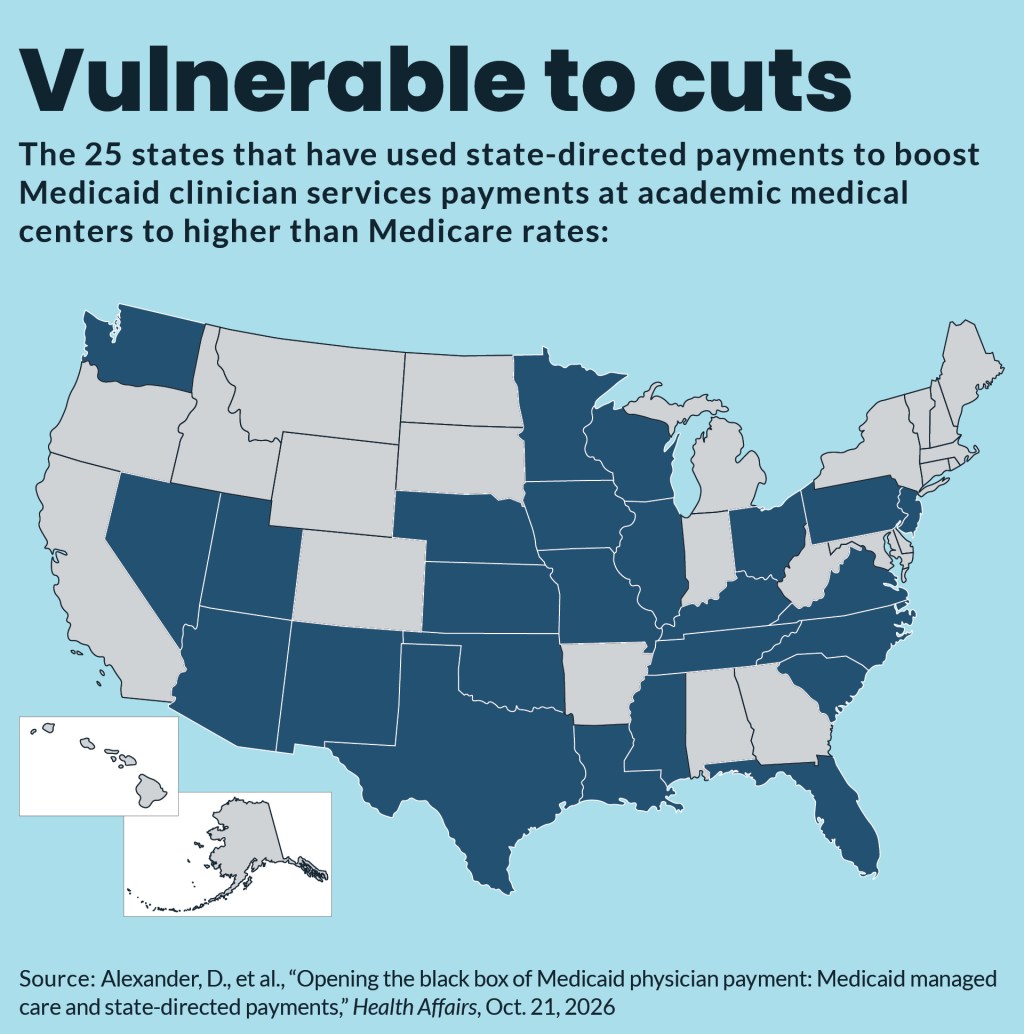
Twenty-five states used SDPs to raise Medicaid managed care payment rates for AMC clinicians above Medicare rates.

Published
5 hours ago
Physicians employed at academic medical centers (AMCs) garner the largest boosts from Medicaid state-directed payments (SDPs) and stand to lose the most from coming cuts, according to recent research.
The analysis of SDP-approved preprints from 2023 to 2025 found that 14 states had SDP policies for primary care services and 27 had policies for AMC professional services. The study was published online Oct. 21 in Health Affairs.
In 25 of the latter states, SDPs raised Medicaid managed care payment rates above Medicare rates. The ratio of Medicaid managed care payments to Medicare payments for AMC professional services exceeded 1.5 in 16 states, with the highest in Wisconsin and Minnesota.
Those higher-than-Medicare rates are above limits imposed by the One Big Beautiful Bill Act (OBBBA), which is also called the Working Families Tax Cut Act. OBBBA will begin to phase down SDP-boosted provider rates to Medicare rates in Medicaid expansion states and to 110% of Medicare in nonexpansion states after Jan. 1, 2028.
“They would see a hit to their payments and, ultimately … would threaten their ability to continue to provide those services to their communities,” Shahid Zaman, hospital payment policy director for the Association of American Medical Colleges (AAMC), said in an interview.
He noted that AAMC’s more than 400 member hospitals provide 65% of pediatric ICU beds and many of the burn units and Level 1 trauma units.
AAMC does not have estimates about how much AMCs stand to lose in the coming SDP cuts under OBBBA. Although many AMCs received SDP funding that applies across hospital types, at least 11 states have SDPs that specifically target AMCs and teaching hospitals for inpatient and outpatient services, AAMC found.
Primary care funding
In contrast, two states with SDP policies for primary care services raised those rates only slightly higher than Medicare rates.
“The incremental effects of SDPs targeting primary care services were modest in most states,” wrote the authors.
Such primary care boosts “appear to be aimed at improving access to Medicaid services via increasing physician payments toward Medicare levels,” stated the authors.
That approach echoed the short-lived 2013-2014 boost in Medicaid primary care fees provided through the ACA’s fee bump that raised them to Medicare levels.
Why it matters
The study provides more detail on where the SDP cuts under OBBBA would fall — estimated at $510 billion over 10 years by CMS. However, SDP funding was expected to continue to increase ahead of the 2028 start of cuts, with some industry analysts saying they could increase from an estimated $144 billion in FY25 to $200 billion by the start of 2028.
The study authors were critical of the difference in the extent to which SDPs are used for physician services based on site of care.
The AMC professional services boost raises “concern that directed payments may reinforce institutional advantages for large health systems,” they wrote.
Alternatively, SDPs may be aimed at boosting federal revenue “instead of advancing broad-based access goals that reach beyond populations seeking care at academic medical centers.”
Zaman said that such criticism misses the fact that services provided by clinicians in AMCs are among the most complex in healthcare.
“We definitely take issue with that characterization,” Zaman said. “The types of services — when you’re looking at primary care services versus the types of services that AMCs are uniquely situated to provide — those services are grossly underpaid.”
That complexity was why CMS allowed for more than 20 years for physicians at AMCs to receive payment up to the average commercial rate in the fee-for-service (FFS) payments, even before SDPs were launched in 2016.
A proposed rule implementing the SDP cuts would reverse that policy, among other provisions that drew hospital concerns.
Zaman also worries about OBBBA’s limits on SDP-boosted rates to Medicare rates, because those rates have not kept up with inflation over the last decade and often lag far below costs.
Proposed rule for cuts
AAMC joined other hospital groups in raising a range of concerns about the proposed rule implementing the OBBBA SDP cuts.
The AAMC’s comments called on CMS to preserve the ability of states to target Medicaid FFS payments to physicians and practitioners, including physicians at academic health systems and safety-net hospitals. Additionally, AAMC urged CMS to allow states flexibility to target payments to providers with historically low payment rates and that treat a disproportionate number of Medicaid patients. The average payer mix across AAMC members is 18% Medicaid, Zaman said.
“Our primary concern was that Congress set strict parameters around how it envisioned [that] these reductions to state-directed payments would take place, and it was clear in the rule that CMS unnecessarily went beyond the text of the statute and expanded the reach,” Zaman said.
Other AAMC issues included mandating that the limits be set at a service-specific level, which Zaman said would be administratively burdensome and potentially end up paying for some services below Medicare rates.
“Ultimately, it takes a statutory revision that is already going to be very harmful to hospitals and academic health systems, and make it even worse for those institutions and their patients,” he said about the proposed rule.
The effects of the physician rate cuts at AMCs could include worsening the physician shortage and hitting access due to service reductions, he said.
Transparency push
The study authors also said that SDPs need greater transparency to show specifically where such boosted payments are going. Such transparency also has been urged by the Medicaid and CHIP Payment and Access Commission, which Congress created to provide nonpartisan advice.
Zaman agreed that more SDP transparency would help.
“We can agree that transparency on state-directed payments would help policymakers,” he said. Also, “it would help researchers who are trying to get a better understanding of how these payments are made.”
