



Healthcare Revenue Cycle

AI Governance for Autonomous Medical Coding: What HIM and Revenue Cycle Leaders Should Settle Before Go-Live
Nym's VP of Compliance Operations lays out the baselines, contract terms, controls, and validation steps health systems should have in place before autonomous coding touches a live claim.

Published
4 hours ago
Sponsored by Nym
Autonomous medical coding sends coded patient encounters straight to billing. Once the first live claim goes out, gaps in scope, ownership, or validation get harder to explain and slower to fix.
In Part 1 of this playbook, Vanessa Youmans, Nym’s VP of Compliance Operations, shows HIM, coding, revenue integrity, and compliance leaders how to govern autonomous coding like a chargemaster, with clear ownership and change control, and monitor it like a coder, with review against coding standards.
The Joint Commission and the Coalition for Health AI explicitly include revenue cycle management and coding in their responsible-AI guidance. If autonomous coding is on your roadmap, set governance before the contract is signed, not after the first audit finding. Download the playbook to see what to have in place, who should be involved, and where to start.
Download this playbook to:
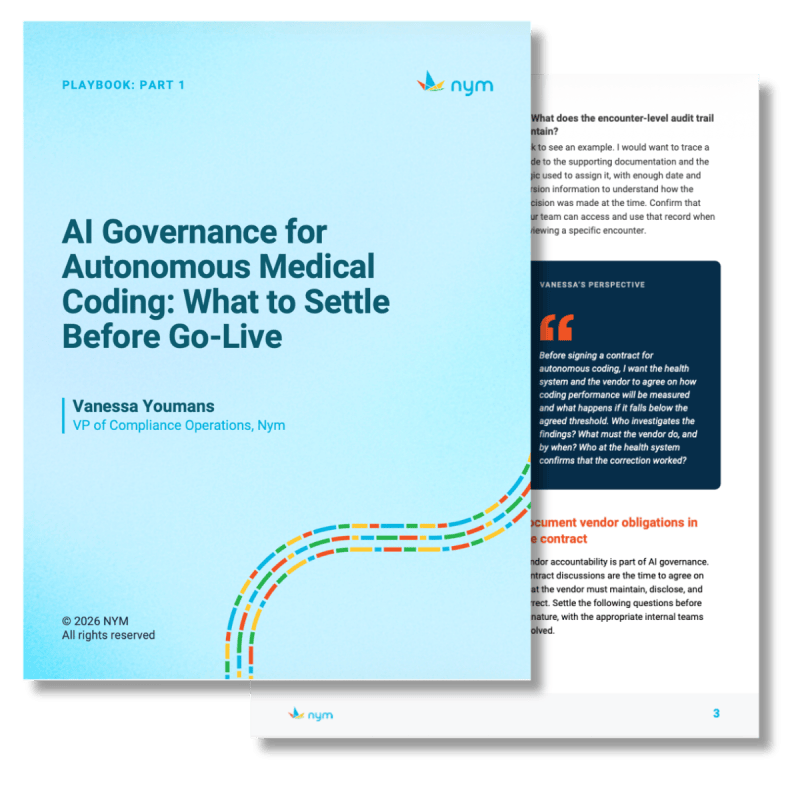
- Set coding performance and inter-rater agreement baselines that make post-go-live results comparable
- Ask the four accountability questions to settle in your vendor contract before signature
- Define in-scope encounters, review queues, and the controls that stay in place
- Validate coding output with a three-step process that checks agreements as well as disagreements
- Assign governance ownership and plan audit capacity for the first 90 days
