



Healthcare Business Trends
Hospital revenue surges ahead of OBBBA cuts
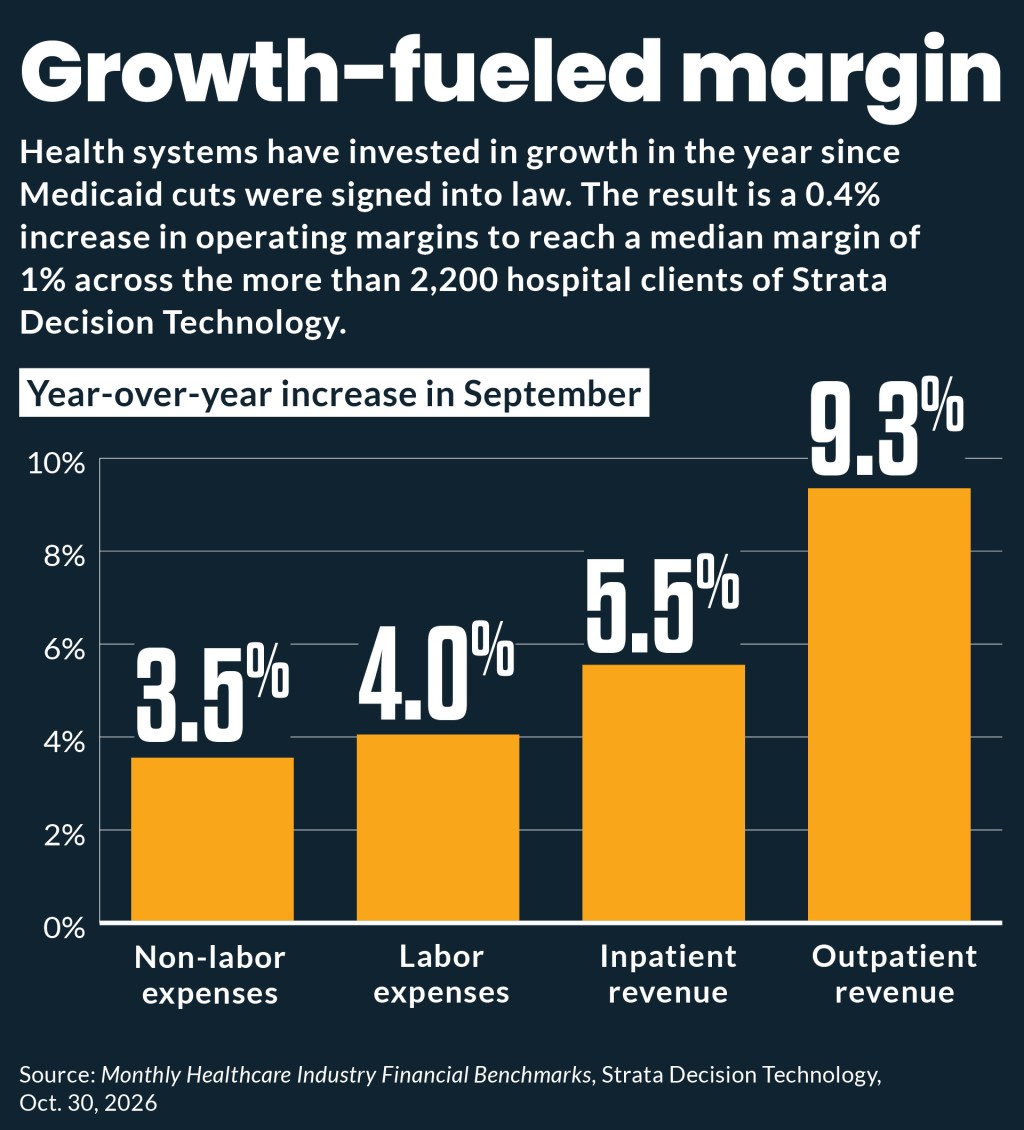
Outpatient revenue surged 9.3% from the previous year.

Published
4 hours ago
Growth-fueled hospital revenues improved their margins to the best of the year, according to the latest Strata tracking data. But an adviser warned a more nuanced growth approach and expense reduction are needed ahead of Medicaid cuts.
Health systems’ median operating margin remained at 1.0% in September — 0.4% better than a year earlier — remaining at the highest point of the year, according to tracking released Oct. 31.
Driving that operating performance were:
- 7.7% higher gross operating revenue from the previous year
- 3.8% increase in total expenses
“They’re seeing more volume and they’re continuing to capture more of the outpatient revenue,” said Alina Henderson, vice president of healthcare solutions and partnerships for Strata Decision Technology.
Outpatient revenue surged 9.3% from the previous year, while inpatient revenue increased 5.5%.
That revenue split underscores the continued outpatient push of many health systems as public and private payers aimed to curtail higher-priced inpatient spending. That payer priority was most recently seen in Medicare this month dropping 637 procedures from the inpatient-only list for 2027 as part of a three-year phase-out. Most of those procedures were added to the Ambulatory Surgery Center (ASC)-covered procedures list.
Health systems’ outpatient pushes included Ascension’s $3.9 billion June purchase of AmSurg, which gave the health system the third-largest ASC network with more than 300 locations.
Expenses up
On the expense side of the ledger, labor costs jumped 4%.
“They’ve also not brought down your fixed cost and your large-scale kind of facility and overhead,” Henderson said in an interview.
The labor-cost increase was driven by continued hospital hiring, ongoing raises for wages reset much higher after the COVID-19 pandemic and overtime pay.
Over the last year, hospitals created 125,800 jobs, while ambulatory healthcare services — many of which are employed by health systems — created 199,100 new jobs, according to data from the U.S. Bureau of Labor Statistics.
Also affecting labor costs are health system efforts to address burnout and improve retention by expanding such benefits as education grants and employee services.
Advocate Health recently announced plans to boost 2027 labor spending by $1.24 billion, with approximately $846 million for compensation and $390 million for incremental benefits.
Prep continues
The revenue-driven financial improvement over the last year for health systems is the result of a common growth-focused response to looming Medicaid cuts, Henderson said.
Healthcare cuts under the One Big Beautiful Bill Act (OBBBA, also called the Working Families Tax Cut Act) begin in January with the start of work requirements for some Medicaid-expansion enrollees. Those will be followed next year by biannual certifications and cuts in provider taxes (starting Oct. 1). On January 1, 2028, cuts to state-directed payments begin.
But Henderson warned of a grow-at-any price push as a long-term response to those cuts, especially if that growth is inpatient focused. Instead, organizations need to use a nuanced approach that mixes:
- Service-line expansions to move volumes out of hospitals
- Partnerships to open outpatient capacity
- Service expansions tailored to shifting patient demand
She highlighted the example of women’s health, where hysterectomy volumes have shifted over the last year out of the inpatient setting due to clinical innovations.
“They [must] have their clinicians at the table to tell them, ‘This is what clinical innovation is going to look like; we’re simply not going to deliver this procedure in the way that we do now,’” she said. “And let’s start with that fact and back into what it means to our operations, to our financial plans.”
That type of clinical collaboration with financial planning has paid off in breast healthcare services, where patient volumes have increased. She credited that to organizations’ investments in wellness screening services in recent years, which has identified more patients in need of treatments and downstream volumes for reconstructive surgery.
Patients “are looking for more bundled rate considerations of how they’re getting that care,” said Henderson.
Cost control
Standard cost control pushes from health systems still include examining supply chain contracts, clinical utilization, drug costs and rebate data.
But even as organizations look to continue their growth push, some have prioritized doing it in ways more efficiently to reduce the attendant costs of that expansion.
“They’re not coming to their physicians saying, ‘We’ve got to reduce cost,’ because culturally that’s a very different conversation,” Henderson said. “They’re saying, ‘How can we look for scale, how can we do this efficiently so we can do a lot more of what you want to deliver?’”
Improving clinical-finance collaboration starts with the service lines, where many operate in silos with little relationship to strategic financial functions of a health system.
“It’s imperative for an organization to understand where they are in that maturity model, how they partner with their service-line leaders to look at strategy, business growth and financial performance and then start there,” she said.
The lack of such alignment shows up in data like expenses per adjusted patient day, which haven’t improved at the largest organizations, despite greater resources to address it.
Administrative costs
Henderson expects health systems in the coming years to focus more on reducing administrative costs, which will be driven by new insights from the deployment of AI tools.
“Organizations that are leading in AI understand that you’re not going to get value by replacing one step of a process unless it is a one-step process,” she said. “You’re going to get value by revisiting the entire workflow, and when you revisit the entire workflow of anything we do in healthcare, you’re going to run into administrative and overhead functions.”
Such expense-related insights may challenge some of healthcare’s sacred cows, such as the investments in recent years on large and costly data analytics infrastructures.
“Where it’s been hard to measure is just how we know when that thing is doing what it’s supposed to do? How do we measure the success of that function?” she said.
