


AI
David Johnson: The biology of AI and its role in the survival of healthcare

Published
May 28, 2026
10:48 am
|
Updated
September 18, 2026
10:54 am
There’s no denying my title for this column is absurd. AI is bloodless. It has no flesh and bone. Beneath the “skin” of large language models, predictive algorithms and other AI manifestations are endless streams of numeric codes. Unlike biological creatures that are born, reproduce and die, AI produces outputs that are inert and can last forever. They have no biology, just computational origins.
And yet …
AI’s evolutionary development mimics that found in nature. When genetic mutations emerge in species, most die, but some beneficial mutations take root. The most successful of these amplify throughout a species’ total population over generations. In this way, natural selection differentiates superior traits through an evolutionary fitness test that enables existing species to develop new traits or become entirely new species.
With AI, computational models ingest gargantuan quantities of data to gain understanding, situational awareness and the power to act. As happens in nature, AI’s evolution is self-sustaining, exogenous and incremental. Superior models differentiate themselves from less effective models by generating more accurate responses to queries. The outcomes that emerge from this form of human-machine collaboration are often novel and increasingly autonomous solutions.
Unlike natural evolution in species, which can take millennia to unfold, AI’s evolution is happening with breathtaking speed.
Where Beinhocker meets Darwin
In 2006, the economist Eric Beinhocker published the Origin of Wealth. The book’s title references Charles Darwin’s On the Origin of Species by Means of Natural Selection, or the Preservation of Favoured Races in the Struggle for Life (known more simply as On the Origin of Species).
Published in 1859, Darwin’s pathbreaking and controversial book introduced a new theory of evolution based on natural selection to explain why and how species adapt to their surroundings (i.e., the organisms best adapted to their environment stand the best chance of passing on their heritable traits to next generations). In the struggle for survival, species that cannot adapt go extinct. Darwin’s theory is often characterized as “survival of the fittest.” That phrasing ignores the way his theory also describes the roles collaboration and symbiosis play in the adaptation of species to new environments.
In much the same way Darwin challenged the scientific community of his time, Beinhocker challenges traditional neoclassical economists, by asserting that markets are complex adaptive systems (not equilibrium-seeking machines) that mirror biology in their function. Beinhocker draws on Darwin’s theories to explain how marketplace mechanisms organically create wealth. This occurs in a three-stage evolutionary process.
1 Differentiate. Companies differentiate their offerings through innovative ideas, business models and/or technologies.
2 Select. Purchasers select preferred offerings through their individual buying decisions, thereby enabling the most successful offerings to demonstrate their market fitness.
3 Amplify. Successful offerings amplify into the marketplace through replication, enhancement and proactive scaling. Failed offerings disappear.
For Beinhocker, physical technologies (e.g., steam engines) and social technologies (e.g., laws, business models) co-evolve. Feedback loops within the ecosystem transmit information that enable individual actors to make better decisions and generate incremental value. More than money, knowledge and its applications are the true sources of wealth creation.
How Beinhocker’s theory applies to AI
Beinhocker’s framework applied to AI demonstrates how AI is not simply a new technology, but the core engine of an economic transformation that is moving through its evolutionary development with remarkable speed.
Consider AI in relation to Beinhocker’s three evolutionary stages.
1 Differentiate. AI can rapidly propose thousands of new designs — from new drug molecules to targeted gene therapies to personalized fitness regimens — far faster than human trial-and-error mechanics.
2 Select. Machine-learning models act as digital fitness functions, simulating millions of scenarios to predict which designs will succeed before they are ever built in the physical world.
3 Amplify. Once successful designs emerge, AI-enabled tools support their development, replication and improvement on a global scale with near-instantaneous digital feedback loops that inform personal preferences and local-market demand characteristics.
How AI’s datanomes mimic evolution’s genomes
Darwin discovered and explained the mechanics of an organic natural-selection process that gave birds wings, humans opposable thumbs and dolphins fins. However, it wasn’t until the 1950s with the discovery of DNA’s three-dimensional double-helix structure that scientists began to understand biology’s building blocks at a molecular level.
As with DNA and RNA in natural biology, there is an equivalent organic organization to AI. AI’s building blocks consist of a three-layer stack, as shown in the exhibit below. An intelligence platform ingests gargantuan amounts of unified data (the infrastructure) to generate insights that support end-user applications. Like DNA and RNA in nature, it is possible to apply this stack to respond to almost any environmentally driven signal demanding change.
Think of this stack as the genome (or datanome) of an increasingly autonomous healthcare ecosystem. It encrypts what a health system knows, can see and can do. Like genes, AI models and applications express suggestions for potential actions. They switch on, adapt and specialize in response to clinical and operational context.
Over time, the system learns the way living systems learn: through iterative differentiation, selection and amplification.
The datanome stack
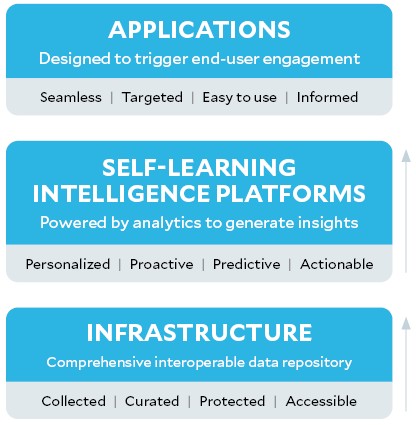
This “stack” (i.e., AI’s building blocks) can be likened to a genome
for an increasingly autonomous healthcare ecosystem.
Mining datanomes with AI can optimize almost any clinical, operational or administrative business function. Only imagination limits AI’s reach. In healthcare, for instance, algorithms can bring clarity to discharge planning, efficiency to claims adjudication, innovation to preventive care and sanity to clinical documentation and improvement. In this way, datanome solutions have a singularity that encompasses the universe of all existing point solutions.
The permanence of acquired knowledge within the datanome
One final point on the datanome. Within evolutionary circles, there is a vigorous debate whether one generation can pass encoded knowledge to the next generation. A parent’s ability to play the saxophone doesn’t pass automatically to their child; yet every monarch butterfly has knowledge of migration patterns at birth.
Within the datanome, however, there is no debate. AI is endogenous. Any knowledge acquired by AI models becomes permanently encoded within its algorithms and cloned into its agents. Mechanically, that’s how AI’s pattern recognition and decision-making capabilities advance.
While the datanome’s operations can seem alien to human understanding, they cannot be ignored. The machines don’t wait for human intervention. They learn and develop solutions on their own with remarkable speed. This is why AI’s machine-driven evolution occurs immeasurably faster than biological evolution.
Survival of the most adaptable
Abhinav Shashank, the CEO of the data analytics company Innovaccer, recently explored these and other ideas with my assistance in a manifesto titled Autonomous Healthcare.a Shashank describes a moment when, while touring a health system’s operations center a dozen years ago, he realized that healthcare’s data infrastructure lacked intelligence and the ability to act:
I had seen this pattern before in other industries. Data preparation is the cost of entry. Intelligence, however, only emerges when systems are designed to act on that data, to complete work, reduce human effort, and learn from outcomes over time. Healthcare had invested heavily in the first step, but it had barely begun the second.
AI’s version of DNA reconfiguration moves from data to model to action (DMA), which represents the underlying organic process that moves existing manual functions toward increasingly autonomous solutions. As Shashank asserts, healthcare lags other industries in its ability to translate data into actionable solutions efficiently and cost-effectively. Its DMA is under-developed.
Dinosaurs roamed the earth for approximately 150 million years until a meteor struck just offshore of Mexico’s Yucatan peninsula 66 million years ago. The meteor’s impact led to significant climate change. The dinosaurs largely became extinct, but there now is a consensus among paleontologists that today’s birds are the descendants of the group of meat-eating dinosaurs called theropods, the smallest of which were able to adapt to the changed environment.
An AI “meteor” is now striking human society. At this moment of profound AI-driven transformation, the existential question for healthcare incumbents is whether they can adapt their operations quickly enough to accommodate AI’s emergent impact. A coherent strategic response requires investing in AI infrastructure today to prepare for the new operating paradigms that will soon govern industry operations.
In 1963, Leon C. Megginson, a professor of management and marketing at Louisiana State University, extrapolated on Darwin’s theory as it relates to business management with the following observation: “It is not the most intellectual of the species that survives; not the strongest that survives; but the species that survives is the one that is able best to adapt and adjust to the changing environment in which it finds itself.”
Megginson draws a direct link between Darwin’s theory of biological evolution and a management theory explaining the evolution of human ideas. Beinhocker subsequently linked Darwin’s theory to marketplace behaviors, successes and failures. Collectively, these works have created an incisive framework for understanding how AI is rewiring human behaviors, business operations and healthcare itself. Dig in. Ignoring AI’s evolutionary impact is a path to organizational decline and extinction.
Footnote
a. Shashank, A., and Johnson, D., Autonomous Healthcare: A Manifesto for the System Healthcare Was Always Meant to Be, Innovaccer, December 2025.
